Song Section Repetition Count Calculator
Count intro, verse, chorus, bridge, solo, and outro repeats while estimating arrangement length, rehearsal passes, and live polish.
Intro
Verse
Chorus
Bridge
Solo / Instrumental
Outro / Tag
Use the repeat fields for actual played returns. A chorus that appears after verse one, after verse two, and again at the end counts as three repeats.
Repetition and Rehearsal Plan
| Arrangement Type | Common Repeat Pattern | Typical Length | Polish Focus |
|---|---|---|---|
| Radio pop single | Intro, V1, C, V2, C, Bridge, C | 3:00 to 3:45 | Hook returns and final lift |
| Rock encore | Intro, V, C, V, C, Solo, C, Tag | 3:30 to 5:00 | Solo entry and ending tag |
| Jazz head solo form | Head, solos by form, head out | 4:00 to 8:00 | Form count and cueing solos |
| Worship set opener | Intro, V, C, V, C, Bridge repeats, C | 4:30 to 6:30 | Dynamic bridge build |
| Section | Repeat Range | Bar Range | When To Add Another Repeat |
|---|---|---|---|
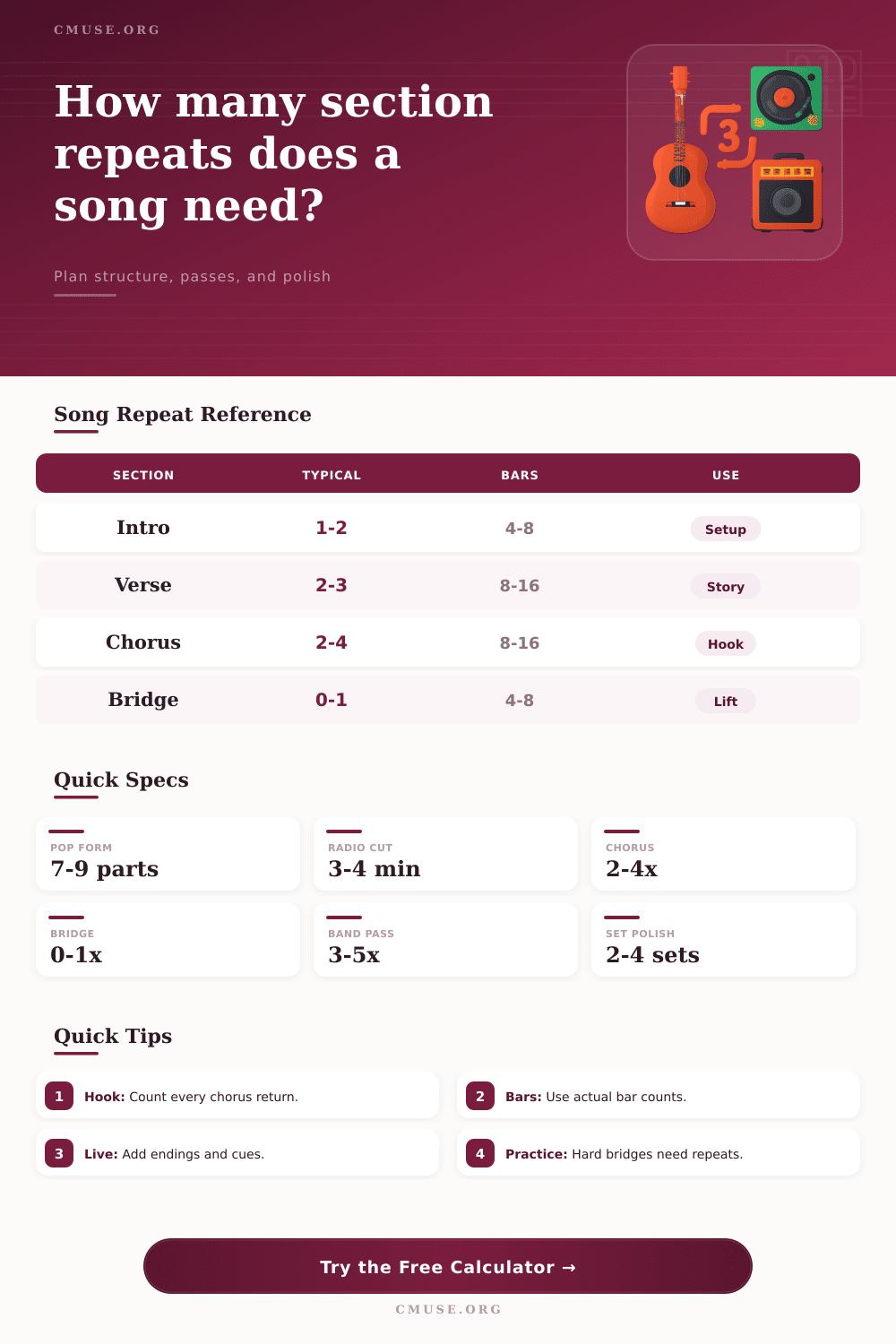
| Intro | 1 to 2 | 2 to 8 bars | Band needs count-in space or audience setup |
| Verse | 2 to 3 | 8 to 16 bars | Lyrics need another story beat |
| Chorus | 2 to 4 | 8 to 16 bars | Hook needs a final lift or tag |
| Bridge | 0 to 2 | 4 to 12 bars | The arrangement needs contrast before the last chorus |
| Outro / Tag | 0 to 4 | 2 to 8 bars | Live ending needs a clear cue |
| Difficulty Signal | Practice Multiplier | Likely Risk | Best Section Pass |
|---|---|---|---|
| Easy groove | 0.85x | Loose endings | Final chorus into outro |
| Moderate changes | 1.00x | Verse-to-chorus timing | Last bar before each chorus |
| Syncopated stops | 1.22x | Missed hits | Two bars before each stop |
| Modulation or meter change | 1.42x | Wrong entry after bridge | Bridge exit into next section |
| Show cues | 1.62x | Band and vocal cues split | Cue-to-downbeat repetitions |
| Live Context | Suggested Full Runs | Section To Isolate | Polish Check |
|---|---|---|---|
| Cafe duo | 2 to 3 | Intro and ending | Eye contact cues are visible |
| Four-piece band | 3 to 5 | Bridge and final chorus | Drums and vocal lead transitions |
| Theater pit | 5 to 8 | Cue starts and cutoffs | Entrances match staging |
| Click-track set | 4 to 7 | Count-offs and tracks | Tempo map matches the arrangement |
In a rehearsal room you might find the song feels too brief. You get through the structure one time and then it end. Or you run it out by repeating sections until the energy dies.
Writing a song is less about structuring the melody than its about structuring the expectation. How many times should you deliver the hook before the audience tire? When’s the time to let the bridge drop out before band collapses? Many writers guess. They feel around how many times things repeat until they hear something that sounds right.
Plan Your Song Lengths and Rehearsal Time
The problem with feeling is you often dont realise youve overstayed your welcome until song is played live or recorded. Plug in your sections lengths and tempo into the calculator and let it do the math for you. You will no longer fumble around with conversions and coefficients. You no longer have to wonder how long an epic chorus will be. You has minutes and bar counts now.
And this matters because time is the only currency that doesn’t inflate. What may feel epic in your head, that thirty second intro, can be a momentum killer if verse doesn’t come through with an impact. Define the number of repeat sections and force yourself to account for why each part of the track deserves the amount of time it gets. Four repetitions of a verse? Ask yourself: Do I have enough lyrical progression there to back up that many repeats? If not, then you need to cut rather than stretch.
This all changes with tempo. At a fast tempo, you might be able to get away with six repetitions of a chorus in a punk track and it doesn’t sound tiring because the energy pulls you along. At slow ballad tempo, it would of been tiresome. So the beat per minute is vital here. It pins down the abstract idea of repetition against actual time. Instead of just counting sections, your budgeting minutes.
And the tool makes you realize that eight bars at 70 BPM doesn’t equate to eight bars at 120 BPM. One is a lingering mood piece, the other a quick hit. If you forget this, then two arrangements that count exactly the same on page will feel unbalanced.
And then, of course, there’s actualy doing it. One can write the song. That’s different than getting the band to play it tight. Syncopated hits and tricky transitions takes longer to rehearse than straight-ahead chord changes. When going for a polished live set, that complication must be included. Extra passes are necessary to get a sudden stop or modulation exactly right.
According to the calculator, the more complicated these sections are, the more focused section runs you will need in rehearsal. It is not simply about memorizing the notes but about having muscle memory under pressure. For example, if you don’t rehearse the entry into the bridge enough, the whole song comes crashing down despite an awesome hook.
This lays it all out in reference tables on page. Different genres has a completely different set of rules. A radio pop single hinges on immediate memorability whereas a jazz head-solo form hinges on the flow of improvisation inside a known structure. Attempting to apply a rock encore structure to a worship set opener will only confuse everybody involved. The presets give you a benchmark to measure your ideas against the standard expectation. It provides a reality check.
Do you need a sixteen-bar-long bridge? Ask yourself: does it earn its space? Bridges are typically intended to provide contrast, not be their own song.
The key is mostly knowing what we’re really talking about. You’re counting prep time and attention span. Each additional repeat adds something but also carries some risk. If you repeat too much, the musician might fumble or the audience may tune out. So there’s this balance between the music’s requirement for reinforcement, and the reality of human performance. It is like using a needle to find the sweet spot.
Start with the basic counts, and adjust from there if the song need it. Don’t add length because you think you can do it. Add it because song needs it. As you work your way through and count up the rehearsal load and the number of times you plan to go around, you know exactly where you stand. You no longer have to guess so now you can plan. That’s what makes a good song into a great performance.