Practice Loop Repetition Count Calculator
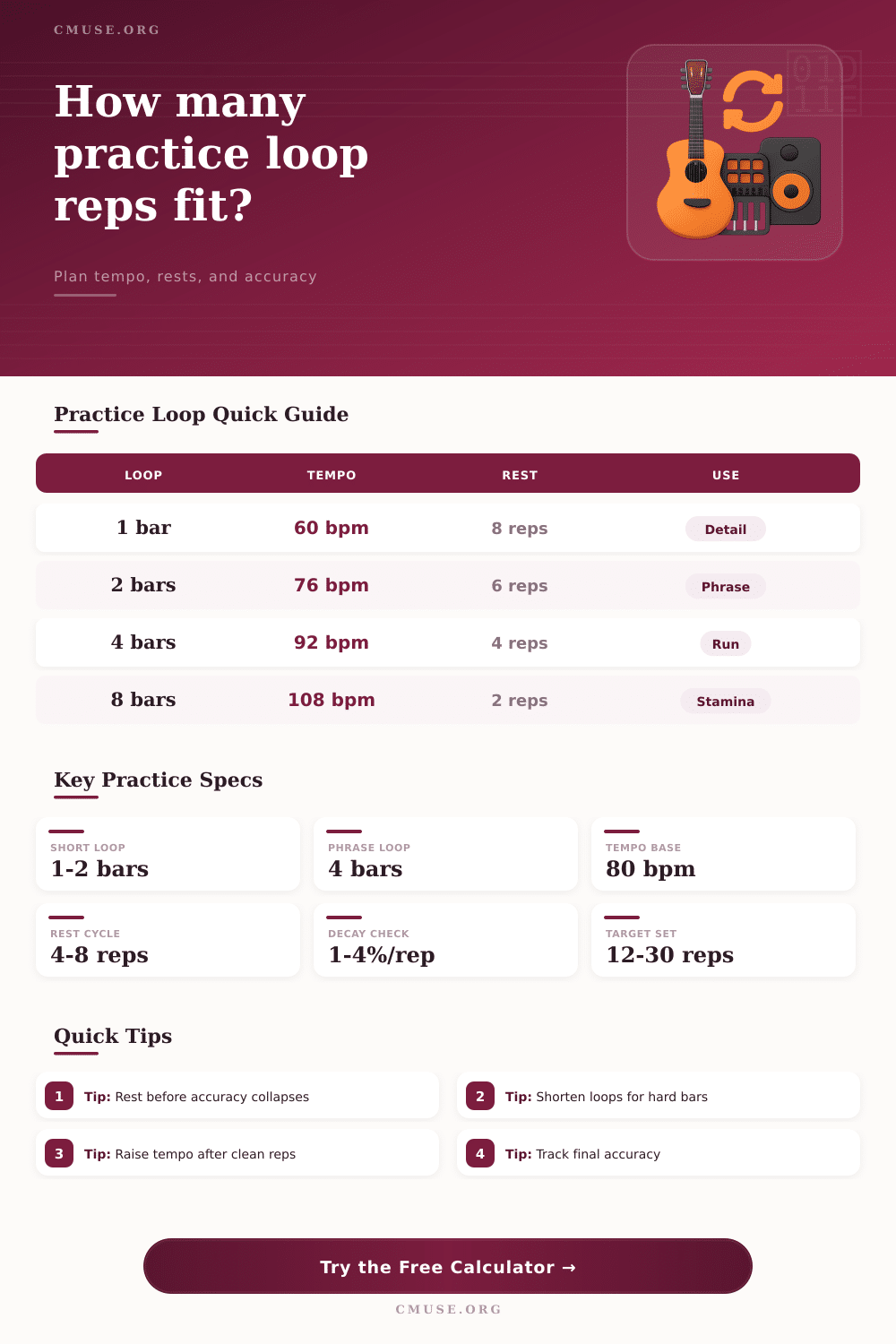
Plan loop reps by length, tempo, rest cycle, difficulty, and expected accuracy decay.
🎯Practice Presets
🎛Loop Inputs
📊Loop Spec Grid
💡Practice Notes
📘Loop Length Reference
| Loop Type | Common Length | Best Target | Watch Point |
|---|---|---|---|
| Micro-loop | 0.25 to 1 bar | Fingerings, entries, shifts | Stop before it becomes automatic in the wrong shape |
| Single-bar loop | 1 bar | Rhythmic detail and articulation | Use more rests when the bar is dense |
| Phrase loop | 2 to 4 bars | Breath, bowing, voicing, or picking flow | Accuracy decay arrives faster at higher tempos |
| Transition loop | 4 to 8 bars | Connecting sections cleanly | Rest cycles protect timing consistency |
| Stamina loop | 8 to 16 bars | Endurance and performance pacing | Use fewer total reps and longer rests |
Short loops support precision. Longer loops test whether the repaired movement survives musical context.
🎼Difficulty Modifier Table
| Section Difficulty | Load Factor | Typical Section | Suggested Rest |
|---|---|---|---|
| Easy pattern | 0.85x | Known chord change, simple scale shape | After 8 to 12 reps |
| Moderate phrase | 1.00x | Normal passage with one detail to refine | After 6 to 8 reps |
| Tricky coordination | 1.18x | Hands, breath, pedal, or subdivision conflict | After 4 to 6 reps |
| Hard technical spot | 1.38x | Fast shift, register break, dense fill, leap | After 3 to 5 reps |
| Audition pressure | 1.60x | Exposed entrance, excerpt, or memory risk | After 2 to 4 reps |
⏱Rest Cycle Reference
| Rest Plan | Work Block | Rest Length | Best Use |
|---|---|---|---|
| Light reset | 8 to 12 reps | 10 to 20 seconds | Easy loops where timing is stable |
| Focused reset | 5 to 8 reps | 20 to 35 seconds | Moderate passages with small accuracy drift |
| Technical reset | 3 to 5 reps | 35 to 60 seconds | Difficult movement or high tension risk |
| Performance reset | 1 to 3 reps | 45 to 90 seconds | Audition-style starts and memory checks |
🔢Tempo Density Table
| Tempo | 1 Bar 4/4 | 4 Bars 4/4 | Practice Read |
|---|---|---|---|
| 60 bpm | 4.0 seconds | 16.0 seconds | Slow enough for detailed correction |
| 80 bpm | 3.0 seconds | 12.0 seconds | Balanced repetition density |
| 100 bpm | 2.4 seconds | 9.6 seconds | Good for phrase continuity tests |
| 120 bpm | 2.0 seconds | 8.0 seconds | Fast loops need stricter rest timing |
| 144 bpm | 1.7 seconds | 6.7 seconds | Use fewer reps if accuracy drops quickly |
Without a map to guide our efforts, most of us become good at practicing until we are broken. We sit down with an intention in mind and we work through a passage five times. Okay, that feels better; let’s do it again twenty times just to make certain. After the twentieth time, your accuracy have dissolved. Tension has mounted. Ten minutes were wasted solidifying poor habits without a single step toward developing skill.
That isn’t realy a problem with playing. It’s a problem with structure within the repetitions. Practicing becomes a fuzzy intention instead of a measurable process. This dynamic shift when we approach practice in a structured way.
How to Practice Better with Data
After plugging in your tempo and the length of the loop, the calculator do the math for you (see box). That eliminates any guesswork about whether you’re having an efficient session or simply burning yourself out. It’s like putting limits on how hard you work. The inputs are simple stand-ins for actual life variables.
The loop length determine the size of the problem. A one-bar loop isolate a technical flaw. Four bars tests the continuity of a phrase. Eight bars taxes stamina. Eight bars challenges stamina. Who knows what that does. Because the mental effort is so much more different among these loops, there’s no such thing as treating them all the same.
Short loops tax precision and require constant resetting. Long loops taxes endurance and call for pacing strategy. Blending them without adjusting your rest cycle are inefficient. Different activities requires different fuel.
The same goes for tempo. Slow tempos expose errors that you correct in detail, but they hide other error that only show up when moving fast. The tool give you an idea of the number of reps that can performs in a given time frame. It even factors in the real rest time required for you to reset. Learning is consolidated during recovery. Playing through fatigue while out of tune with yourself teach your nervous system to adapt to error state. In effect, you’re training yourself to be sloppy.
That’s why the tool has a decay metric. Based off fatigue and difficulty levels, it guesses how much you’ll drift from accuracy as each rep proceeds. Most people don’t notice this decay until they run up against a wall halfway through their session. Tracking it ahead of time allows you to schedule rest intervals that maintains your accuracy above some useful threshold.
For example, the page has a series of standard load factors set up in tables that list load factor according to level of difficulty. For instance, a complex movement take more mental effort to perform correctly. Pressure reduces your capacity to pay attention. So if you attempt to perform a hard section like a tricky coordination spot with the same number of reps as you do something relatively easy, like a scale run, you’re going to wear yourself down rather than get stronger.
You want to match the rest time to the complexity of the skill being performed. The easier the pattern then the longer the run. The harder the tech spot the shorter the burst of focused effort followed by true disengagement. Think of practice as a series of sprints instead of a single long jog.
So you go all-out on the work blocks; you carve deep into the neural pathway, doing it right. And then you fully rest so that when you begin the next rep, you start fresh. That’s how you maintain quality control. Once your accuracy falls under seventy-five percent, though, you’ve flipped the signal-to-noise ratio. Your error now overshadow the proper movements. By this stage, halting the loop (or making it shorter) isn’t quitting. It’s strategically preserving your forward momentum. You are shielding the clean version of movement from being overwritten with a less pristene one.
In sum, practicing efficienty is as much about how quickly you improve as it is about how much you practice. If you frittered away the last half-hour of your practice distracted or fatigued, then why bother repeating a passage fifty times? You want ten clean reps, ten reps that shows you the right way to do it.
By using recovery, tempo, and time in the calculator, you can discover that sweet spot. And that’s where intuition meets data. With data, there is no guessing about whether you’ve practiced ‘enough’. You know precisely how many quality repetitions you completed. Every minute count towards mastery instead of exhaustion.