Arpeggio Pattern Count Calculator
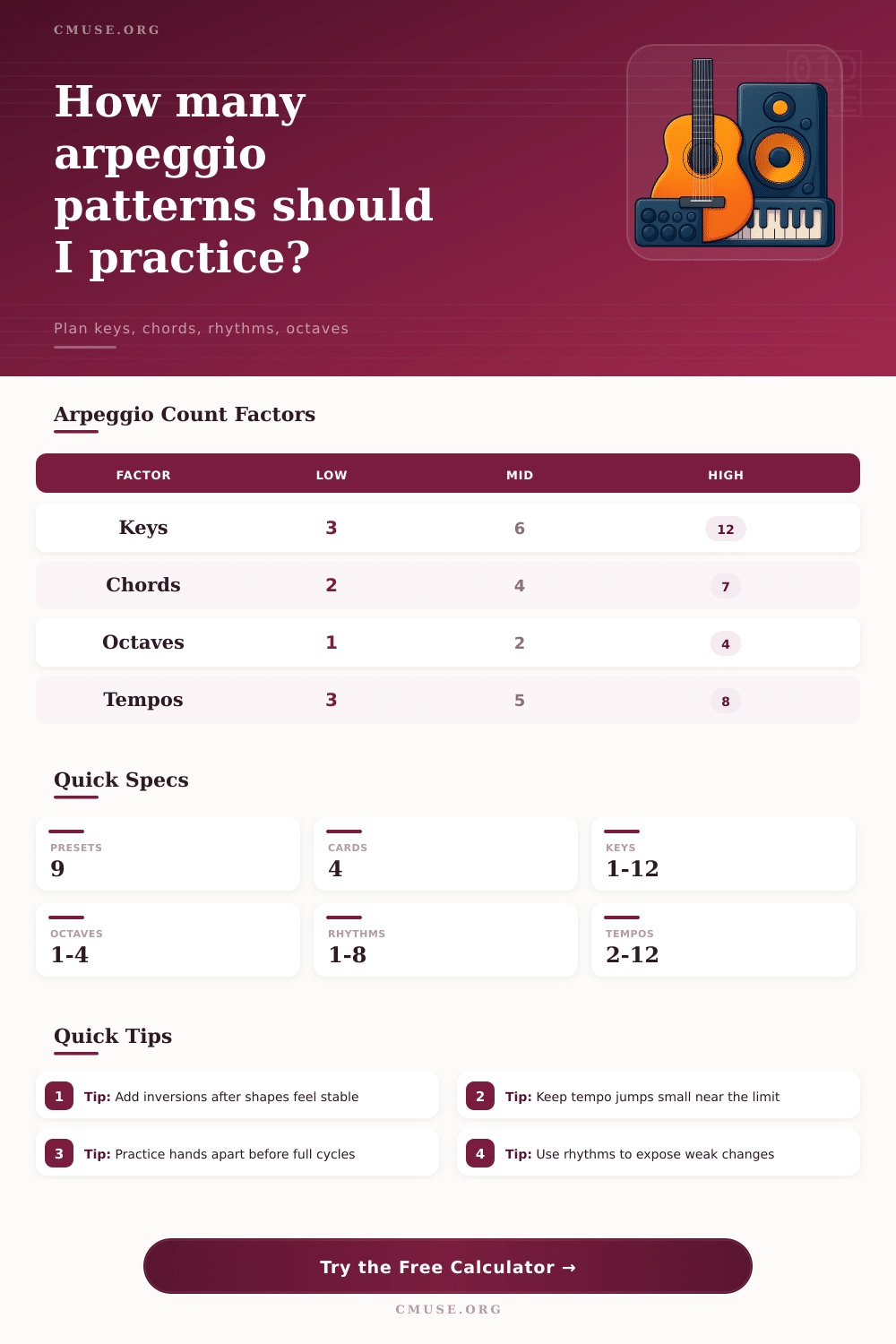
Count practice patterns across chords, inversions, keys, octave spans, fingerings, rhythms, and tempo stages.
| Chord Set | Count | Typical Use | Inversion Match |
|---|---|---|---|
| Basic triads | 3 | Major, minor, diminished fluency | 3 positions |
| Complete triads | 4 | Add augmented sound and symmetry | 3 positions |
| Suspended set | 5 | Pop, folk, film, open voicings | 2 or 3 positions |
| Seventh set | 7 | Jazz, theory, chord-scale outlines | 4 positions |
| Extended colors | 9 | Advanced comping and improvisation | 4 positions |
| Rhythm Set | Count | Best For | Counting Focus |
|---|---|---|---|
| Even notes | 1 | First pass accuracy | Steady subdivisions |
| Straight and swung | 2 | Jazz articulation contrast | Grid versus lilt |
| Three-rhythm set | 3 | Technical cleanup | Triplets and accents |
| Five-rhythm control | 5 | Audition polish | Short-long balance |
| Eight-rhythm advanced | 8 | Deep practice cycles | Accent rotation |
| Instrument View | Fingering Systems | Inversion Target | Practice Note |
|---|---|---|---|
| Piano or keyboard | RH, LH, hands together | Root, 1st, 2nd, 3rd | Group by thumb turns |
| Classical guitar | Position and shift paths | Root and close inversions | Track string crossings |
| Electric guitar | CAGED, sweep, three-note | Shape-based inversions | Separate pick direction |
| Bass | One-position and shifts | Root plus guide-tone forms | Emphasize chord tones |
| Voice or ear training | Sung and named tones | Root through 3rd | Keep range comfortable |
| Preset | Core Focus | Typical Span | Tempo Ladder |
|---|---|---|---|
| Piano Major Triads | Three triad colors | 2 octaves | 72 to 120 |
| Guitar CAGED Arps | Five position map | 1 octave | 60 to 108 |
| Jazz Seventh Drill | Seventh chord colors | 2 octaves | 66 to 132 |
| Classical Broken Chords | Clean hand patterns | 3 octaves | 54 to 96 |
| Sweep Picking Shapes | Economy direction | 2 octaves | 80 to 160 |
| Bass Chord Outlines | Root and guide tones | 1 octave | 70 to 126 |
| Minor Key Cycle | Minor tonal centers | 2 octaves | 58 to 116 |
| Exam Scale Syllabus | Full-key preparation | 4 octaves | 60 to 144 |
| Studio Warmup Ladder | Balanced daily technique | 2 octaves | 72 to 144 |
Musical fluency begins with arpeggios. These takes chordal isolation and make it flow. What was once theory becomes something you can play. A metronome isn’t enough to help you learn them effectively; what you need is a map. And that’s what this is.
How do most people go about practicing? They blindly cycle through keys until someone notices their hands are all knotted up or their mind has wandered. Motivation isn’t usually the issue here. More often it’s scope creep. They start off in C major but end up attempting to learn every inversion in each key before even having a single coffee break.
How to Plan Your Music Practice
To put this ambition into numbers, here’s a tool to help you measure it. It will translate an abstract notion (“I want to get better”) into something real: a specific amount of time spent practicing certain thing. Why? Because when you have this number, you can break it down into smaller chunks that fit in your day.
When you’re aware that your plan includes forty-two unique patterns, for example, you can schedule those out during a reasonable span of days. But if you assume it’s “only” fifty minutes of playing around, you might whiz right through and not really learn anything about any one of these shapes at all. You’ll save yourself from either underestimating the work you’ve planned for yourself or else building too much complexity into a straightforward warm-up.
So think about all the variables that really exist in a single clean run. It’s not as simple as playing some notes. You’re selecting a key, a chord family, and an inversion. You are also covering octaves, using a fingering system, and adding rhythmic variety. Each of these choices builds on the others. This is why numbers gets big quickly. What sounds like a simple single triad in a single key turns out to be a lot when you throw in four tempo stages, two hands and three inversions. That five minute drill has now turned into an hour long project.
If you understand the multiplication effect of all those choices you can make better trade offs. Need more time to perfect your finger accuracy? Limit the rhythms. Want to cover fewer keys but dive deep instead of spread out? These options are explained by the tables of references within the interface. For example, it helps you remember to add the third inversion of a seventh chord. These is often left out, but they are important if you want to voice lead smoothly.
You can see how this might differ from playing the same rhythmic material ‘straight’ as opposed to swung. The swing presents another physical demand on your hands. How do you manage the tension required to play swung? If it’s all straight notes then it’s an issue of evenness. If it’s swung notes then it’s an issue of balancing between long and short values. Mixing styles exposes weaknesses that practicing one style alone hides.
Another example is tempo ladders. How often have you tried to play something faster then it feels natural? Planning ahead saves you from this frustration. The calculator tells you what pace you need to reach, then divides it into bite-sized chunks. Why is that important? You develop bad habits if you go from sixty beats per minute to one hundred twenty too fast. You’ll create a neural pathway in your brain for the slower speed. When you rush, you end up creating a messy pathway that can’t hold together when it counts. With small increments, you build each stage clean before progressing to the next.
The tool calculates roughly how many stages there are between your starting and final tempi. That is how long it thinks it will take you to achieve mastery. The grand total of passes might feel overwhelming. That’s ok. You’re in the midst of realizing that getting skills takes time. But, here’s where I want to reassure you: Passes are not a wall. They’re a stairway.
Choose a single key. Choose a single family of chords. Master the slow walk through all their inversions. Expand. The structure doesn’t change with size. When you’re matching your plan with your capacity, you’ll be in that zone. And it won’t be chaotic. It’ll be a bit uncomfortabley at times (the best kind of practice). Your brain will learn while you don’t burn out.
Go ahead and use the calculator. Fiddle with the inputs until your estimated minutes aligns with your real-world available time. A twenty-minute focused session beats an hour of distracted noodling every time. Playing something well is nothing more than practicing until it becomes second nature. You must get the technique correct over and over again. You are creating the base from which your music choices will be made. Begin with baby steps, take stock of the task then layer it up a single cell at a time. All that tedious practice will pay off in your improvised playing down the line.