Breath Support Phrase Length Calculator
Estimate phrase duration, air demand, reserve margin, and recovery planning for singers and wind players using tempo, beats, load, capacity, and dynamics.
▶Real Phrase Presets
♫Phrase Inputs
Breath Support Estimate
▣Breath Spec Grid
▦Mode Flow Reference
| Mode profile | Baseline flow | Typical phrase use | Planning note |
|---|---|---|---|
| Classical or choral singer | 90-125 ml/sec | Long legato vowels | Reserve protects tone at final consonants. |
| Musical theatre singer | 115-150 ml/sec | Projected text | Consonant load often limits phrase comfort. |
| Trumpet or trombone | 85-120 ml/sec | Resistant brass line | Higher dynamics raise pressure demand. |
| Flute | 210-320 ml/sec | Airy edge-tone line | Air loss is high even at moderate volume. |
| Clarinet or saxophone | 70-110 ml/sec | Reed phrase | Articulation density can dominate the load. |
▦Phrase Load Factors
| Factor | Low load | Medium load | High load |
|---|---|---|---|
| Vowel or tone resistance | Closed vowel, focused reed | Balanced vowel or tone | Open, airy, or leaky tone |
| Consonants or attacks | Smooth legato | Normal text or tonguing | Fast diction or staccato |
| Dynamics | Piano uses less flow | Mezzo-forte baseline | Forte needs more flow |
| Support efficiency | Efficient release | Balanced support | Leakage raises air cost |
▦Common Phrase Benchmarks
| Scenario | Tempo and beats | Approx. duration | Breath concern |
|---|---|---|---|
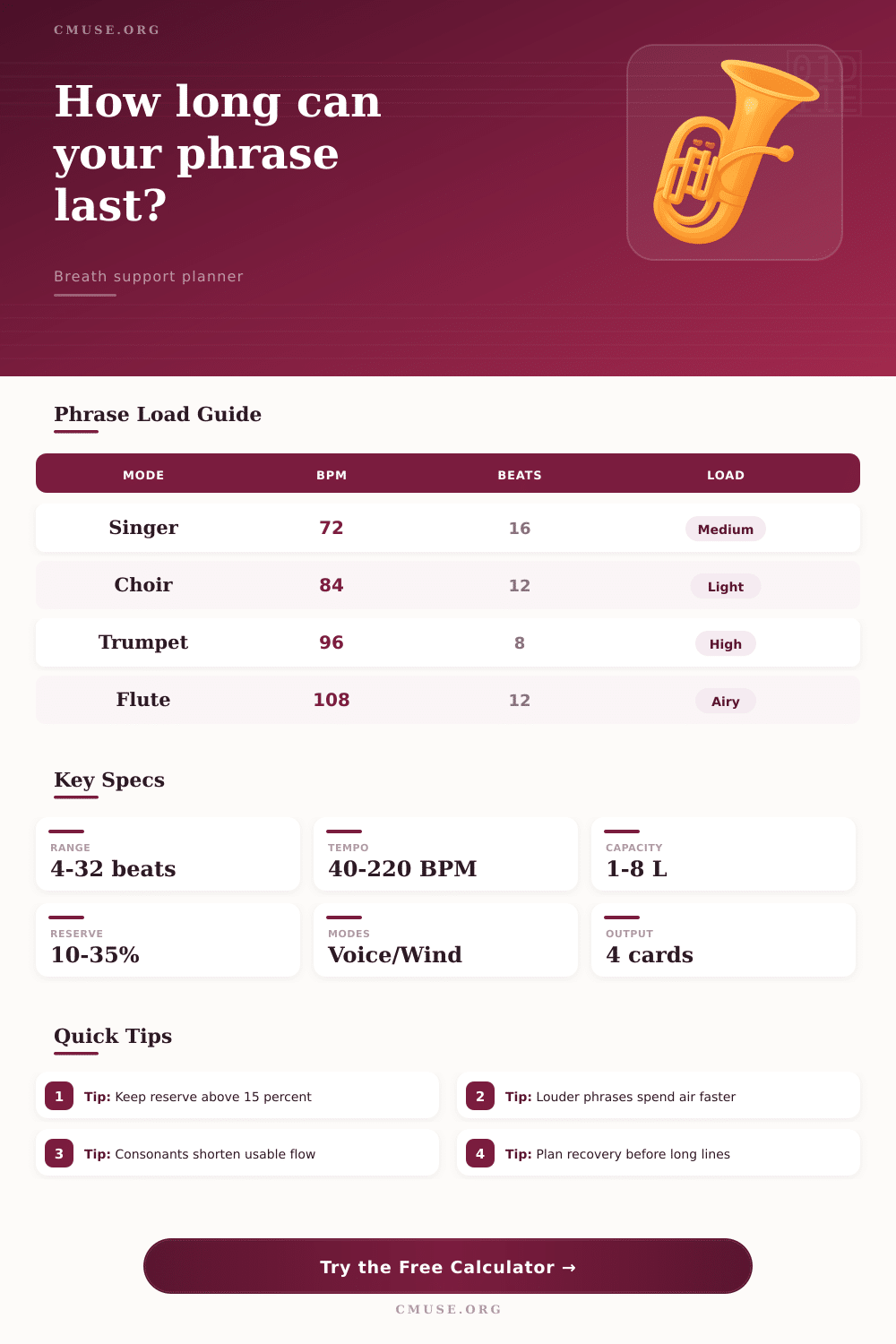
| Ballad vocal line | 72 BPM, 16 beats | 13.3 sec | Sustain and vowel balance |
| Choir legato entry | 84 BPM, 12 beats | 8.6 sec | Blend without late squeeze |
| Flute lyrical phrase | 108 BPM, 12 beats | 6.7 sec | High air loss |
| Trumpet study phrase | 96 BPM, 8 beats | 5.0 sec | Pressure and dynamic load |
| Aria extension | 60 BPM, 20 beats | 20.0 sec | Requires planned renewal |
▦Recovery and Reserve Guide
| Reserve result | Margin signal | Breath action | Use case |
|---|---|---|---|
| Above 25% | Comfortable | Keep current phrase plan | Practice tempo or light dynamics |
| 10% to 25% | Manageable | Mark a recovery point if tempo moves | Performance-ready with focus |
| 0% to 10% | Tight | Reduce load or breathe earlier | Long line with little rest |
| Below 0% | Over limit | Split phrase or lower air demand | Forced ending likely |
◆Support Notes
And then it’s too late: you lift up your instrument or step to the mic for that extended phrase but discover, too late, that you’ve miscalculated. That high note soars…or wavers. Instead of finishing on a strong consonant, it becomes a gasp.
Why? Because even though air isn’t actualy limited, it does have hard-and-fast physical rules. And the panic arises not from planning but from guesswork. You thought you had just enough air, but if you arrived exactly on time, where was your safety margin all along?
How to Calculate Your Breath for Music
To avoid guesswork, I built a breath support phrase length calculator on page. It measures how long you think the phrase is compared to how much air you can provides versus how much air you will need. Performers typically consider their breath in terms of volume, but they should be considering pressure and time.
Before musical style is thought about, the tool require the beat count and tempo as these will ‘lock’ in the duration. Eight beats at a fast pace feels different than sixteen at a slower one. Both may be short on paper but feel different. Once converted to seconds, which is the only unit that concern us when our lungs are emptying, the calculator does the rest.
Then comes the change for weight of the phrase itself. Here’s where most folks go astray. They think each note carries an equal value of air, but they don’t. A singer who holds a tone with a closed vowel drains his/her air supply different than one who sings with a breathy texture or open vowels. Likewise, a wind player will have different trade-offs based off instrument.
For example, brass instruments typically uses high pressure with lower volume flow, while flutes are like leak buckets that require massive airflow to maintain pitch. These changes is shown by the load multipliers built into the calculator that represent the resistance of the source of your sound. So if you play a passage that needs a lot of air and it is articulated with an airy sound, the system reflects how your air demand skyrockets. This has a small individual effect, but it makes a huge difference when you’re already out of reserves.
The most useful thing you can do with this, if anything, is set a reserve target. Without any air remaining at the end of a phrase, you lose control of the tone and pitch. You can then choose what percentage of your air you’ll have left when you finish. Having a buffer of more than fifteen per cent guarantees that there is enough residual air pressure to allow you to shape the conclusion of the phrase cleanly and without having to force it out.
If the calculator indicates less than this, it doesn’t imply that you shouldn’t play the piece. It suggests that you’re either going to have to breathe earlier, drop the volume slightly, or accept that the phrase will end up tightly closed. These are artistic decisions, but informed ones.
The other thing is recovery time: can it work in practice? Can I take a quick shallow breath after each phrase to top up my tank without resetting my posture and going back to the beginning? Or do I have plenty of time until the next entry? If so, I need a deeper reserve so I don’t inhale in panic mode which destroys the musical flow.
To see how this compares, such as a standard choral line versus a tricky aria extension, look at the reference tables on the page.
At the end of the day, breathing well isn’t about taking a deep breath but rather controlling what happens when you hold your breath. Having the biggest lungs in the house won’t matter if you don’t manage your dynamics or practice good technique because you’ll still find yourself running out of air. You should of practiced more. The calculator exposes these inefficiencies before you do on stage.
When you think of breath as something to be conserved like a budget instead of an endless supply, you take control of each phrase. You know precisely how long you have and how you need to spend it so that the music never runs dry. You walk back to that microphone with a plan.