Vocal Warmup Duration Calculator
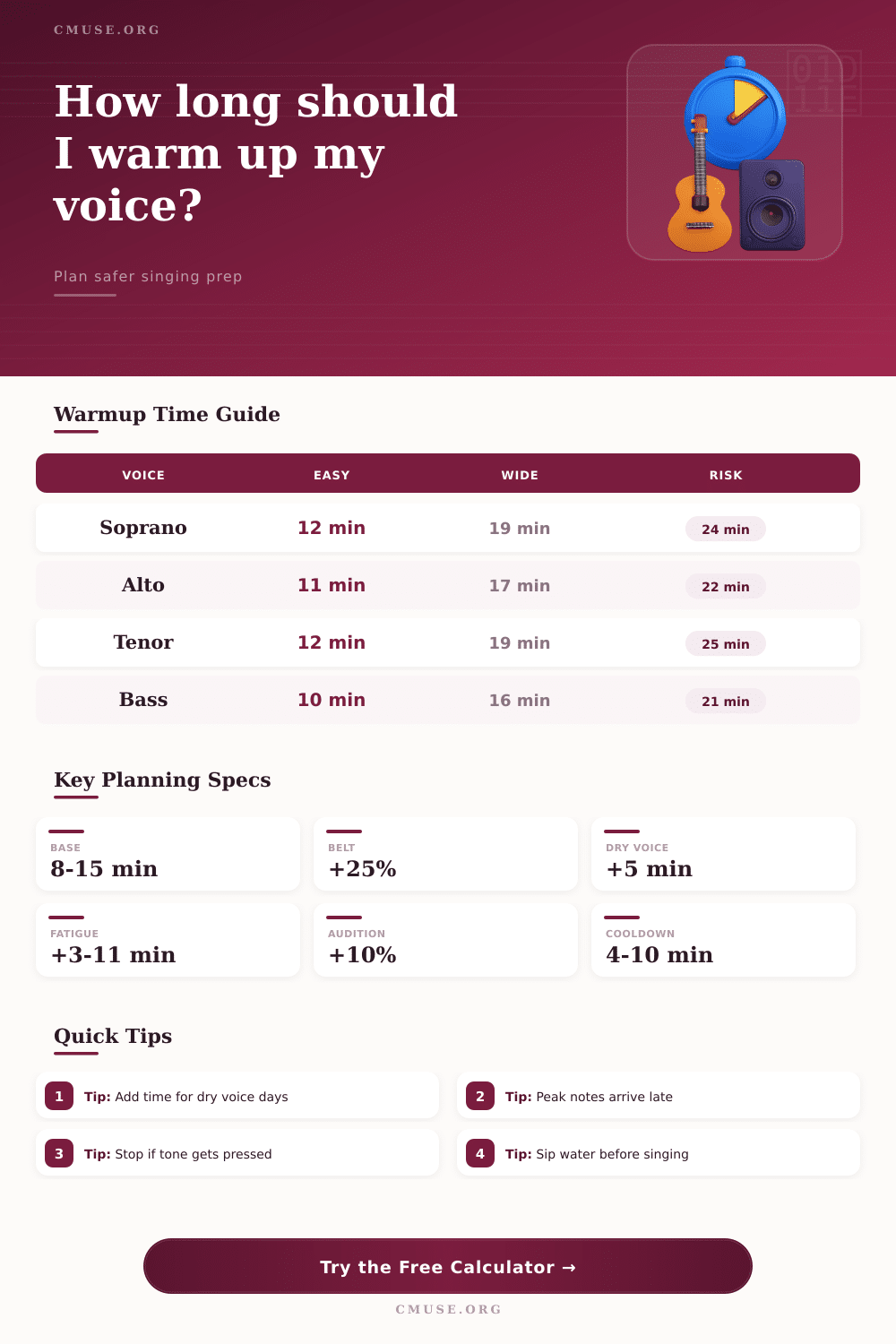
Estimate a focused warmup window from voice type, range demand, genre, fatigue, hydration, session length, and performance risk.
Your Vocal Warmup Plan
| Voice type | Typical base | Range sensitivity | Best first exercise |
|---|---|---|---|
| Soprano | 14 minutes | High passaggio and top notes | Straw phonation, sirens |
| Mezzo-soprano | 13 minutes | Middle-to-upper mix | Hums, lip trills |
| Alto / contralto | 12 minutes | Lower registration balance | Gentle descending slides |
| Countertenor | 15 minutes | Falsetto coordination | SOVT glides, soft vowels |
| Tenor | 14 minutes | Passaggio and upper mix | NG slides, lip trills |
| Baritone | 12 minutes | Upper extension and clarity | Five-note scales |
| Bass | 11 minutes | Low resonance and agility | Light hums, octave slides |
| Spoken voice | 8 minutes | Endurance and articulation | Breath flow, resonant hums |
| Genre | Time modifier | Warmup emphasis | Peak work timing |
|---|---|---|---|
| Classical / opera | +15% | Breath, vowel alignment, legato | Final third of warmup |
| Musical theatre | +20% | Speech-to-song, mix, articulation | After middle range is stable |
| Belt / rock lead | +25% | SOVT, mix setup, twang balance | Last 20% only |
| Pop / contemporary | +5% | Registration shifts and onset variety | After easy phrases |
| Jazz / standards | -5% | Flexibility, diction, soft dynamics | Middle of warmup |
| Choral blend | -10% | Tuning, vowel blend, gentle range | With ensemble scales |
| Speech / lecture | -25% | Resonance, diction, breath pacing | No peak singing needed |
| Condition | Add time | Why it matters | Safer adjustment |
|---|---|---|---|
| Mild fatigue | +3 minutes | Coordination may arrive slowly | Stay quiet longer at first |
| Moderate fatigue | +7 minutes | Pressing can appear early | Use SOVT and reduce volume |
| Dry throat or room | +5 minutes | Onsets may feel sticky | Sip water and avoid force |
| A week off | +9 minutes | Range coordination needs reset | Delay peak notes |
| Return after strain | +30% | Tolerance may be reduced | Keep session short and gentle |
| Common scenario | Session length | Warmup target | Cooldown target |
|---|---|---|---|
| Choir rehearsal | 90 minutes | 10-16 minutes | 4-6 minutes |
| Studio lead vocal | 120 minutes | 18-28 minutes | 6-9 minutes |
| Audition slot | 10 minutes | 18-25 minutes | 4-6 minutes |
| Musical theatre set | 150 minutes | 22-34 minutes | 8-10 minutes |
| Lecture or podcast | 60 minutes | 6-12 minutes | 3-5 minutes |
While most singers are aware of their need to warm up, few realise that preparation time is an area where less is rarely more. Enter your specific details into calculator to do all the math for you; you won’t have to guess if ten minutes was enough or wait until everything is perfect.
Anatomy is the starting point. The vocal folds is mucous membrane covering muscle. They are essentially like fingers getting stiff from the cold, and they swell up a little when they wake up as their blood flows. It isn’t safe to try and stretch cold tissue. Jumping right to heavy phrasing or high notes, then asking them to produce tone while also having that swelling dissapears immediately causes friction. Inflammation results from friction, and inflammation will decrease your range more quicklier than any other error.
How to Warm Up Your Voice Safely
That’s why the tool takes into account this by baselining based off your voice type, since amount of tissue flexibility needed for a bass’s low resonance isn’t the same as a soprano’s top notes. And this isn’t arbitrary. It aligns the warmup with how you mechanicaly load up those folds.
The equation changes considerable with context. Is it hydrated? Does hydration allow the voice to lubricate itself well and reduce drag on surface of the voice? Are you dried out from a heated room or from traveling? Are your tissues somewhat stuck together instead of sliding smooth over themselves? If you are dry from things like travel or a heated room, you need extra time just to get those tissues moving smoothly. Environmental factors will adds minutes as indicated in reference table.
Are you tired? Your brain sends the signal to move the muscle but it’s laggy and doesn’t happen fast enough. Once you get tired, you start to notice that crack in the tone. Plan for that lag and avoid cracks in the voice.
How much it takes is also down to genre: Rock and belted style in musicals tend towards high impact forces on the cords, including more of a ‘twang’ as part of their sound. This means more muscular engagement and a longer ramp-up to condition muscles for the shock. If you treat a belt-heavy set like a gentle jazz session, you would of likely strain your cords. The calculator factors in percentages for these heavier styles, recognising not all styles of singing require equal levels of physical demand. It keeps you from over-warming up for a lighter set or under-preparing for a heavy one which would tire your voice out before you’ve even begun.
And then there’s the psychology of it all. Your warm-ups establish your intention; they’re just as much about your mind as they are your body. Rushing them? Chances is high your performance won’t be far behind. The other point the tool makes, one that’s frequently overlooked but critical. Is the cooldown. Allowing your tissues to slowly come back into their rest state prevents the sudden swelling that cause hoarseness hours after you stop singing.
You invested time in your morning ritual; don’t let it go to waste. The truth is that it’s all about time as a strategy, not a number. It’s about juggling conservation and readiness. Wait too long, and you’re exposed; wait too soon, and you’ve spent your fuel tank before the race even start. What we hope for is to be at the starting line in sync and loose enough to open up and let go without having to push. Follow this process and your voice will do what it does best: it will sing freely and strongly on every single note from the start.