Pedalboard Power Draw Calculator
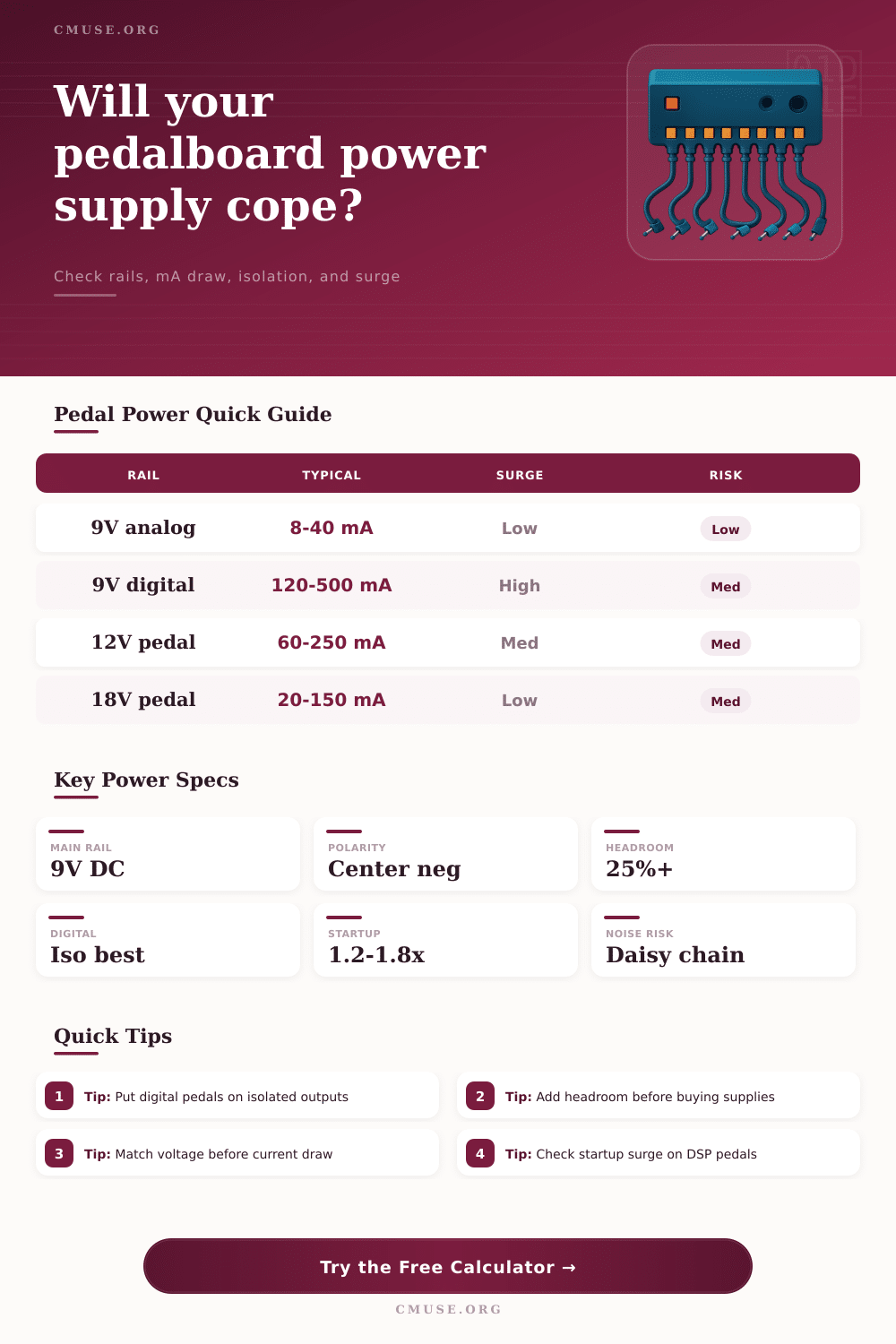
Total the current draw of 9V, 12V, and 18V pedals, then check digital startup surge, headroom, isolated-output capacity, and daisy-chain noise risk before wiring the board.
Load a common board style, then adjust the rails, digital pedal count, output limits, headroom, and daisy-chain layout to match the actual pedal labels or manuals.
Power Draw Breakdown
| Pedal type | Usual rail | Typical draw | Power note |
|---|---|---|---|
| Analog overdrive, boost, fuzz | 9V DC | 5 to 30 mA | Good daisy-chain candidate when polarity and ground are compatible. |
| Analog modulation or compressor | 9V or 18V DC | 10 to 80 mA | 18V operation needs a rated pedal and a matching supply output. |
| Digital delay, reverb, looper | 9V DC | 120 to 500 mA | Use isolated high-current outputs for lowest noise and best startup behavior. |
| Modeler or multi-effect pedal | 9V, 12V, or 18V DC | 400 to 1200 mA | Read the exact label; voltage, polarity, and current vary greatly. |
| Wireless, MIDI, utility pedals | 9V or 12V DC | 60 to 350 mA | Digital utility devices can inject noise into shared daisy chains. |
| Output rating | Best use | Warning point | Headroom target |
|---|---|---|---|
| 100 mA isolated output | Low-draw analog pedals | Digital pedals often exceed it | Keep running draw under 75 mA |
| 250 mA isolated output | Most compact digital pedals | Startup surge may still exceed rating | Keep running draw under 185 mA |
| 500 mA isolated output | Large reverb, looper, MIDI pedals | Some modelers need more | Keep running draw under 375 mA |
| 1000 mA output | Modelers and high-current units | Voltage and plug size must match | Keep running draw under 750 mA |
| Layout | Usually safe with | Risk factor | Calculator signal |
|---|---|---|---|
| All pedals isolated | Digital, analog, mixed rails | Lowest shared-ground noise | Risk falls when outputs match pedal count |
| Analog daisy chain | Drives, fuzz, analog EQ, tuner | Total chain current and ground hum | Risk stays low when digital pedals remain isolated |
| Digital daisy chain | Only if manufacturer allows it | Clock whine, resets, startup dips | Risk rises with digital count and daisy-chain count |
| Single adapter board | Small all-analog boards | No per-output current protection | Risk rises when total draw or surge is high |
| Board style | Typical pedals | Running draw | Suggested supply shape |
|---|---|---|---|
| Small blues or rock board | Tuner, comp, two drives, delay | 200 to 450 mA | Five isolated outputs, one high-current output |
| Ambient worship board | Drives, stereo delay, reverb, volume, MIDI | 900 to 1600 mA | Eight or more outputs with several 500 mA taps |
| High-gain metal board | Gate, tuner, boost, modeler, delay | 650 to 1400 mA | Dedicated high-current output for modeler |
| Bass utility board | Tuner, compressor, preamp, octave, DI | 350 to 900 mA | Mixed 9V and 12V outputs if preamp requires it |
| Synth or experimental board | Pitch, sequencer, MIDI, granular delay | 1000 to 2200 mA | Digital-first isolated supply with generous headroom |
One kind of power problem that faces musicians and electricians alike is what to expect onstage. Before soundcheck, you’re standing in the wings looking down at your gear. There’s your power supply laying on the floor. Nothing are happening. But will it be reliable?
You flick the master switch, and your delay unit goes “click” rebooting. Your noise gate blips off for a second, then your amp go silent. Why? Because one of your pedals caused the power rail to drop under load of its surge. It ain’t magic, but it could of been prevented by checking numbers before plugging in those cables.
How to Choose the Right Power Supply for Your Pedals
Power Supplies are treated by most as black boxes; they function or they don’t. Buy one that has a large total current rating (i.e., fifteen hundred milliamps) and it will feed everything. Not true. There is two considerations: one is current, and the second is how that current is delivered.
How many amps do I have available? That’s the total current. But if there is only one output feeding into ten pedals in a row, every pedal are sharing a common ground return. This means nothing to analog overdrive pedals. However, digital pedals produce noise. That noise radiates back down that common wire and enters your amp as a whining hum that dissapears upon touching the strings.
The solution is that each pedal get its own circuit to the source. We call it isolation. It’s the primary reason the calculator above favors isolating outputs.
Voltage rails are fixed values, and you need to know this stuff. If your pedal calls for nine volts and you give it twelve, you’ll blow it up. A pedal designed for center-negative polarity may fry when connected to a center-positive supply. Amps (current draw) is more flexible because they are limited by the source. The calculator add the small numbers for you. It differentiates between digital effects, which draw a lot of juice, and analog pedals, which don’t use much at all.
For example, a typical fuzz pedal draws maybe twenty milliamps. A new multi-effects processor could be drawing five-hundred milliamps or more. Connect three such device and the combined demand is over an amp of current.
Planning for pedal power has its own challenges with startup surges. To get a digital chip going take a burst of energy to start up the processor. It’s often thirty to fifty percent more than steady state draw listed on the pedal. So if you’ve got a looper that requires three-hundred milliamps to operate and your isolated output is only good for three-hundred, it’ll probably reset when you switch it on. That surge may reach four-hundred or five-hundred milliamps for just a split-second. You can use a multiplier on the tool to make up for that temporary load. A little tweak like this avoid big problems onstage.
The other idea I’m thinking of here, headroom, appears to be an added cost with no benefit. But then, when needed, it is essential. If your supply runs at one hundred percent capacity, there’s no margin for error. Even a tiny amount of voltage loss in the cable, a single new pedal, or an older component can tip the balance into overdrive. Twenty-five percent more headroom means that the supply isn’t running up against its thermal maximum. That keep things cooler and has a lower noise floor. It’s insurance, sacrificing some efficiency for reliability.
Instead of organizing your board by manufacturer, organize it based off power use. Place sensitive, digital pedals on your highest rated isolated output(s). Analog drives can be daisy chained safely so group them. Always check the polarity marking on each adapter tip. Based off your decisions, the calculator above will show your risk assessment and where your layout might fail under load.
The idea here isn’t about purchasing the most expensive supply. It’s about matching the power demand to its delivery. After all, grounds are shared paths and current flows in pulses. That’s why pedaled rigs reboot: it’s no longer a mystery once you get that. You won’t have to guess anymore; you will just have a rig that runs quiet, stably, and is ready to rock from the first chord.