Cymbal Lifespan Calculator
Estimate remaining cymbal life from alloy, diameter, weight class, weekly use, playing force, genre, crack growth, keyholing, cleaning habits, and transport risk.
🎵Cymbal Use Presets
⚙Cymbal Condition Inputs
Typical range: 6 in splash to 24 in ride.
Cymbal Lifespan Estimate
🔬Cymbal Alloy and Spec Comparison
📊Reference Tables
| Alloy / build | Typical baseline life | Best role | Watch point |
|---|---|---|---|
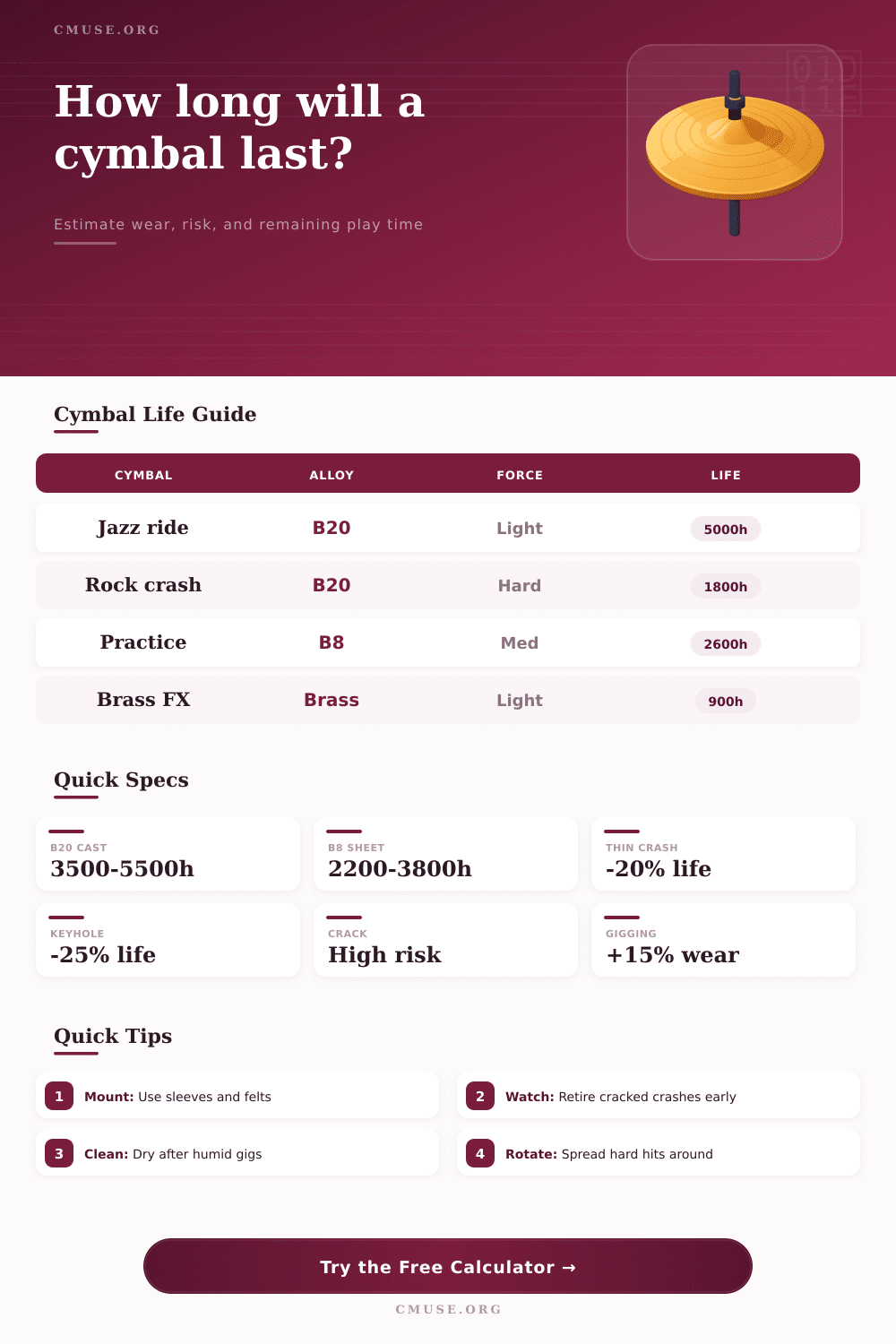
| B20 cast bronze | 3,500 to 5,500 playing hours | Ride, crash, hats, professional use | Thin edge fatigue after hard crashing |
| B15/B12 cast bronze | 3,000 to 4,700 playing hours | Stage crashes, all-purpose sets | Medium-thin crash riding |
| B10 sheet bronze | 2,700 to 4,200 playing hours | Practice and live utility cymbals | Bell hole wear if mounted bare |
| B8 sheet bronze | 2,200 to 3,800 playing hours | Practice, student, bright rock sounds | Edge chipping under hard force |
| Brass or nickel silver | 700 to 1,500 playing hours | Starter, effect, low-volume practice | Bending, dents, and fast tone drop |
| Custom thin prototype | 1,600 to 3,000 playing hours | Special studio colors | Unknown temper and edge stability |
| Diameter and weight | Flex behavior | Wear tendency | Calculator modifier |
|---|---|---|---|
| 8 to 12 in splash, paper thin | Very fast flex and choke | Cracks quickly if struck like a crash | 0.70 to 0.86 life factor |
| 14 to 16 in thin crash | Fast opening, small edge mass | Edge wave and small radial cracks | 0.78 to 0.95 life factor |
| 17 to 19 in medium crash | Balanced flex and projection | Reliable if angled and not over-tightened | 0.95 to 1.12 life factor |
| 20 to 24 in ride | Large surface, lower crash load | Bell and center wear from stands | 1.10 to 1.32 life factor |
| China or trash cymbal | Flanged edge concentrates force | Edge cracks and inverted lip splits | 0.62 to 0.82 life factor |
| Marching crash pair | Hand grip and outdoor shocks | Dents, straps, and rim-to-rim impact | 0.65 to 0.85 life factor |
| Use profile | Force pattern | Extra risk | Inspection rhythm |
|---|---|---|---|
| Jazz ride work | Light tip patterns, rare edge hits | Keyhole from old stands | Every 10 to 12 weeks |
| Studio crash cymbal | Medium force, repeated takes | Tone must stay predictable | Every 6 to 8 weeks |
| Rock cover gigs | Hard crashes, loud wedges | Transport and shared stands | Every 3 to 5 weeks |
| Metal crash riding | Repeated shoulder hits | Heat, sweat, and edge chopping | Every 1 to 3 weeks |
| Church or theater set | Moderate weekly cycles | Many players sharing one cymbal | Every 5 to 7 weeks |
| School practice room | Mixed force, inconsistent setup | Missing sleeves and tight wing nuts | Every 2 to 4 weeks |
| Damage sign | What it means | Lifespan effect | Action threshold |
|---|---|---|---|
| Flea-bite edge nicks | Small impact marks at rim | 5% to 12% life reduction | Monitor and rotate strike area |
| Hairline crack | Early radial or edge split | 35% to 55% life reduction | Retire from critical gigs |
| Large spreading crack | Active metal fatigue | 70% to 90% life reduction | Replace for live or studio work |
| Keyhole center wear | Hole stretched by stand metal | 12% to 45% life reduction | Add sleeve, inspect bell weekly |
| Bell crack | Stress at the thickest section | 80% to 95% life reduction | Retire quickly; failure can spread |
| Wavy or bent edge | Over-flexed thin metal | 20% to 45% life reduction | Lower force or move cymbal angle |
🛠Common Cymbal Scenarios
| Scenario | Typical cymbal | Main stress | Planning note |
|---|---|---|---|
| Jazz quartet ride | 22 in B20 medium-thin ride | Long hours, low force | Long life if center hole stays round |
| Rock crash pair | 17 and 18 in B20 medium crashes | Hard edge strikes | Rotate cymbal and check edge monthly |
| Metal china effect | 19 in trash china | Flanged edge shock | Plan earlier replacement than rides |
| Practice room crash | 16 in B8 medium crash | Many players, mixed setup | Use sleeves and mark inspection dates |
| Studio hi-hats | 14 in cast bronze pair | Clutch and edge contact | Track top cymbal edge and clutch felt |
| Orchestral suspended | 20 in thin suspended cymbal | Mallet swells, low impact | Low fatigue, high tone sensitivity |
💡Practical Cymbal Life Tips
That’s when it happens; that time in your song where you decide to crash the cymbal in a certain way and it simply refuses to speak back to you. It doesn’t always happen with drama. Instead, tone gradually gets dull and metal wears out. Before you know it, a tiny crack begins moving slow from the rim toward the bell. This is often when many drummer finally wake up and realize they should of been paying more attention to their wear patterns long before.
Cymbals are not indestructible shields. They’re vibrating bits of bronze that recieve abuse each and every time you hit ’em, so knowing how long they’ll last can help you avoid being stuck mid-set with a broken instrument. Manual calculation is almost impossible because there are so many variables. These include alloy composition, playing force, mounting tension, and environmental factors. Most people say, “if it rings it’s good enough.” That is a very dangerous way to think if you’re making money doing this for a living.
How to Make Your Cymbals Last Longer
For instance, a B20 (cast bronze) ride cymbal may provide thousands of hours of clean sound with just light jazz touches, but the same physical size in brass will deteriorate far quicker due to being less strong. The tool takes into consideration difference between those materials based off how you actualy use them. If you carry it around each week and hit it hard, how long it lasts decreases more than if it sits on a few stands at home in a studio environment.
Most players don’t give much thought to longevity, but mounting mechanics are an incredibly important factor. Cranking down a wing nut too tightly stops the cymbal from vibrating freely. This causes stress around the center hole and can lead to faster metal fatigue near the mounting point. Proper felt washers, along with sleeves allow instrument to breathe and move freely. Although you may view this as minor detail work, it increases longevity while minimizing nearby strain.
Also very important is how and where you rotate your strikes. Repeatedly hitting the exact same spot on a crash cymbal each night will wear down that particular edge zone until it starts to become wavy or prone to cracking. Switching positions, or changing your angle a bit, reduces physical load while spreading it out over surface area. Cracks that extend from the outer rim into the center of the cymbal are a structural emergency while one little nix in the rim is usually just cosmetic and not harmful.
When the metal starts separating then vibrations will no longer be predictable, creating even more stress on the still-intact areas. So when a crack does begin to spread it tends to do so rapidly. On the page we’ve included some reference tables outlining general lifespan expectations based on build and alloy. These ranges vary depending on situation, so they give you something to compare your situation with. For example, a heavier crash cymbal may outlast many more impacts due to its greater mass to absorb the impact. In contrast, a thin splash may fail silently under too much pressure as it flexes in ways not designed for it.
Other contributors to the deterioration include how you clean things and humidity. Oils and sweat from your hands promote corrosion and oxidation if allowed to sit on bronze surface. After gigs or rehearsal sessions where they’re exposed to high humidity, simply wipe down your cymbals so that chemicals don’t break them down and weaken metal structure. The storage environment can be every bit as important as what happens when you play. If it’s stored in a case with protection from the elements, this helps guard against any environmental pressures that accumulate over time. You don’t have to go crazy about it, but taking care of basic maintenance will keep the structure strong and tonal quality intact more effectively than anything else.
Knowing when it’s time to swap out your cymbal can be a bit of art mixed with a little science. Entering data into calculator will provide a data-based assessment, but at the end of the day your ears need to decide. Just because there might still be some ‘theoretical’ life in the cymbal doesn’t mean anything if tone isn’t clear and the response isn’t alive. You’re using an instrument that depends upon precise vibration. By taking care of this, you’ll know that your sound is reliable and consistant. This means you’ll always be ready for the next musical challenge.