Reed Lifespan Calculator
Estimate how many playable sessions remain for cane or synthetic reeds across clarinet, saxophone, oboe, and bassoon setups.
Reed Life Estimate
| Instrument | Typical reed type | Estimated best hours | Common lifespan limiter |
|---|---|---|---|
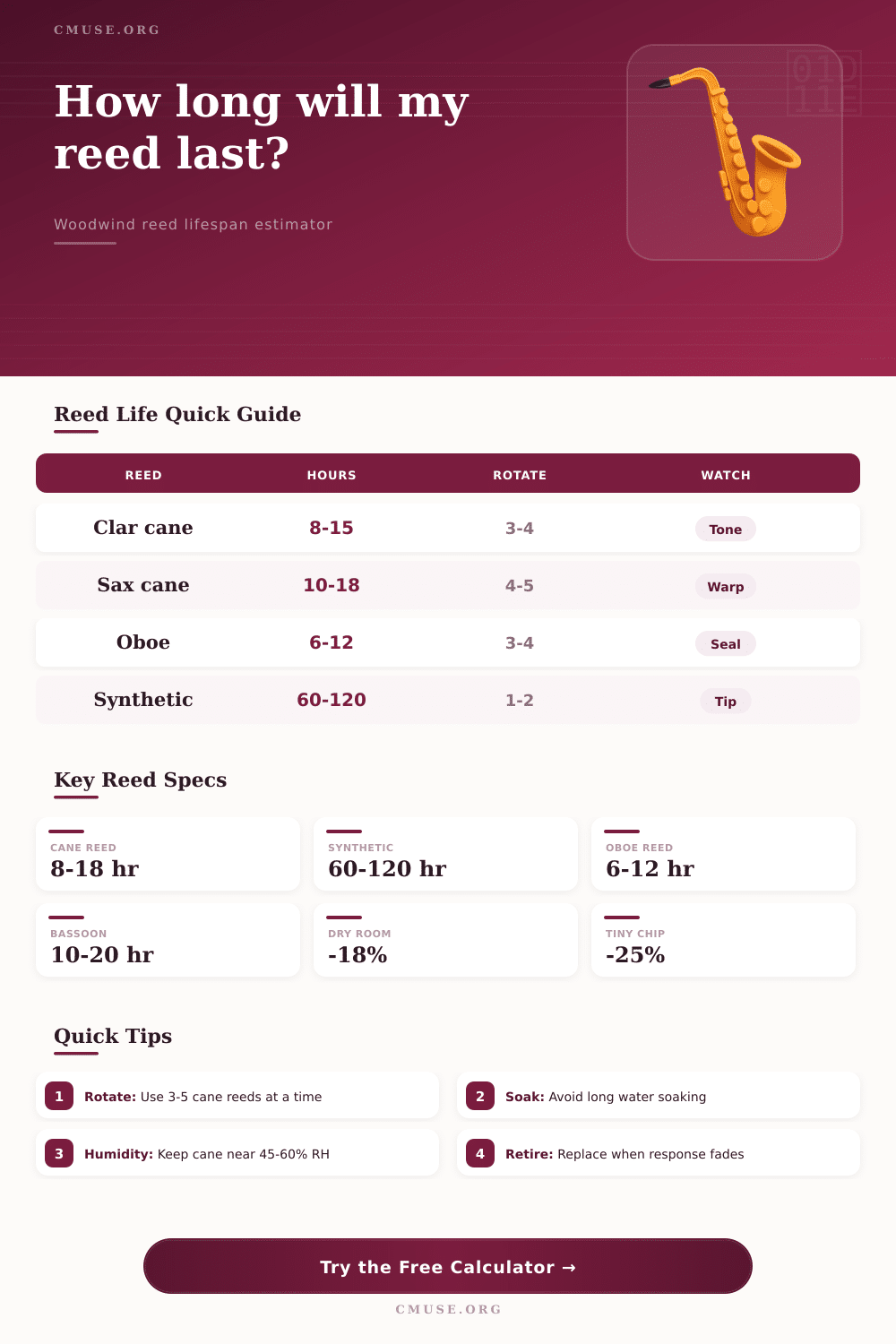
| Bb clarinet | Single cane or synthetic | 8 to 15 cane, 60 to 110 synthetic | Tip fatigue, tone dullness, warping |
| Soprano saxophone | Small single cane reed | 8 to 14 cane, 55 to 100 synthetic | Thin tip response and pitch instability |
| Alto saxophone | Single cane or synthetic | 10 to 18 cane, 60 to 120 synthetic | Edge damage, softening, uneven resistance |
| Tenor saxophone | Larger single reed | 12 to 20 cane, 70 to 130 synthetic | Waterlogging and reed heart collapse |
| Baritone saxophone | Large single reed | 14 to 24 cane, 75 to 140 synthetic | Warping, rail leaks, heavy moisture load |
| Oboe | Scraped double reed | 6 to 12 playing hours | Tip opening change, seal, vibration loss |
| Bassoon | Larger double reed | 10 to 20 playing hours | Blade fatigue, wire fit, tip opening drift |
| Reed setup | Baseline behavior | Lifespan effect | Best use in calculator |
|---|---|---|---|
| Filed cane single reed | Flexible response with exposed bark shoulder | Slightly shorter if over-soaked | Clarinet and classical sax setups |
| Unfiled cane single reed | More bark at shoulder, often resilient | Slightly longer when rotated well | Jazz sax or players wanting darker resistance |
| Premium reserve cane | More consistent blank and cut selection | Small durability gain | Advanced clarinet and sax rotation |
| Handmade double reed | Highly responsive, player-adjusted scrape | Shorter peak window | Oboe or bassoon performance reeds |
| Student double reed | Stable but less refined scrape | Moderate peak window | School oboe and bassoon use |
| Synthetic reed | Moisture-stable polymer or composite | Much longer usable life | Outdoor work, doubling, marching, practice |
| Condition | Reed effect | Calculator modifier | Practical reading |
|---|---|---|---|
| 1 reed only | No recovery between sessions | Shorter calendar life | Most wear lands on one reed |
| 3 to 5 cane reeds | Even moisture cycling and rest | Longer rotation life | Best normal woodwind rotation |
| Balanced soaking | Fibers hydrate without waterlogging | Neutral to positive | Usually 1 to 3 minutes for cane |
| Very dry storage | Tip curls and rails become brittle | Moderate penalty | Common winter or air-conditioned issue |
| Very humid storage | Reed stays swollen and dull | Moderate penalty | Can shorten response before visible damage |
| Observation | What it usually means | Lifespan impact | Retirement signal |
|---|---|---|---|
| Tiny tip chip | Air column still responds, but edge is compromised | Noticeable penalty | Keep only if tone remains centered |
| Small crack or split | Vibration pattern is interrupted | Large penalty | Retire for exposed performance |
| Major chip | Tip no longer seals or vibrates evenly | Severe penalty | Retire immediately |
| Dull tone | Fibers have softened or heart has collapsed | Moderate penalty | Rotate down to practice reed |
| Unstable pitch | Response or opening is no longer reliable | Large penalty | Retire if it repeats after adjustment |
Under the lip, everything feels dull and the articulation becomes sluggish. That’s what happens when your Bb clarinet sounds like it’s stuffed with wet newspaper. Sure, most players will point to the mouthpiece facing or blame their embouchure. In reality, it’s normaly easier and cheaper. Your reed was done yesterday. Plug in your usage habits, and the calculator above do the math for you. It eliminates guesswork about that subtle bit of resistance, Is it fatigue I can get used to, or is this permanent damage? It converts a hunch into a concrete estimate of how much more time remains.
That’s the thing about reeds, they’re biological tissue contained within a mechanical system. The input is important. Your choice of material and instrument determine how the tool will accommodate physical stress that your particular set-up inflicts on the cane. An oboe player puts far less air volume behind their reed than a tenor saxophone player, for instance. Even with equal amounts of practicing, that gap creates a difference in terms of pressure which cause the fibers of the tenor reed to collapse at a quicker rate.
Why Your Reed Dies and How to Fix It
Strength is not the only thing that matters here even though novices believe a harder reed is a stronger one. Harder doesn’t always mean longer lasting. Often it simply means that a harderr reed becomes harder to play as soon as it begins to go off. If the cane has lost its spring, a hard reed goes from great to useless in a heartbeat. Soft reeds deteriorate more slowely, allowing you a little more time before they’re no good anymore. There’s the rub.
Many amateur players waste weeks of playing time because they do not rotate. Rotating just three to five reeds give you a large reward from the calculator. Cane must dry out in between plays to return to its original strength. Playing on the same reed for four hours in a row will render it mushy and waterlogged. Swelling past their elastic limit, the fibers don’t ever really bounce back. By switching to a new reed each session, the old one can rest as the humidity stabilizes. It’s not that you need more reeds, but rather that you give your reeds time to heal.
The other silent assassin is storage conditions. Cane becomes brittle when exposed to dry air. This causes very small cracks that destroy the seal of the mouthpiece. On the flip side, overly humid air keeps the cane swollen and dulls your response long before you notice any damage. Because the tool takes your local humidity into account it adjusts the lifespan estimate accordingly. You can take control of this yourself with a few simple cases. However, most players don’t pay attention to it until they’re dealing with warped reeds in useless shape.
Surprisingly, soaking habits matter too. Too much time in water can be harmful. This can break down the fibers by soaking them for too long. Soaking for just 30 seconds or less is generally sufficient to soften and prime the reed without shocking the fibers. Longer soak times reduces the window of peak performance. The calculator penalizes this. Playing a reed that still has some stiffness but responds well is preferrable to a dead, sodden reed.
The last sign is tone decline. Here the tool will ask you to rate how you think the tone sounds. That’s subjective, but it’s also the best predictor of reed health. You hear chirps in the high register? Are you fighting to keep that note steady? In other words, the cane has probably lost its steady vibration. So you retire the reed because of what you hear, not necessarily how it looks. This increase your overall satisfaction with each box you purchase.
The bottom line is that thinking of reeds as consumable instead of fixtures alters your practice habits. You begin to rotate fresh ones into the mix and quit trying to eke a few more performances from a dead piece of cane. It becomes obvious when it’s time for a change. With this calculator, you don’t have to wonder why the setup doesn’t feel right; you just know. It is a small mental adjustment but it makes an incredible difference for the sound of your instrument week after week.