String Lifespan Calculator
Estimate tone dullness, corrosion timing, and breakage risk from material, sweat, cleaning, tension, climate, and playing style.
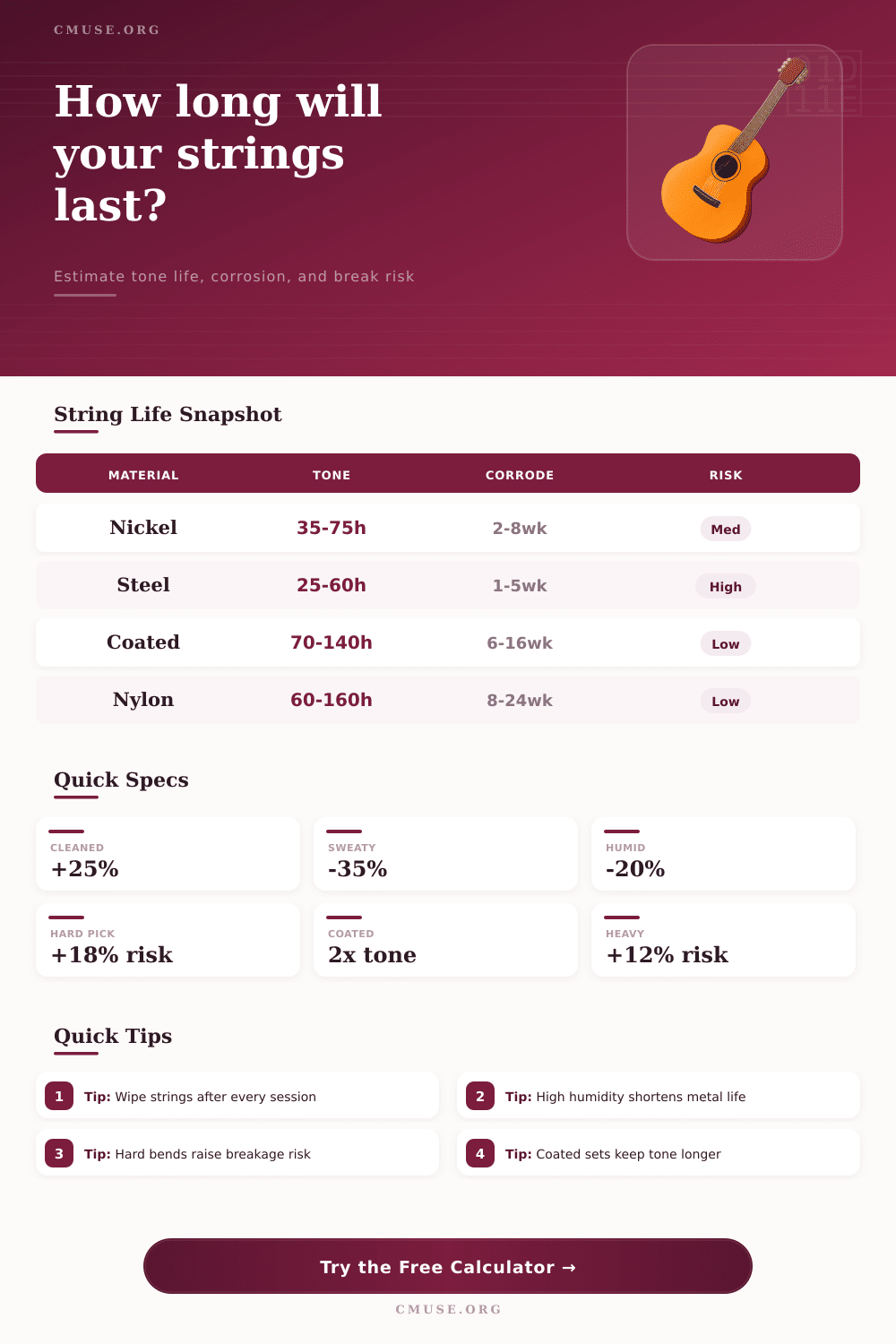
| Material | Typical Tone Life | Corrosion Behavior | Best Fit |
|---|---|---|---|
| Nickel-plated steel | 35-75 playing hours | Moderate sweat sensitivity | General electric guitar tone |
| Pure nickel | 40-85 playing hours | Smoother tone aging, moderate oxidation | Warm vintage electric response |
| Stainless steel | 25-60 playing hours | Resists rust but feels bright and abrasive | High-output attack and long sustain |
| Phosphor bronze | 25-55 playing hours | Bronze darkens as oils and humidity rise | Balanced acoustic guitar tone |
| 80/20 bronze | 18-45 playing hours | Brightest first week, faster dullness | Fresh acoustic shimmer |
| Coated metal | 70-140 playing hours | Barrier slows oil, sweat, and dirt | Consistent tone over many sessions |
| Flatwound nickel | 120-300 playing hours | Smoother wrap traps less finger grime | Jazz, bass, and low squeak needs |
| Nylon | 60-160 playing hours | No metal corrosion, but settles and frays | Classical and flamenco guitars |
| Factor | Low Wear | Normal Wear | High Wear |
|---|---|---|---|
| Hand moisture | Dry hands can add 10-15% | Average sweat is neutral | Acidic sweat can remove 30-45% |
| Cleaning | Thorough wipe can add 25-35% | After-session wipe adds about 15% | No wipe can remove 20-30% |
| Humidity | 40-55% is most stable | 56-70% adds oxidation pressure | Over 70% sharply raises corrosion |
| Travel swings | Stable room reduces fatigue | Rehearsal travel adds mild stress | Outdoor swings add tuning fatigue |
| Use Case | Tone Wear | Breakage Pressure | Watch Point |
|---|---|---|---|
| Light fingerstyle | Slow oil buildup, less pick abrasion | Low unless strings are old | Plain string intonation drift |
| Mixed rhythm and lead | Predictable normal wear | Medium at bridge and nut contact points | Brightness loss on wound strings |
| Hard strumming | Faster wrap denting and pick wear | Medium-high on thin plain strings | Flat spots near the picking zone |
| Frequent bends | Normal dirt wear plus metal fatigue | High on first and second strings | Kinks over frets and bridge saddles |
| Aggressive metal | Sweat, palm mute grime, and attack combine | High if tuning and gauge are mismatched | Bridge burrs and winding separation |
| Scenario | String Type | Playing Load | Expected Change Window |
|---|---|---|---|
| Casual electric practice | Nickel light gauge | 3-5 hours weekly | 6-10 weeks for tone |
| Daily acoustic songwriting | Phosphor bronze | 7-10 hours weekly | 3-6 weeks for tone |
| Weekend gigging | Coated electric or acoustic | 8-14 hours weekly | 6-12 weeks with wiping |
| Touring high-sweat player | Uncoated steel or bronze | 15-25 hours weekly | 1-3 weeks before dullness |
| Jazz flatwound setup | Flatwound nickel | 5-12 hours weekly | 3-9 months if stable |
| Classical nylon practice | Nylon trebles and wound basses | 6-12 hours weekly | 6-14 weeks for response |
There comes a time when guitar string stop sounding like instruments and begin sounding as though they have something to hide. Often it’s during a live performance where the need for maximum sustain leave no room for error. This is especially true when you are trying to get a clean take for recording. Strumming a chord yields a muddy thud instead of the sparkle you expect; nothing you do with your amp EQ will remedy this situation.
The solution isn’t likely your playing style or your equipment. It’s simply old metal. To understand hows of this problem one needs to look beyond surface concept of wear-out and into chemical realm of fatigue and corrosion. In fact, string life is three different clocks on overlapping timelines, all of which this calculator untangles for you.
Why Guitar Strings Lose Their Sound
Tone retention happen from physical wear caused by your fingers’ oils and pick. Corrosion are a chemical reaction sped up by humidity and acidic sweat. Structural integrity is ruled by material stress and tension cycles. Players commonly think of these as a vague concept we call old strings, but they break down into clear distinctions that explain why a string might look shiny but sound dead, or be able to sound fine but then snap with no warning. The tool models these different modes of failure so you can plan changes based off actual performance needs instead of guesswork.
That’s partly based on the material choice, though human and environmental factors play a big role too. Stainless steel is going to be brighter and rougher on your fingertips, but it won’t rust. Nickel plated steel have a warmer sound with a bit of give that ages well. Then coated strings add an oil-trapping layer between you and the bare metal. They really do extend string life, weeks most of the time. And they also keep the oils from oxidizing underlying metal core. Finally flatwounds are special. They don’t allow grime to get stuck in the gaps around the winding threads. This extends their life by months compared to roundwounds, which might last only weeks under same conditions. The table at the bottom of the page lays out those baselines so you know what to expect when you set out your weekly playtime.
More than the metal, however, there are human variables at work here. When we sweat, it’s not just water; it’s an acid and salt solution that quickly consumes plating protection. Every time you play with wet fingers, you’re bathing those strings in a corrosive substance. After sessions, wiping them down slows the process dramatically as it removes the residue before it bonds with metal. This simple habit extends usable life significantly and often adds twenty-five percent or more to the window of good tone. To neglect this step is to pay for premium strings and allow your own body chemistry to eat away at their performance in days.
Most people also forget to consider environmental conditions. Even if you’re playing brand new strings, high humidity will speed up their oxidation process and result in swelling of fretboard which impacts intonation. Regardless of how old your strings are, temperature changes (especially when traveling) introduce physical stresses into the windings which cause tiny cracks to develop over time, resulting in breakage. Think about it, these are unseen forces working against your instrument as it’s sitting in its case or being transported to rehearsal. The calculator factors this in, adjusting its corrosion and breakage scores according to your reported travel frequency and storage environment.
Often people think breakage is just a matter of bad luck, but most of the time it’s due to accumulated metal fatigue. The tension gauge on high-tension strings adds significant stress to the anchor point (both the nut and the bridge). Repeatedly bending the plain steel string past its elastic limit eventually produces weak spots where the string will snap under normal playing pressure. Understanding your chances of breakage allows you to swap out heavy strings before disaster strikes or carry a set of spares with you for important gigs.
In the end, caring for strings is a matter of controlling decay… Not eliminating it altogether. Metal will age; there’s no getting around that. But you can manage how fast they decays and make sure to change the strings when they affect the sound of your instrument. Monitoring decline in tone as well as physical wear ensures your strings remain sonically vibrant while avoiding spending money unnecessarily.
Consistent sound requires knowledge. Knowing precisely when each of these three inner clock has run out of time is how you achieve consistent sound.