Practice Hours to Learn Clarinet Calculator
Estimate focused clarinet practice time using reed response, embouchure stability, break crossing, register-key control, fingerings, tone, articulation, and ensemble repertoire goals.
The estimate treats an hour as focused clarinet work: reed setup, air and embouchure, slow crossings, measured finger work, articulation drills, tone checks, and repertoire integration.
Your Clarinet Practice Estimate
| Milestone | Typical focused hours | Clarinet skills emphasized | Practical outcome |
|---|---|---|---|
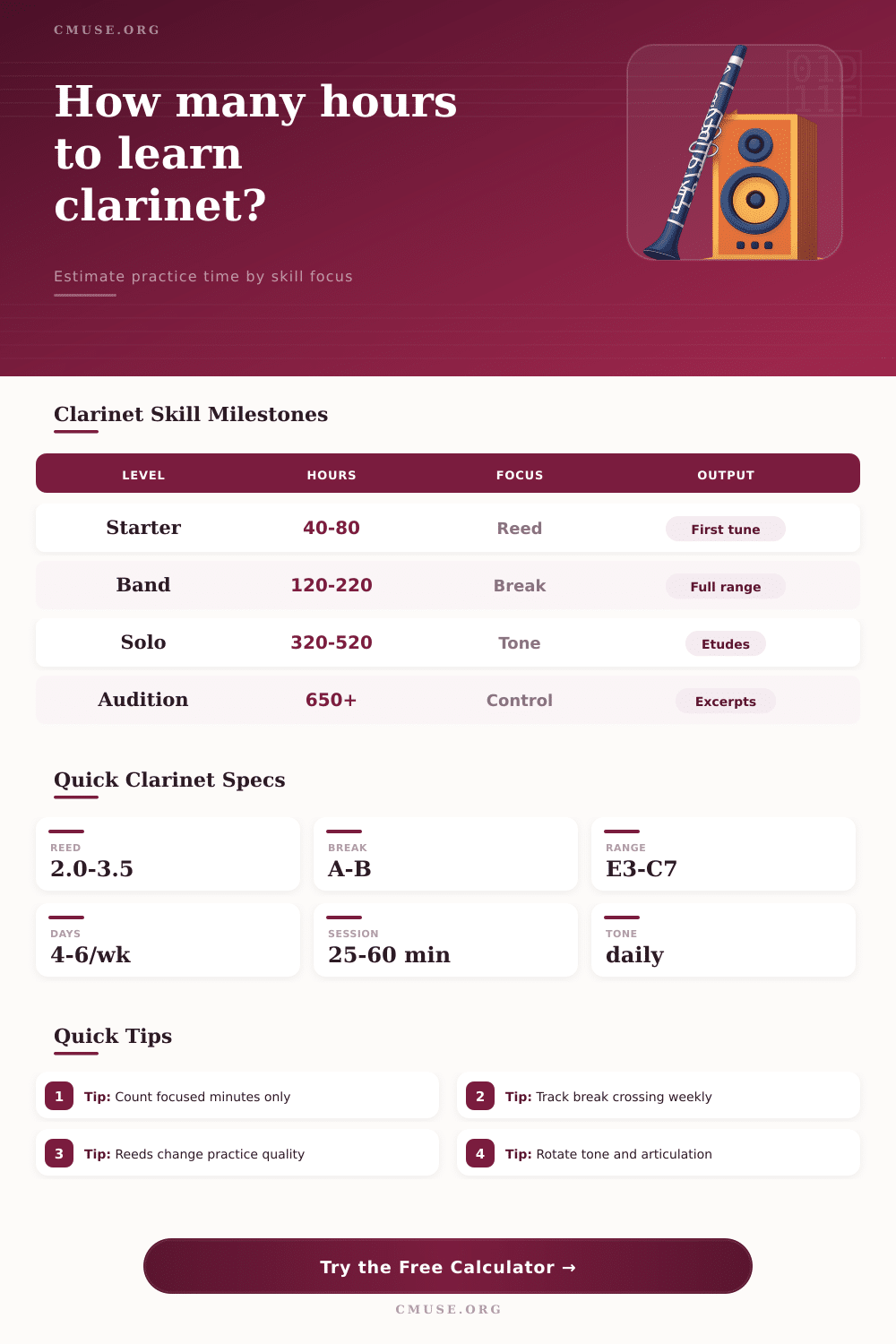
| First sound to first tunes | 40 to 80 | Reed seal, air support, left-hand notes, simple tonguing | Short melodies with steady tone in low register |
| Beginner band readiness | 120 to 220 | Throat tones, break crossing, register key, basic scales | Grade 1 to 2 parts with cleaner entrances |
| Intermediate solo level | 320 to 520 | Dynamic tone, articulation styles, pinky keys, alternate fingerings | Etudes, lyrical solos, and reliable ensemble blend |
| Upper band audition | 520 to 780 | Scales, sight reading, tempo control, clean leaps over the break | Prepared audition etude with consistent register changes |
| Orchestral excerpt foundation | 800 to 1200+ | Soft attacks, color changes, intonation, exposed articulation | Excerpt study with controlled entrances and phrase shape |
| Clarinet area | Why it changes hours | Common practice unit | Progress sign |
|---|---|---|---|
| Reed and embouchure | Unstable setup reduces the value of every minute | 5 minute response check | Same reed speaks softly and loudly |
| Break crossing | The A to B shift combines air, fingers, and voicing | Slow two-note slurs | No pause between throat tones and clarion |
| Register key control | Clarinet overblows by a twelfth, not an octave | Slurred low-to-clarion patterns | Clean clarion response without biting |
| Fingerings | Pinky choices and alternates affect speed and smoothness | Rhythm loops and scale cells | Fewer hand stops during key changes |
| Articulation | Tonguing must release sound without stopping air | Metronome attacks | Even fronts at soft and medium dynamics |
| Target | Range expectation | Technique pressure | Best hours to count |
|---|---|---|---|
| Method book melody | Low E to throat A | Breath, left hand, basic tongue | Short daily tone and note reading blocks |
| Beginner band part | Low E to clarion G | Break crossing, rests, ensemble entrances | Slow part work plus scale patterns |
| Intermediate chamber part | Low E to high C | Dynamics, tuning, alternates, blend | Recorded phrase repetitions and long tones |
| Audition etude | Full school range | Tempo, articulation, scales, sight reading | Metronome ladders and weekly mock takes |
| Orchestral excerpt basics | Exposed clarion and altissimo entries | Color, soft attacks, precision, patience | Small excerpts with tone and entrance checks |
| Weekly total | Useful split | Clarinet priority | Best fit |
|---|---|---|---|
| 1.5 to 2.5 hours | 15 to 25 minutes, 5 days | Reed response, note reading, first articulation | Starter or casual adult learner |
| 3 to 4 hours | 30 to 40 minutes, 5 to 6 days | Break crossing, scales, band part fluency | School band or steady beginner |
| 5 to 7 hours | 45 to 70 minutes, 6 days | Tone color, articulation, etudes, sight reading | Intermediate and audition preparation |
| 8+ hours | Two focused blocks on harder days | Excerpts, soft attacks, tempo stability, endurance | Advanced ensemble or orchestral foundation |
When you are starting out on the clarinet there comes a point where you become aware that it’s not so much about being able to play something through repeatedly but playing it well and slowly. You notice it most during the change between the clarion and chalumeau registers. Even after weeks of practice, transition from A to B sounds more like a glitch then a musical note.
The calculator solves this problem by breaking down your practice into clear hours of focus rather than just counting how many hours you have spent holding your instrument. It also forces you to consider that the register keys, embouchure stability and reed response is individual variables that determine how fast you will progress.
How to Practice Better
New players often think that sitting at their instrument for an hour means they have learned for a full hour. In practice, however, if they spend half that time fighting with a stuck pad or staring at sheet music then this isn’t true. They may also skip over tricky section of music, failing to stop and practise. Instead, the timer above computes your timeline based off solely on focused minutes.
In other words, it removes all the busy work and gives you raw numbers about how many hours you spent actualy gaining skill. These questions (the break crossing ability and reed stability) are the greatest time sinks in the early stages of clarinet learning. If your reeds aren’t stable, you won’t make as much progress each minute which increases total number of hours needed to reach milestones like intermediate solo playing.
In the example table above, it takes anywhere between a hundred twenty to two-hundred concentrated hours to go from playing first tunes to being ready to join the band. Why? Because the calculator factors in things that is unique to each individual learner. For instance, if your embouchure is inconsistent or biting then the algorithm will raise the projected number of hours a lot.
The reason is that it wastes time trying to stabilize your sound instead of developing finger dexterity. A minor mechanical tweak to how you create sound affect the whole learning process. You might want to practice scales faster, but the data shows that you should usually stop and fix your breath support first.
Think of the register key on clarinet that overblows not in octaves as would be expected but instead by a twelfth. It sounds odd acoustically making high and low registers feel disjointed until you find the right voicing for it. The calculator weights how you handle this heavily.
If you have trouble getting around the register key, you won’t be able to perform repertoire with confidence. If it finds that you experience squeaks and jumps when reaching the register key, the tool will readjust your time frame. It will include more repetition of slurring exercises to strengthen the muscle memory needed to cross the break soundlessely. These are dull exercises but essential ones.
Another massive variable is what you want to play. If it’s something simple from a method book, the technical demand will be much lower. This is true when compared to a section of music from an orchestral audition that ask for accurate intonation and soft attacks in the altissimo range. To account for this, the calculator use multipliers on the level of difficulty you are trying to reach.
It is worth noting how many extra hours are added when you push yourself into advanced material without a solid technical foundation to support it. More often than not, this lead to frustration instead of growth. The breakdown can also help establish if your issue is one of tone quality or perhaps finger speed. The clarinet will eventually reward precision and patience rather than sheer brute force.
If your daily practice is scattered and lacking focus, then you don’t need to practice for longer periods each day. Instead, you need to know where your weakness lies. Is it your response in your low register? Is it how you move your tongue? Work deliberately on that until it improves.
Once you’ve structured your estimate of the bottleneck the hours will begin to seem less burdensome and more like a roadmap. The difference is this change of perspective; it transforms what seems like an impossible technical hurdle into a set of manageable steps towards a clean tone.