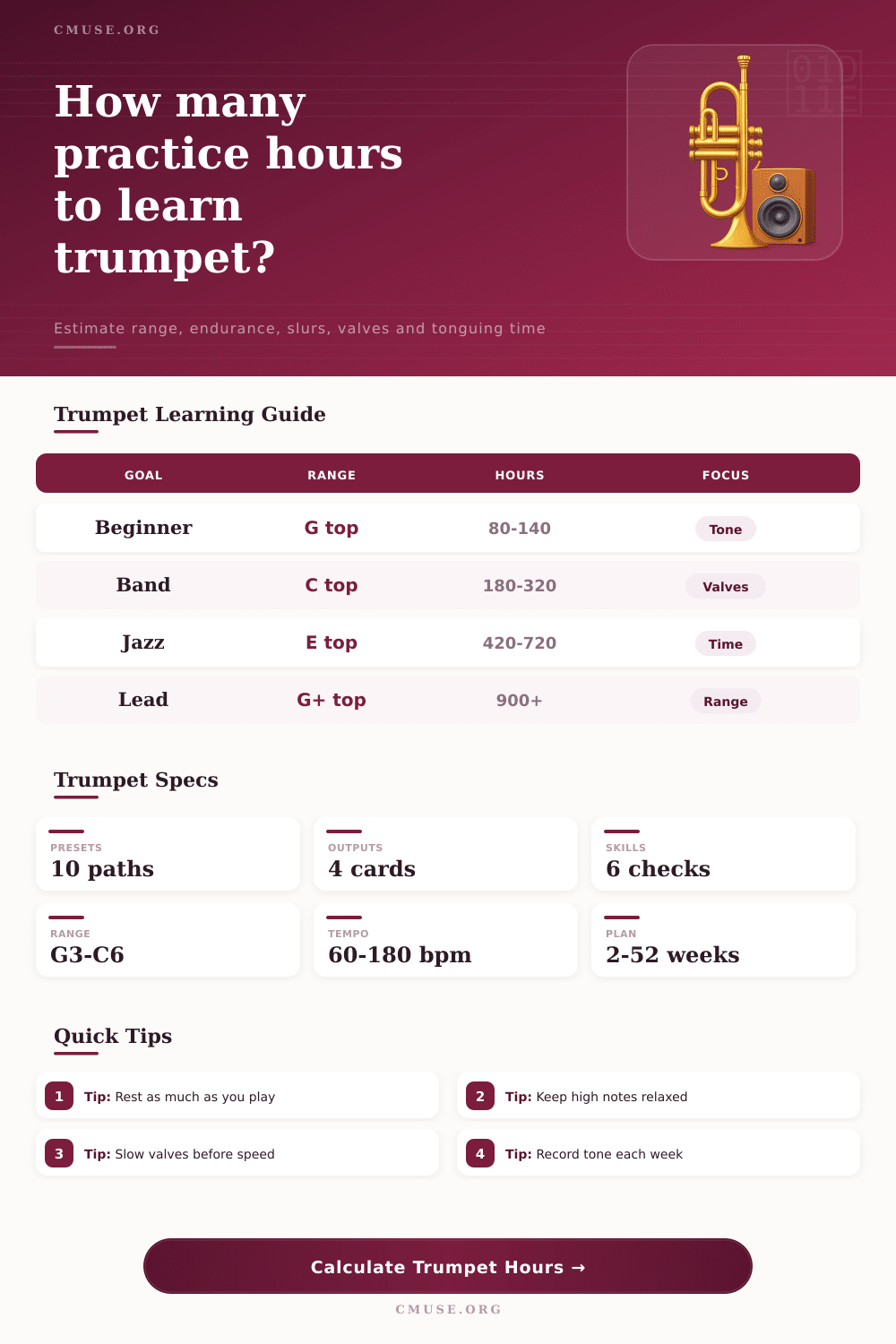
Practice Hours to Learn Trumpet Calculator
Estimate a realistic trumpet practice timeline using embouchure endurance, lip slurs, range, tonguing speed, valve clarity, breath support, and jazz, classical, or lead playing goals.
Trumpet Practice Breakdown
Use these references to sanity-check the calculator against typical trumpet learning paths, technique targets, and range expectations.
| Trumpet Goal | Typical Focused Hours | Core Range | Main Skill Gate |
|---|---|---|---|
| First clear notes and short melodies | 40-90 hours | Low G to middle C | Sound start, relaxed face, steady air |
| Beginner band performance | 120-220 hours | Low G to top-space E | Valve fingering, attacks, basic reading |
| Community band reliability | 220-420 hours | Low F sharp to G above staff | Endurance, tuning, phrase control |
| Classical audition fundamentals | 450-850 hours | Low F sharp to high C | Centered tone, slurs, clean excerpts |
| Jazz combo and improvising | 420-900 hours | Low F sharp to high C or D | Time feel, articulation, flexible sound |
| Lead trumpet work | 800-1600+ hours | High C to double G and beyond | Range recovery, compression, accuracy |
| Technique Check | Developing Target | Solid Target | Advanced Target |
|---|---|---|---|
| Embouchure endurance | 12-20 minutes | 25-45 minutes | 60+ minutes with rests |
| Lip slur cleanliness | 50-65% clean | 70-85% clean | 90%+ through registers |
| Single tonguing | 80-104 bpm | 112-132 bpm | 144+ bpm with even tone |
| Valve coordination | 60-75% clean | 80-90% clean | 94%+ at tempo |
| Breath support hiss | 15-24 seconds | 25-40 seconds | 40+ seconds controlled |
| Written Range Target | Common Use | Practice Caution | Readiness Sign |
|---|---|---|---|
| G3 to C4 | First method book tunes | Avoid pressing for sound | Notes start without swelling |
| C4 to G4 | Beginner band parts | Keep corners firm, air easy | Can repeat notes after rest |
| G4 to C5 | Audition and hymn range | Do not chase volume first | High C speaks softly |
| C5 to E5 | Jazz lead and show books | Limit fatigue cycles | Recovery within one minute |
| E5 to G5+ | Lead trumpet register | Use short attempts only | Pitch locks without strain |
| Practice Block | Beginner Split | Intermediate Split | Audition / Lead Split |
|---|---|---|---|
| Breath and long tones | 30% | 20% | 15% |
| Lip slurs and flexibility | 20% | 22% | 25% |
| Articulation and valves | 25% | 22% | 18% |
| Range and endurance | 10% | 16% | 25% |
| Music, style, and reading | 15% | 20% | 17% |
Onstage, the double high C seems easy, but it is result of thousands of hour of practice. You have learned to trust your breath instead of your muscles and to develop muscle memory in the corners of your mouth. To reach higher notes many players push their lips together to force range. This lead to frustration and strain.
Learning to play the upper register can’t be forced, it involves building a physical base for it to exist within. The calculator above take your inputs from your current embouchure endurance and target notes. It runs the math and makes sense of why those inputs is important so you stop guessing and start progressing.
How to Improve Your Trumpet Practice
The amount of time spent practising is less important then taking care to take sufficient time off between sessions. Trumpet playing are physically demanding in a way that piano or guitar player rarely understand. Your chops rapidly become tired. This means your tone ‘spreads’ as your facial muscles fatigue. When you persist despite being tired, you are reinforcing poor technique rather than improving your playing. The number of days you practise counts heavily against the quality of the rest taken in the chop recovery section. Not much maybe but it counts. Someone who plays for 4 hours a day without stopping may find themselves regressing faster then one who only plays two focused sessions with enough time off to recover.
This means that practicing will change depending on your goal range. Do you want to play middle school band parts? You just want consistent air support and some valve coordination. As the chart on the page show, these starter goals take less time than learning lead trumpet. Yet if you start going after those high C’s in an orchestra or chase down some jazz lead line, you’re switching the entire demand up. Now you’re changing your body position to accommodate higher sounds, while avoiding any pinching issues. That’s what the calculator wants to know, your single tonguing speed and lip slur control. These measures shows if you stay flexible enough to reach your goals. Being able to hit a high note doesn’t mean you have the range yet if you can’t slide smoothly into it, that’s just luck.
Generic hour counters fail to account for this kind of complexity. Sitting in an orchestra pit is not the same as playing in a jazz combo. Jazz improvisation involve being able to play quickly. It requires recovering from phrases quicky. It also requires being able to articulate quickly. For orchestral players, long sustained lines with precise dynamic control are often required. Selecting your style goal determine how much the algorithm weights endurance against articulation. This isn’t just about hitting the note, it’s about being consistent in performance conditions. It’s easy to have a clean attack at sixty beats per minute but having a clean attack at one-hundred and eighty beats per minute when fatigued is another skill altogether.
All else stems from good breath support. How do you know? Can you exhale while maintaining a steady pressure for as long as necessary to time? If so, then if I ask you to play a thirty-second phrase in a concerto, you might not have enough lip strength to maintain it. Your ability to control your breath controls your baseline. That’s what the calculator does; it calculates your starting point based off your breath control. And it’s a humble metric, but it’s honest. There is no faking good support. Naturaly, as you get better, the hiss lasts longer. Your high notes begin to speak without effort because the air is doing the work, not your jaw.
Speed is patience in disguise when learning trumpet. Everything take time. Tissue adapts and neural pathways rewire for every inch of progress. So it seems slow. But follow your inputs honestly and time stops being this vague dream. It turns into a project with an end. Suddenly, instead of questioning why you’re stuck, you can see exactly where the bottleneck is.
Let the hours add up quietly, respect the rest days, trust the process. The high C will arrive when the foundation’s ready. It would of not arrived before then.