Practice Hours to Learn Ukulele Calculator
Estimate focused ukulele practice hours for chord shapes, island and pop strums, fingerpicking, reentrant tuning control, singing while playing, and a playable repertoire.
Choose a real ukulele-learning scenario, then adjust the measurements to match your current hands, ears, and song goals. The estimate separates chord fluency, rhythm, picking, reentrant tuning awareness, voice coordination, and repertoire load.
Practice Breakdown
13 in
Typical soprano scale
15 in
Typical concert scale
17 in
Typical tenor scale
19 in
Typical baritone scale
GCEA
Standard uke tuning
High G
Reentrant string 4
Low G
Linear tenor option
DGBE
Baritone tuning
| Ukulele Goal | Typical Focused Hours | Core Measurements | Ready When |
|---|---|---|---|
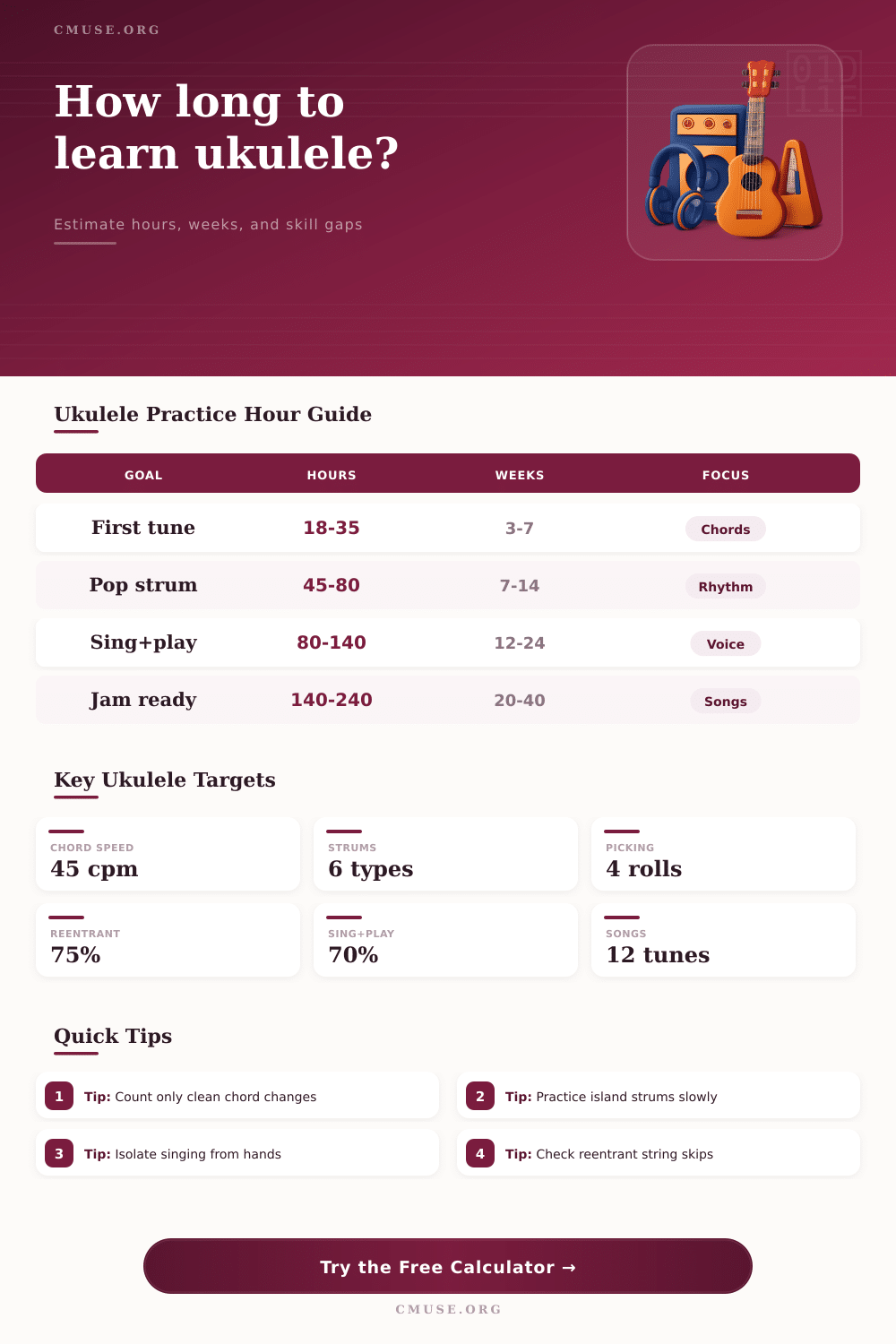
| First tune | 18 to 35 hours | C, F, G or G7, Am changes; down-up strum | One complete tune stays steady at slow tempo |
| Pop strummer | 45 to 80 hours | 45+ clean changes per minute; 4 to 6 patterns | Several pop-style songs keep time without stops |
| Island groove | 60 to 110 hours | Syncopation, chunk mute, relaxed wrist timing | Island-style groove feels even across verses |
| Sing and play | 80 to 140 hours | Chord memory plus lyric placement and breath timing | Voice stays independent while strumming continues |
| Jam ready | 140 to 240 hours | 12+ songs, steady rhythm, quick key changes | You can follow common charts and recover from slips |
| Uke Setup | Common Tuning | Learning Effect | Calculator Adjustment |
|---|---|---|---|
| Soprano high G | g-C-E-A | Compact fret spacing, bright reentrant picking jumps | Small added hand and string-skip load |
| Concert high G | g-C-E-A | Balanced spacing for most beginners | Neutral baseline for chord and rhythm work |
| Tenor high G | g-C-E-A | More room for fingerpicking and melody shapes | Slightly easier fretting, same reentrant awareness |
| Tenor low G | G-C-E-A | Linear bass line supports picking and chord melody | Less reentrant load, more repertoire translation time |
| Baritone | D-G-B-E | Guitar-like tuning with wider stretch | Different chord vocabulary and longer scale factor |
| Skill Area | Beginner Target | Confident Target | What It Means |
|---|---|---|---|
| Open chord changes | 25 to 35 clean cpm | 55 to 70 clean cpm | Hands find C, F, G7, Am, Dm without long pauses |
| Hard chord clarity | 40% to 55% | 75% to 90% | E, Bb, Bm, or barre shapes ring without muting |
| Strumming patterns | 3 to 4 patterns | 6 to 9 patterns | Down-up, island, swing, pop, and mute patterns repeat evenly |
| Fingerpicking rolls | 1 to 2 rolls | 4 to 6 rolls | Thumb and fingers repeat patterns without losing chord tone |
| Singing while playing | 35% to 50% | 70% to 85% | Lyrics stay aligned while the strumming hand continues |
| Repertoire Type | Typical Song Hours | Uke-Specific Load | Best Measurement |
|---|---|---|---|
| Very easy 2 to 3 chord tune | 3 to 5 hours | Chord memory and clean endings | Full song without stopping |
| Easy pop strum | 5 to 8 hours | Four-chord loops and dynamic strumming | Stable verse and chorus tempo |
| Island groove song | 7 to 11 hours | Syncopation, swing feel, and chunk mute | Groove stays relaxed for the full form |
| Fingerpicked ballad | 9 to 14 hours | Roll pattern plus chord transitions | Picking continues through chord changes |
| Sing-play arrangement | 12 to 18 hours | Voice independence and phrase entrances | Vocals stay steady over a full take |
There you are in the store with a cheap uke under one arm (which, by the way, cost half what you typically spend on lattes). And there’s the salesperson grinning: “Easy,” they say. “You’ll pick up on it.” So you arrive home. You fire up YouTube and absorb a couple of videos. Then you spends twenty minutes trying to make an F chord sound like anything other than a dull thud.
That’s when you pull out the hours-to-practice-calculator up top. That’s when you find out how long you has to wait… No longer led by blind hope but by real-world skill deficits.
Why You Need a Practice Calculator
Novice ukulele players’ most common error is to assume that staring at the fret board count as practicing. With the tool, you’re forced to distinguish actual practice time from setup time or just strumming around in mindless circles. Why? Muscle memory come through repetition, free of mistakes. Practicing a chord change incorrectly ten times doesn’t count as five minutes of practice. It means you’ve learned how to play it incorrecty. The calculator takes this fact into account and asks for your focused practice share percentage. This acts as reality check on how much of what you do is actualy productive work.
Ukulele progression are measured in terms of Chord changes. It doesn’t matter how good your rhythm is; if you stop dead on the G7 after playing a C, the song has come to a halt. Clean chord change per minute seems like a technical input but it’s really just measuring fluidity. If you’re hitting forty changes a minute most players believe they’re fast. In fact, forty clean changes sound rushed to an audience. Thirty-five steady changes per minute with appropriate strumming dynamics sounds professional. That is the subtle difference that the tool captures by allowing you to set your current speed against a target fluency rate.
But then there’s the question of style of tuning that most general advice overlooks. For standard concert and soprano ukulele players, the instrument are tuned in a way called reentrant. That means that the fourth string (the high ‘A’) is higher in pitch than the second (also an ‘A’). This gives it a distinctive jump up in pitch that muddies fingerpicking patterns. Moving instead to either a baritone or low G tenor eliminate this because all four strings goes up in pitch one after another, just like on a guitar. The calculator accounts for the extra mental effort needed to manage string skips on a reentrant uke. A reentrant uke isn’t only about hitting frets, it’s about mentally plotting a non-linear pitch environment.
You also use more of your brain when you play and sing at the same time, because your hands must function separately from another part of your brain. That’s when the difference between learning songs by yourself versus performing them realy starts to open up. This distinction matter because coordinating your breath with strumming rhythm is a distinct skill from fretting chords. Even though you may be able to finger all of the chords to Somewhere Over the Rainbow, if you can’t hit those high notes on cue and still maintain the beat, you’re not quite there yet. To account for having to re-wire your brains ability to handle two types of input (motor signal vs. Audio) the estimate add some significant time.
Then there’s the other variable that seems obvious, but can be underestimated: repertoire size. Getting to learn your first song requires effort. Getting to learn your tenth song should (in theory) be easier because you’re familiar with the chords. But learning your twelfth song may involve a tricky key change. It might also have a new barre chord that slows you down and sets you back slightly. The calculator accounts for this by considering both the number of songs you want to learn and how challenging they is on average. So it doesn’t let you underestimate how long it will take you to smooth out the transitions from one piece to the next. It won’t let you trick yourself into thinking each new song is as easy than the last.
In short, it is not a law but more of a guideline to follow for the timeline it creates. Sometimes your fingers would of felt as if they are moving in molasses on some days. On other days, that hard phrase clicks right into place. Having the structure from the tool means when you don’t feel like making any progress, you won’t give up on the instrument. It breaks down the vague dream of being able to play music into chunks of time that is manageable. Log the minutes, start with that pesky F chord, and then before you know it, you’re just playing.