Practice Hours to Learn Drums Calculator
Estimate how many focused practice hours you need to move from your current drum level to a real playing goal, including limb independence, groove vocabulary, rudiments, tempo control, fills, foot technique, and full-kit coordination.
Choose a real learning path, then adjust the weekly schedule, kit access, style goal, current skill gaps, and target level. Each preset loads a different drummer profile instead of generic practice time.
Drum Practice Breakdown
4 limbs
Independence target for layered kit control
40
Core rudiments for hands and fills
5 BPM
Good one-minute tempo drift target
20+
Grooves for basic gig vocabulary
60%
Minimum time block for groove and time
2 bars
Useful fill phrase length to practice
80-140
Common working tempo range in BPM
3 takes
Record, review, repeat practice loop
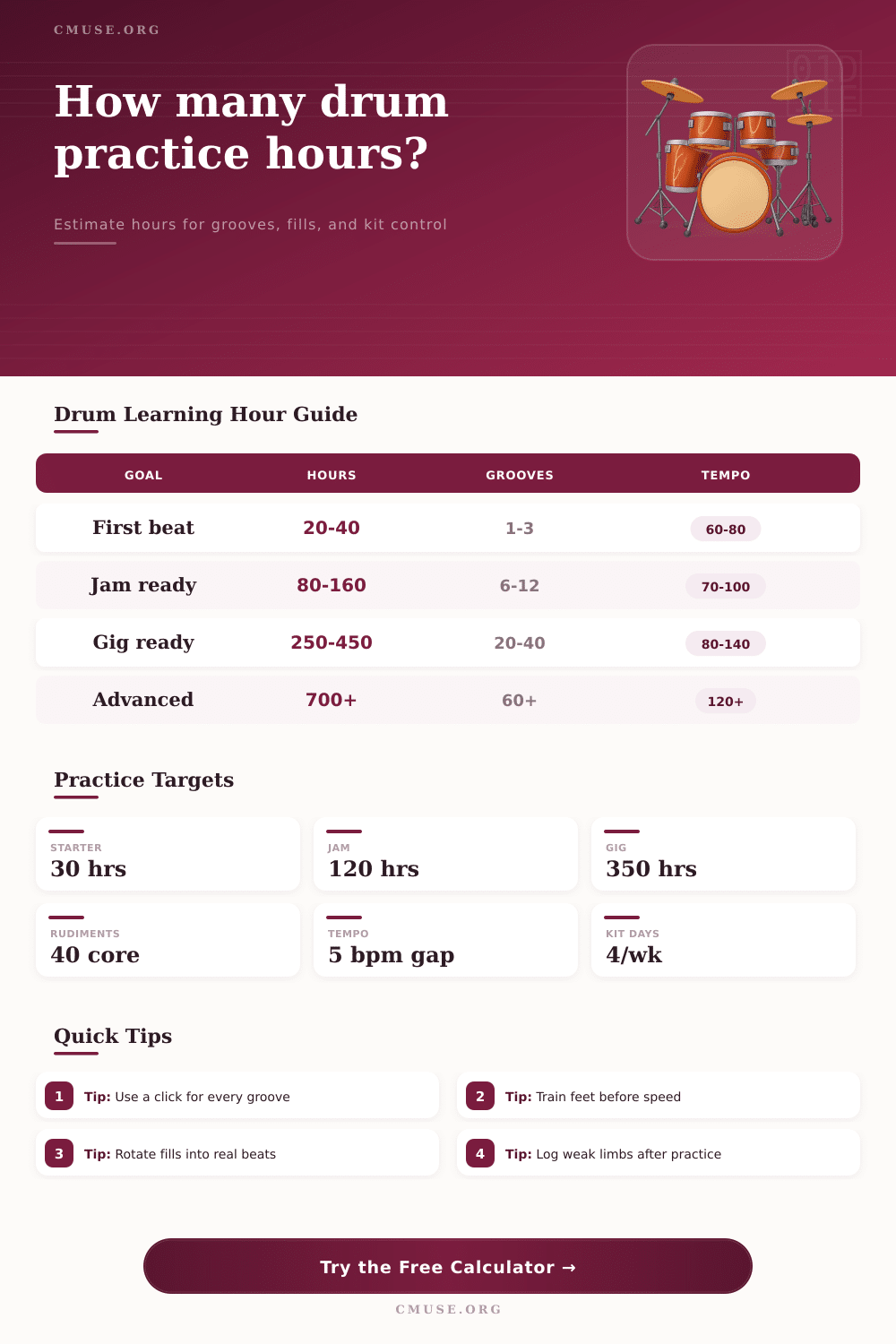
| Milestone | Typical Focused Hours | Drum Skills Expected | Common Bottleneck |
|---|---|---|---|
| First beat | 20 to 40 hours | Basic kick, snare, hi-hat pattern at slow tempos | Hands and feet moving together instead of independently |
| Song player | 80 to 160 hours | Several grooves, simple fills, steady endings, song form awareness | Returning from fills without rushing or dropping the pulse |
| Gig ready | 250 to 450 hours | Set-list stamina, dynamics, tempo consistency, quick groove changes | Maintaining pocket when volume, nerves, and fills change |
| Advanced | 700+ hours | Multi-style vocabulary, odd phrasing, refined touch, four-limb layers | Style authenticity and control at both soft and fast dynamics |
| Block | Beginner Share | Intermediate Share | What To Measure |
|---|---|---|---|
| Time and groove pocket | 35% | 30% | One-minute metronome drift and relaxed repetition count |
| Rudiments and hands | 20% | 18% | Clean strokes, even doubles, controlled accents, no tension |
| Limb independence | 20% | 22% | Separate hi-hat, kick, snare, and ride parts without collapse |
| Fills and transitions | 15% | 15% | Fill returns on beat one without speeding up |
| Song application | 10% | 15% | Full-form takes with dynamics and repeatable tempo |
| Skill Area | Starter Target | Gig-Ready Target | Practice Test |
|---|---|---|---|
| Limb independence | Kick and snare with steady hats | Ghost notes, offbeat hats, syncopated kick patterns | Loop four bars at three tempos without stopping |
| Rudiments | Singles, doubles, paradiddle, flam | Accented rudiments moved around snare, toms, and cymbals | Play quiet, medium, and loud strokes at the same tempo |
| Foot technique | Consistent quarter and eighth-note kick strokes | Doubles, syncopation, hi-hat foot time, or double-kick control | Record kick notes alone and check spacing against the click |
| Fills | One simple fill leading to a crash | Dynamic fills that match the song and return in time | Alternate three bars groove plus one bar fill for two minutes |
| Scenario | Recommended Sessions | Key Priority | Useful Checkpoint |
|---|---|---|---|
| Learning first full song | 4 to 5 days, 30 to 45 minutes | Groove stability and simple crash endings | Play the song twice without stopping |
| Preparing for band rehearsal | 5 to 6 days, 45 to 75 minutes | Set-list transitions, count-offs, and endings | Record a full run with no false starts |
| Building funk or Latin independence | 5 to 7 days, 45 to 90 minutes | Layered limbs, ghost notes, and subdivision control | Hold one pattern at slow, medium, and target tempo |
| Developing faster feet | 4 to 6 days, 25 to 50 minutes | Relaxed ankle motion and even kick spacing | Raise tempo only after three clean one-minute takes |
It’s the day you sit down in front of what appears to be an expensive drum kit, only for it to sound awful. Your feet is still trying to remember which pedal does what, and your hands are itching to lay into some fast fill. If you’re like most drummers who have picked up instrument, you know this all too well.
Inevitably the problem is we chase speed without focusing on the foundation. If you can’t maintain time with a simple groove, how will you ever run something more complex than that? How many times have you heard someone being measured by their ability to play fast and/or loud? Never by their consistency as the tempo slackens and the volume decreases.
How to Practice Drums Correctly
It runs the math for you in the calculator above. And it gives you a solid timeline based off your current limitations. Why? It works because you has to recognize where you struggle. Most players over-estimate their limb independence. They under-estimate how much foot technique work need to be done. The tool then asks for very specific inputs such as tempo drift and rudiment control. These matter a lot! That little drag or rush you experience when you get all fired up doing a fill, is called tempo drift. And if you are off by twelve beats per minute on the clock, you ain’t ready to jam with no other musician yet.
This is why it doesn’t merely count hours. It also counts quality. And it adjusts your estimated number of hours accordingly. It might feel like progress when you play along to a tune, but unless it’s in terms of muscle control, it will only reinforce poor habits. Casual practice time won’t get counted as highly by the calculator. An hour of free-form noodling is worth fewer minutes than an hour of playing rudiments to reach a specific goal. Harsh, yes. However, it is true. Correct muscle control develop neural pathways. Many movements that lack muscle control, such as hitting wrong notes, do not develop neural pathways.
So what does the calculator want to know about how you practiced? Did you hide your errors or did you review them? Kit access changes the equation too. Build up some great hand speed on a small practice pad at home. Do it quietly and efficiently. Hands are not drum. Pedals and sticks require different mechanics.
If all you’ve got is a pad, it will take longer to learn, because you need to use your whole body to coordinate with the kit, which you simply cannot do with pads. You need to feel how it feels when you push through a beater, or feel the snare wire rebounding against the bottom head. That tactile feedback help your brain create a complete map of the instrument. Your reflexes will translate somewhat without it, but your spatial awareness will remain fuzzy until you get on real thing.
For perspective, the page has a table of real-life expectations as milestones. Two-hundred to four-hundred concentrated hours are typical to reach gig readiness. This doesn’t sound so bad when you put it in terms of time per day. If you practice for 30-minutes per day, it’s about a year. If you practice for an hour per day, it’s about half that. The bottleneck is rarely talent; it’s consistency.
Drumming feels more like sputtering forward through a plateau with intermittent bursts of breakthrough. Weeks of feeling like you’re spinning your wheels on something easy, then all at once it just click. Early on, it’s hard to be independent with your hands and feet and your brain will want to connect them together in order to perform as a single unit. This means doing the awkward repetitive drills to break that connection. You should of known this was going to be hard.
This is what the calculator takes into account for your schedule depending on how coordinated you rate yourself. If you give yourself a lower score, it will take longer because you must repeat the process to link those separate pathways. Don’t rush this part and remember, speed isn’t a goal itself but rather an outcome of control. Slow practice makes fast playing possible. Fast practice simply makes sloppy play faster.
The numbers are only a framework, a visual representation of where you are today, and where you’d like to go. There’s no algorithm that teaches you to listen; you’ve got to hear the pocket for yourself. You’ve got to feel yourself pushing on the beat or being dragged behind it. The tool provides you with a map, yet you’re still walking the path. You gain muscle memory from the process. This memory translates noise into music.