Practice Hours to Learn Violin Calculator
Estimate focused violin practice hours by weighing bow control, intonation, shifting, vibrato, positions, scale tempo, orchestra reading, and solo repertoire readiness.
Violin Practice Breakdown
0%
Bow Control Gap
0%
Intonation Gap
0%
Position Gap
0/0/0
Bowing / Pitch / Repertoire Hours
| Learning Target | Typical Focused Hours | Primary Violin Skill | Usual Checkpoint |
|---|---|---|---|
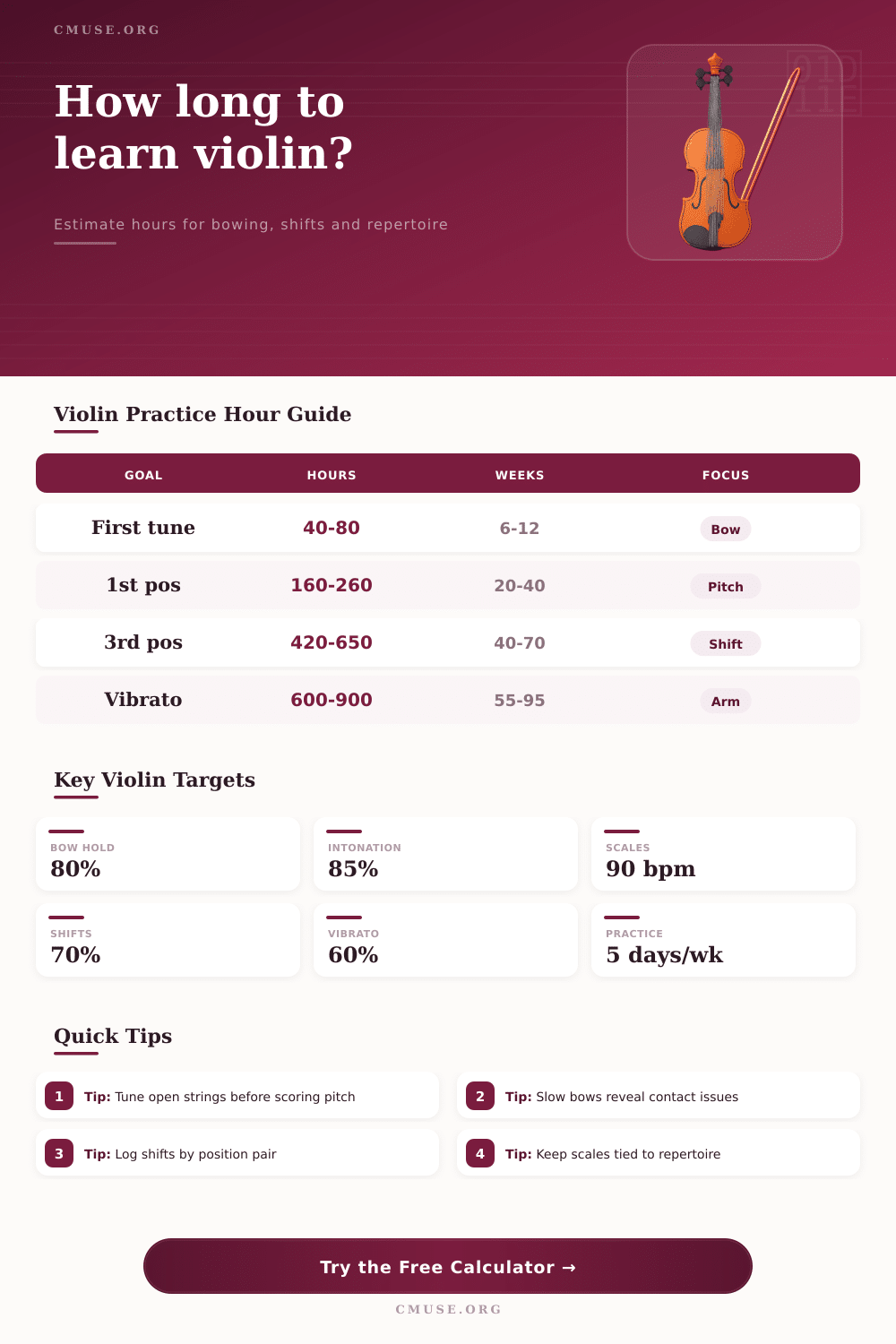
| First clean tune | 40 to 80 | Open strings, left-hand frame, simple bow starts | Recognizable melody at steady pulse |
| Secure first position | 160 to 260 | Finger spacing, string crossings, basic slurs | Several short pieces with stable intonation |
| School orchestra entry | 260 to 420 | Counting, bowing marks, tuning to A, ensemble rests | Can follow conductor and section bowings |
| Third position pieces | 420 to 650 | Guide fingers, arrival pitch, first-to-third shifts | Two-octave scales and simple position changes |
| Vibrato repertoire | 600 to 900 | Relaxed oscillation, tone color, expressive bow speed | Controlled vibrato on long notes without squeezing |
| Solo recital program | 1000 to 1600+ | Positions, phrasing, double stops, memory, stamina | Polished performance with musical pacing |
| Instrument | Scale Length | Early Challenge | Practice Implication |
|---|---|---|---|
| Violin | About 328 mm | No frets, small finger spacing, high bow sensitivity | Short, exact repetitions matter more than long unfocused sessions |
| Viola | About 375 mm | Wider spacing and heavier bow response | More time for left-hand frame and sound production |
| Cello | About 690 mm | Large shifts and seated coordination | Position mapping and shifting drills become central earlier |
| Double bass | About 1040 mm | Large spacing and physical endurance | Practice blocks need rest spacing and stamina planning |
| Position Work | Readiness Sign | Common Fault | Useful Hour Block |
|---|---|---|---|
| First position frame | Whole and half steps land by ear and touch | Collapsed wrist or drifting thumb | 15 to 25 minutes across a week |
| Half position | Low first fingers stay relaxed and in tune | Squeezing to reach low notes | 20 to 35 minutes across a week |
| Third position | First finger arrival matches open-string checks | Overshooting without guide finger | 30 to 50 minutes across a week |
| Fifth position | Hand shape stays compact near the violin body | Left elbow and thumb lag behind shift | 40 to 70 minutes across a week |
| Target Area | Beginner Marker | Intermediate Marker | What It Measures |
|---|---|---|---|
| Scales | 1 octave at 60 to 80 BPM | 2 or 3 octaves at 80 to 110 BPM | Left-hand frame, shifts, even bow division |
| Bow control | Detache and simple slurs | Martele, hooked bows, controlled dynamics | Contact point, bow speed, weight, straight path |
| Orchestra reading | Counts rests and repeats | Tracks divisi, cues, bowings, key changes | Ensemble reliability beyond solo practice |
| Solo repertoire | Short pieces in first position | Position shifts, vibrato, phrasing, memory | Integrated technique under performance pressure |
Pick up a violin for the very first time and you’ll instantly know that the instrument is one of most difficult to learn. Where’s the guidance? Your fingers must navigate they way along each note without help of any frets. Every note is something you work out with both your hand and your ear. Unlike the breath forcing air through reeds or hammers hitting piano keys, sound emerges from a bow that needs balancing delicately across strings. It’s almost as if you’re trying to build the instrument while playing it.
New players often think that practicing involve counting how many hours they have held their violin. So they noodle around for an hour, hit the occasional wrong note, get frustrated and call it a day. That isn’t practicing. That is just showing up. Practice on the violin come from hours of concentrated focus isolating certain technical issues.
How to Practice the Violin Better
This calculator weighs inputs based off bow control, intonation, shifts, and readiness with repertoire. This helps you tell difference between idle time and true skill acquisition. In other words, it makes you admit if you’re running through tunes you already know or are realy drilling into hard parts.
Typically the first bottleneck is bow control. Sure you’ve got your fingers in exactly right place, but what happens when you don’t even out your bow speed, or you begin to move it closer to bridge? Then tone gets thin and scratchy. This is what the tool considers. It asks you for a bow control score. If that is a lower number, you will battle with basic production issues whenever you try to learn something new. Your estimate for time-to-goal will also stretch out longer. You can’t build a house on foundation of noise.
And then there’s intonation. You must memorize spacing of each finger to within a millimeter without any frets. One note can be too wide or too narrow and destroy an entire phrase. Your intonation percentage is part of the equation. How close are you? You have to memorize finger spacing down to millimeter. That percentage is used by calculator to estimate how much time will be required for you to get dependable muscle memory.
Slow practice cannot be negotiated. It’s when you play slowly that you expose all the micro-mistakes that were hidden while playing fast. Rushing simply reinforces poor habits more quickely.
Then you enter intermediate territory, where next challenges are developing vibrato and learning to shift. To shift means using a new type of kinesthetic awareness, lifting your hand from string while keeping contact with the string. Vibrato, on the other hand, is more difficult still, asking for relaxation of tension in an arm that tends to stiffen. These jumps are what the tool’s presets will help you visualize. They’ll show you how many times longer it takes to develop your proficiency in third position than simply maintaining the steadiness of first position notes. And they’ll point out why so many player stall out around year two.
What does that mean in hours? The calculator comes with some helpful reference tables that shows you how many hours to expect to get there, and they do vary greatly. Forty to eighty focused hours may get you to a respectable first tune if it’s just you and the music. However, when talking about an orchestra desk for a community orchestra, that number goes up a lot. It adds another layer of complexity to your job. You have to keep your place, follow the conductor, pay attention to other sections, and hear bowings on top of everything else. It is a whole new mental load when you are just practicing by yourself in your bedroom.
At its heart, this is an expectation management tool. It teaches us that it’s more important to be consistent different than talented. If all I’ve got time for is half-an-hour a day, then don’t spend two hours furiously plodding through scales and arpeggios, that won’t help. What will help is making the most of the half-an-hour. Do you solve your problems during this time, or are you simply repeating them over and over again? The real action happens in the silence between notes, when you stop playing and think about what just happened.
The math will show you how long it takes to get where you want to be. Begin slowly: Create a doable week of practice and follow through. Use feedback loops from your teacher or recordings to check your progress against scores in the calculator. Don’t get bogged down by total number of hours. Make them daily habits. Follow the tips above for string tuning each day prior to practicing. Keep your bow map simple. Work only on one technical hurdle at a time. No matter how hard you try, violin doesn’t care; it only cares how accurately you move it. With sufficient hours spent focusing, that accuracy turns into instinct. You’ll stop thinking about where your fingers go and start thinking about making music.