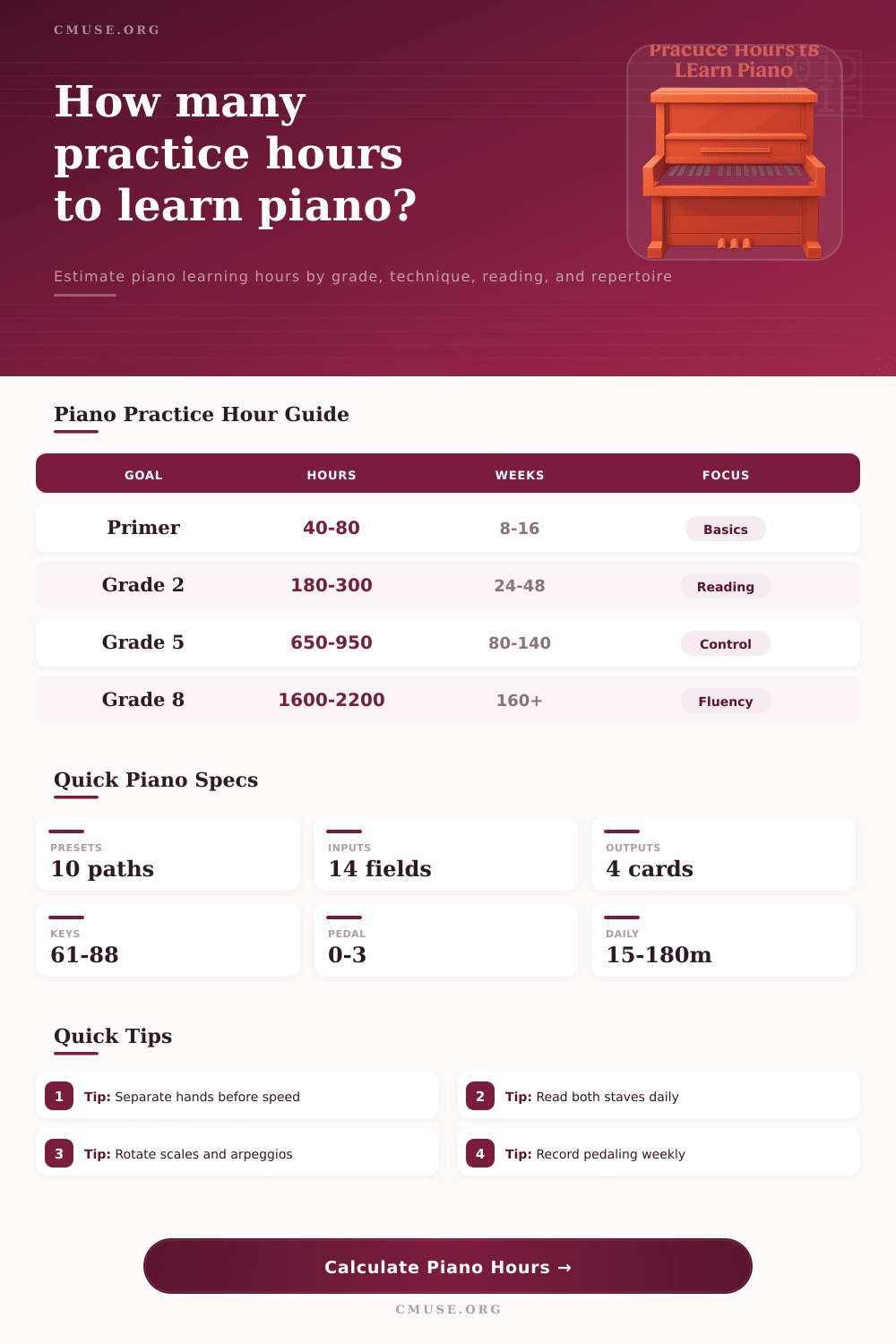
Practice Hours to Learn Piano Calculator
Estimate focused piano practice hours using repertoire grade, hands independence, grand-staff reading, scales, arpeggios, voicing, pedal control, sight-reading, and theory readiness.
Calculation Breakdown
Technique per day
Reading per day
Repertoire per day
Theory per day
Suggested Daily Bench Split
- Warm-up: slow five-finger patterns
- Reading: short grand-staff excerpts
- Repertoire: hands separate to hands together
- Review: record and mark fixes
| Level | Cumulative Hours | Typical Pieces | Core Piano Demand |
|---|---|---|---|
| Primer | 0-60 | Five-finger pieces, simple rhythm | Keyboard geography and finger numbers |
| Grade 1-2 | 60-240 | Easy hands together, basic dynamics | Grand-staff reading and steady pulse |
| Grade 3-4 | 240-560 | Sonatinas, inventions, lyrical pieces | Scales, phrasing, pedal starts, independence |
| Grade 5-6 | 560-1050 | Intermediate classical, pop accompaniments | Theory, voicing, arpeggios, cleaner pedaling |
| Grade 7-8 | 1050-1800+ | Advanced repertoire and auditions | Texture control, stylistic detail, endurance |
| Skill Area | Calculator Weight | What It Measures | Practice Signal |
|---|---|---|---|
| Hands independence | 18% | Separate rhythms, articulation, and motion | Hands separate, rhythm taps, slow joins |
| Grand-staff reading | 18% | Bass and treble fluency together | Two-line reading, interval drills, landmarks |
| Scales and arpeggios | 15% | Key fluency and common piano shapes | Rotating keys, hands together, metronome |
| Voicing and tone | 14% | Balance between melody, bass, and inner notes | Melody louder, ghost inner notes, chord balance |
| Pedal coordination | 10% | Clean harmony changes and resonance control | Delayed pedal, half-speed changes, listening tests |
| Sight-reading | 14% | Reading ahead while keeping pulse | Daily easy excerpts without stopping |
| Theory and harmony | 11% | Keys, chords, cadences, and form recognition | Analyze before playing, label patterns |
| Practice Instrument | Keys and Action | Pedal Reality | Hour Effect |
|---|---|---|---|
| Acoustic grand | 88 keys, responsive repetition | Damper, soft, sostenuto possible | Best transfer for advanced tone and pedal |
| Acoustic upright | 88 weighted keys, slower repetition | Usually damper and soft pedal | Solid all-level practice baseline |
| Digital weighted 88 | Weighted action with full range | Pedal varies by model and sensor | Good transfer, slight tone-control penalty |
| Semi-weighted 76 | Shorter range, lighter resistance | Usually switch-style pedal | Useful early, weak for voicing and touch |
| 61-key light keyboard | Limited range, synth action | Often no pedal or simple switch | Adds transfer time beyond beginner level |
| Goal Type | Daily Minutes | Weekly Pattern | Best Focus Mix |
|---|---|---|---|
| Primer adult learner | 20-30 | 5-6 short sessions | Reading, rhythm, relaxed hand shape |
| Grade 1-2 student | 30-45 | 5 days plus review | Hands together, scales, simple sight-reading |
| Grade 3-5 exam | 45-75 | 5-6 days with teacher feedback | Scales, repertoire sections, theory, aural awareness |
| Accompanist or pop player | 40-70 | 4-6 days with chord review | Voicing, left-hand patterns, lead sheets, pedal |
| Advanced classical prep | 90-180 | 6 days with recovery | Slow control, voicing layers, technique, memory |
| Preset | Starting Point | Target | Main Piano Constraint |
|---|---|---|---|
| Adult Primer | No prior piano | First easy pieces | Keyboard map and rhythm security |
| Returning Player | Old Grade 3 skills | Grade 5 confidence | Reading rebuild and technical refresh |
| Pop Chord Player | Chord shapes known | Accompaniment fluency | Voicing, inversions, and pedal clarity |
| Jazz Lead Sheet | Intermediate piano | Lead sheet basics | Theory, left-hand shells, swing feel |
| Advanced Chopin | Grade 6-7 base | Advanced romantic work | Voicing, rubato control, pedal layers |
The sheet music appears complicated and so with good intentions, you plop yourself down on the keyboard. An hour or two passes, and while it may feel like you have accomplished something since you’ve been sitting there at bench, weeks go by and you’re still on page three of your chosen piece. Why? Because you mistake hours for learning. The distance between real learning and casual playing is far greater then many people imagine.
Focus is key; it’s time to switch from measuring time to measuring focus. Plug in your starting point, goal, and which skills is giving you trouble. The calculator handles the heavy lifting once you plug in those details. It doesn’t just divide hours into weeks left. Oh no, it takes into account your music style, how often your teachers gives feedback, and what kind of instrument you’re learning on.
How to Practice Smart and Learn Faster
You could think that it makes no difference whether you’re playing an acoustic upright or learning on a cheap sixty-one-key keyboard. In terms of muscle memory (it doesn’t). That’s right, the weighted action and foot pedal response make an enormous diffrence as you develop technique for actual performances. Without the correct resistance from your instrument, your finger strength will never acquire the control needed. Therefore, reality discounts each and every hour spent there.
Players often believe their failure at the piano lies with poor note-reading ability or a lack of speed at memorization. Typicaly, this isn’t the case. What’s often limiting you are your fluency with grand-staff notation or hand independence. Losing all texture occurs when your left-hand imitates what the right-hand does. Practicing separate hands seems laborious and time-consuming initially, but it’s essential. Each hand needs to be drilled independently until movement becomes automatic before adding both hands together. Attempting to join both hands immediately only cements bad habits which can take months to unlearn.
Another huge variable is your ability to read music. Repeatedly referencing a finger number written above the stave trains you to be dependent, not a skilled sight-reader. Because of this, the tool will give your reading rating a lot of weight in the overall estimate. The way to improve that is to learn to look at landmarks and intervals, not count up from middle C each time. Simple as it may sound, this makes a fundamental difference to how your brain reads sheet music. Instead of just seeing individual notes, you begin to see the pattern. That reduces mental effort, so you can concentrate on expression and tone rather than geographical basics.
Often what happens is there is no time to consider theory over simply just playing. This means that I might be able to play a chord but not necessarily know name of the chord. If you have an idea about harmony then you will know when the music comes to a cadence or other expected harmonic progression. Your hands will subconsciously position themselves ready for the resolving chord. It saves many hours of trying things out in practice sessions. Once we move past the beginner level of repertoire, theory becomes a major reason why learning curves increases dramatically. This is factored into the calculator.
Your time-frame is also influenced by repertoire style. If you are learning to play chords in a pop song it will use a different set of mental pathways than learning a piece from the Romantic era that requires dynamic voicing and uses pedaling techniques. One focuses on rhythm, understanding of harmony the other calls for expressively nuanced playing with fine motor control. Neither is necessarily more difficult for everyone but does call for different kinds of focused practice time. Schedule your time to match, instead of treating all music as the same kind of material.
Intensity doesn’t always trump consistency. Fifteen minutes a day are more effective for retention then three hours all at once during a single weekend. Repetition helps form connections in your brain. Muscle memory depends on repeating the action periodically over time. Your chosen practice schedule will determine speed of these connections. Regularly practicing with short sessions keeps neural pathways firing while avoiding mental burnout or physical tension.
It’s also a good idea to record yourself at some point. When you listen, you’ll hear things you didn’t notice when playing. You might notice things like uneven volume or rhythm shifts that felt normal at the time. Recording yourself can reveal those errors and correct them sooner rather than later before they become habits. It makes for more active problem solving as opposed to passive playing.
Playing the piano is a marathon, not a sprint. It requires pacing yourself and it will be frustrating if you rush it or strain yourself physicaly. When you plan out your hours wisely you begin to see real progress instead of simply adding more minutes on the bench. You no longer guess about being prepared to play the next piece but know precisely where there is room for improvement. Measuring what you do in terms of quality over quantity makes the road ahead far easier to see. That is where your approach to the instrument really changes.