Practice Session Time Split Calculator
Divide one practice block into warmup, technique, repertoire, ear training, review, breaks, and cool-down with a realistic focus score and a minute-by-minute plan.
Choose a named session, then adjust duration, instrument family, level, goal, stamina, break cadence, and category weights to create a focused single-session split.
Detailed Session Breakdown
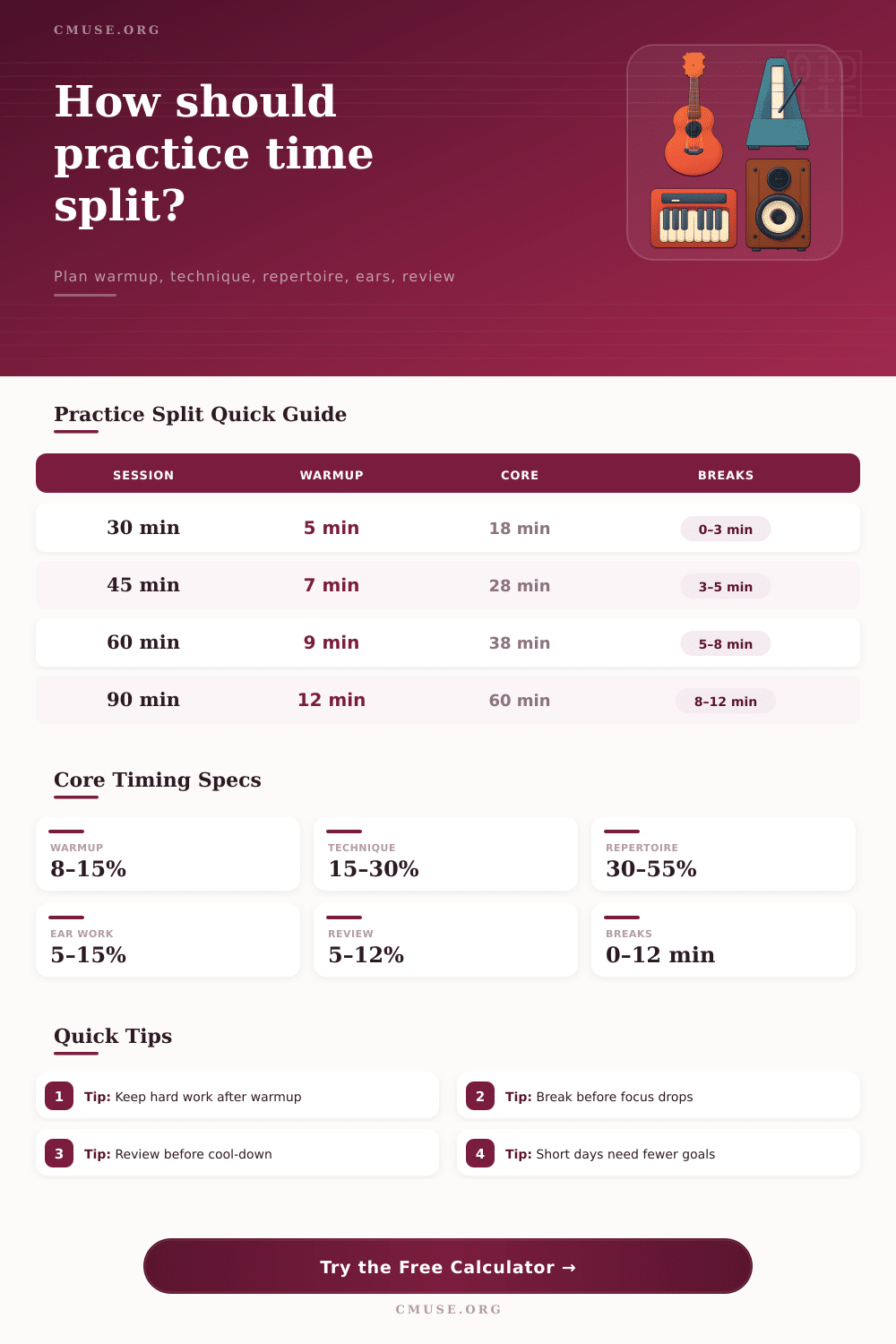
| Session Length | Best Use | Suggested Breaks | Core Work Target |
|---|---|---|---|
| 20-30 minutes | Beginner focus, maintenance, one problem spot | Usually none, or 2-3 minutes | 15-22 focused minutes |
| 40-50 minutes | Daily practice with one clear repertoire goal | One short reset if intensity is high | 28-36 focused minutes |
| 60-75 minutes | Balanced technique, repertoire, ear, review session | One 4-6 minute break | 42-58 focused minutes |
| 90-120 minutes | Audition, recital, ensemble, or deep learning block | Two planned breaks | 65-92 focused minutes |
| Category | Typical Range | Raise It When | Trim It When |
|---|---|---|---|
| Warmup | 8-15% | Voice, winds, cold hands, intense repertoire | Session is under 25 minutes |
| Technique | 15-30% | Scales, tone, rudiments, range, precision lag | Performance is soon and pieces need runs |
| Repertoire | 30-55% | Memory, phrasing, tempo, interpretation need attention | Bad habits appear without technical repair |
| Ear training | 5-15% | Improvising, tuning, transcription, sight singing | Today is purely physical maintenance |
| Review | 5-12% | Material must stick until the next session | The session already repeats old material |
| Cool-down | 3-8% | High load, voice, winds, drums, long practice day | The session ends with quiet review already |
| Instrument Or Audio Work | Warmup Load | Best Core Split | Break Cue |
|---|---|---|---|
| Piano / keyboard | Moderate hands and alignment | Technique 25%, repertoire 45%, review 10% | Tension in forearm or repeated slips |
| Voice | High breath and range preparation | Warmup 18%, repertoire 35%, cool-down 8% | Loss of easy tone or throat effort |
| Drums / percussion | High hands, wrists, and coordination | Technique 30%, repertoire 35%, endurance 10% | Grip tightness or tempo instability |
| Strings | Moderate posture, bow, intonation | Technique 25%, repertoire 45%, ear 10% | Shoulder tension or tuning drift |
| Woodwind / brass | High embouchure and breath load | Warmup 15%, repertoire 40%, review 10% | Air support fades or articulation blurs |
| Production / mixing | Low physical, high ear fatigue | Ear 15%, repertoire 35%, review 15% | Volume creep or decision fatigue |
| Plan Name | Total Time | Main Emphasis | Typical Split |
|---|---|---|---|
| Maintenance Day | 25-35 minutes | Keep touch, tone, and memory active | Warmup, repertoire, review, cool-down |
| Skill Repair Day | 45-70 minutes | Technique correction before repertoire | Warmup, technique, repertoire, review |
| Performance Prep | 75-120 minutes | Run sections, isolate misses, confirm pacing | Warmup, repertoire, review, cool-down |
| Musicianship Day | 35-60 minutes | Ear, rhythm, reading, and recall | Warmup, ear training, technique, review |
After a hard day’s work, you sit at the piano with every intention of practicing for an hour but then find yourself looking at piece of paper for twenty minutes, fingers tapping nervously without achieving anything. The remainder of the session becomes a blur as you repeat same errors again and again. You get increasingly frustrated.
Then it finally hits you that most people just don’t think about how they practice. They treat it like one big blob of time that they hope will magically help improve there playing. If you haven’t thought through what you want or need from the practice session, you will default to doing what comes easiest. This won’t necessarily be what you need to develop your skill at this moment.
How to Practice Better with a Plan
When you enter your main objectives and time limit, the calculator (above) do the calculations for you, transforming vague good intentions into a specific minutes-by-minutes plan. And it makes you realize that you can’t interchange a cool down with a warm up. You also cannot swap tech drills with repertoire polishing, or review with ear training.
Each requires a unique level of physical preparation and mental concentration. If you mix them together, you’ll end up stuck in a pattern of frantic activity without any results. It is the sort of stalling-out that’s most frustrating because you’re doing something, but it doesn’t seem like much.
First up: consider the warmup phase. It isn’t simply about loosening embouchures gently for wind instrumentalists or stretching muscle for string players, although both are important parts of warming up that help prevent injury. A good warmup conditions the nervous system to be precise. To do this, the tool adjusts how much of the warmup you do based off your instrument family and focus stamina rating.
So if you’ve got low stamina for some reason today, maybe you’re tired or stressed, then the system will automatically reduce continuous blocks of hard work and add more rest periods accordingly. Why? Because forcing yourself through mental fog rarely improves your coordination or memory. It does, however, tend to ingrain errors. This is also the part of your practice where you’d do your rudiments, scales, or tricky bits that need some physical adjustment. It’s technique work, but you’re doing it with a warm body and a fresh brain.
Next, you work on your repertoire. This usually takes up most of your practice time because you use your technical tools in real pieces. The chart on this page show how this balance changes during day-to-day practice versus when you are preparing for an audition. For a well-balanced practice session, you may split it between around thirty percent technique and nearly forty percent repertoire. However, that will vary for a drummer working on endurance through repeated movements or a voice student who need plenty of vocal warmups before singing.
Effective practice is a function of the quiet way breaks work: not lazy but essential in order to reset short term memory and consolidate what has been learned. Your calculator may divide your practice session into intervals. It does this because our attention spans drop as we concentrate hard for twenty to thirty minutes. As a result, taking a five-minute break means you come back refreshed and ready to tackle the material again instead of grinding through while fatigued.
You may be surprised at just how much total focused playing time are left once the breaks are subtracted from your overall window. You will recieve a balance score at the end. This score shows how well-distributed your proposed session is across various components. You get a higher score if your distribution matches the best teaching practices for your level and learning aims.
If the score is lower than maybe you’ve skipped over cool-down time after the activity that really helps consolidate what you’ve learnt? Maybe you’ve neglected to include some ear-training? But the point isn’t to get a grade: this is a diagnostic tool, more than anything else. It’s just so you don’t fall into the same hole we all sometimes do. We might spend an hour working on only one very narrow part of our musicianship without building up the underlying skills that support it.
In conclusion, freedom comes from structure. Knowing exactly where you will start playing, rather than just continuing to drill scales, allows you to perform with more energy in each section because you are confident the plan covers the rest. The tension of ‘have I practiced the fundamentals enough?’ dissapears since this is already built into the schedule. This leaves you free to follow the path clearly marked out between warm-up and cool-down.