Practice Hours to Mastery Calculator
Estimate the calendar time, effective hours, feedback cycles, and weekly practice load needed to reach a specific music mastery milestone.
Load a named learning path, then adjust current hours, deliberate practice quality, feedback cadence, review retention, and weekly availability to model a more realistic mastery timeline.
Detailed Mastery Breakdown
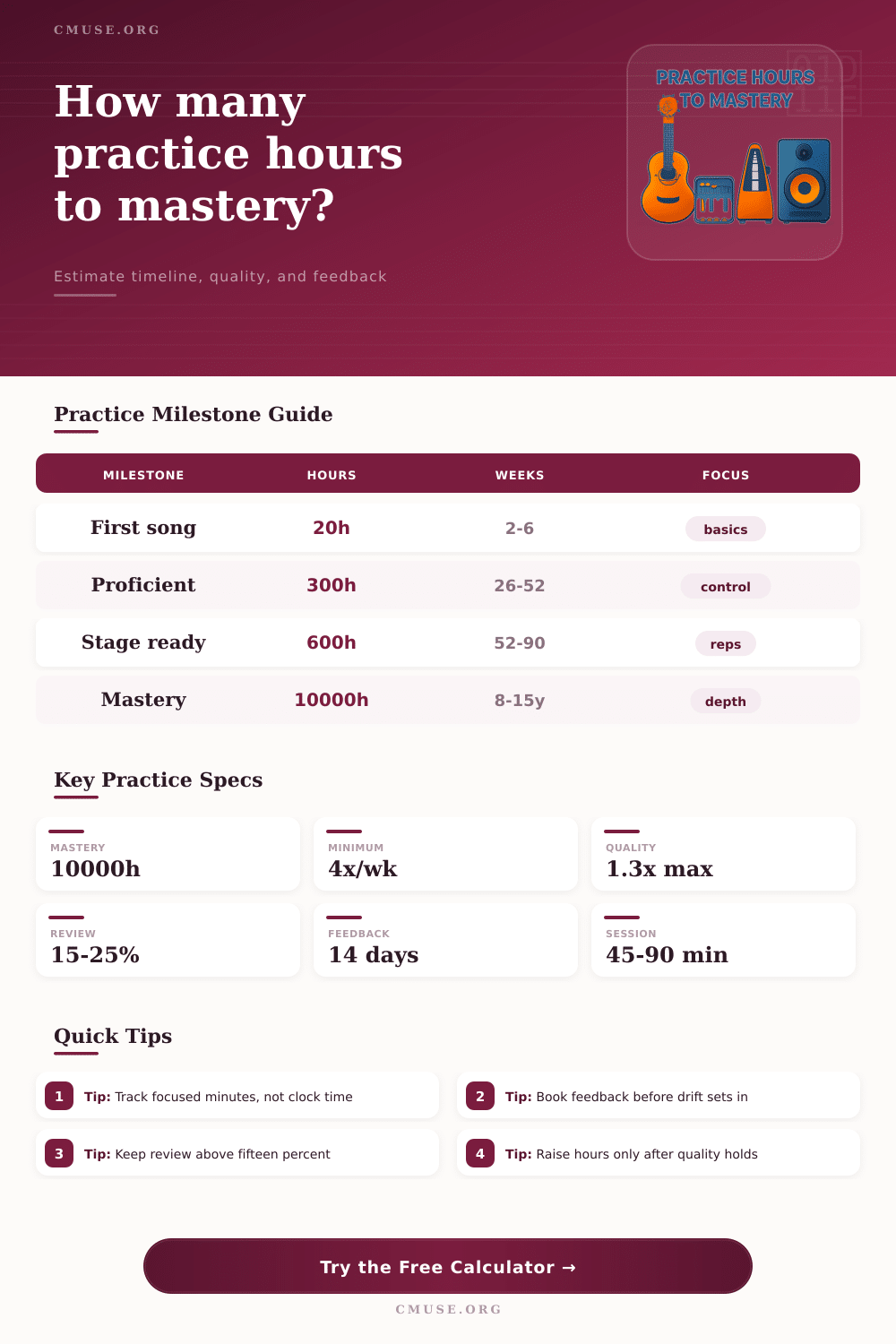
| Milestone | Deliberate Hours | Typical Evidence | Best Measurement |
|---|---|---|---|
| First complete song | 20 hours | One simple piece, mix, routine, or song finished without stopping. | Clean run-through recorded twice in a week. |
| Beginner fluency | 100 hours | Basic technique and simple repertoire feel repeatable. | Tempo control, fingering, pitch, timing, or mix recall. |
| Solid proficiency | 300 hours | Several pieces or workflows can survive mild pressure. | Teacher rubric, recorded takes, or peer critique notes. |
| Performance ready | 600 hours | A public set, exam piece, audition cut, or release mix is dependable. | Mock performance with error log and recovery score. |
| Advanced fluency | 1,200 hours | Nuance, speed, tone, arrangement, and decisions are intentional. | Repertoire rotation plus blind comparison reviews. |
| Deep mastery | 10,000 hours | Flexible expert command across styles, pressure, and teaching contexts. | Professional output, repeatable judgment, and external standards. |
| Quality Level | Multiplier | What It Means | Common Risk |
|---|---|---|---|
| Mostly repetition | 0.70x | Repeating material without isolating the real failure point. | Hours rise while errors become automatic. |
| Structured but uneven | 0.90x | Some drills and goals, but weak logging or inconsistent attention. | Progress feels busy but hard to verify. |
| Balanced deliberate | 1.00x | Warm-up, focused drills, repertoire, review, and one clear objective. | Plateaus if feedback is too rare. |
| Targeted with logging | 1.15x | Measured tempo, error notes, recordings, and next-session targets. | Can become too narrow without musical context. |
| Teacher-guided deep work | 1.30x | High-focus work with correction before mistakes settle. | Needs recovery time and honest self-rating. |
| Feedback Cadence | Multiplier | Useful For | Retention Note |
|---|---|---|---|
| Rare, over 8 weeks | 0.82x | Independent review after a long study block. | Expect more rework when hidden habits appear. |
| Monthly check-in | 0.92x | Stable intermediate work with low technical risk. | Pair with recordings to catch drift sooner. |
| Every two weeks | 1.00x | Most adult lessons, ensemble prep, and mix critique cycles. | Good balance of correction and independence. |
| Weekly lesson | 1.08x | Auditions, exams, new technique, and deadline-driven sets. | Errors have less time to harden. |
| Twice weekly coaching | 1.15x | High-stakes recitals, portfolios, or professional transitions. | Best when practice logs prevent overload. |
| Daily Minutes | Days / Week | Raw Hours / Week | Best Use |
|---|---|---|---|
| 30 minutes | 4 days | 2.0 hours | Maintenance, first song, or slow beginner progress. |
| 45 minutes | 5 days | 3.75 hours | Steady adult learning with review built in. |
| 60 minutes | 6 days | 6.0 hours | Exam prep, band readiness, or reliable repertoire growth. |
| 90 minutes | 6 days | 9.0 hours | Performance, audition, or focused production portfolio work. |
| 120 minutes | 6 days | 12.0 hours | Advanced fluency blocks with recovery and feedback. |
| Path | Difficulty Factor | Most Important Feedback | Checkpoint Output |
|---|---|---|---|
| Piano / keyboard | 1.00x | Reading, hand balance, voicing, pedal timing. | Recorded repertoire at target tempo. |
| Violin / fretless strings | 1.25x | Intonation, bow contact, shifting, posture. | Scale, etude, and piece against drone or tuner. |
| Classical or electric guitar | 0.95x | Left-hand economy, right-hand tone, rhythm accuracy. | Clean take with metronome and dynamic contrast. |
| Jazz sax / winds | 1.12x | Tone, time feel, articulation, changes, transposition. | Head, solo chorus, and backing-track recording. |
| Drum kit / percussion | 1.05x | Time, coordination, groove placement, dynamics. | Click track take plus band or play-along test. |
| Voice / audition singing | 0.98x | Breath, vowel tuning, register balance, text clarity. | Audition cut recorded on two different days. |
| DJ mixing and phrasing | 0.88x | Beatmatch stability, phrase timing, gain staging. | Thirty-minute set with transition notes. |
| Audio mixing and production | 1.10x | Translation, balances, EQ decisions, references. | Mix revision compared on monitors, headphones, and small speaker. |
It sounds like a clean equation where time equals talent, but reality is rarely that tidy. If only life worked this way. Unfortunately, it rarely does.
Here’s the issue: Time isn’t the problem. Not all hour are created equal. Sure, you could play the same scale for an hour every day for 10 years…but if you’re not practicing correctly, you’ll never get better. In fact, chances are you’ve just repeated the same errors over and over again until you memorized them in your fingers.
Why Good Practice Matters More Than Long Hours
Enter a few details about what instrument you want to learn, how well you currenty play, and how you like to practice. The calculator will do the rest, saving you from wondering if you has enough time on your hands.
Volume is always considered a virtue in most musicians’ eyes. They sits down for two hours and play through their repertoire twice to get job done. Well, it is all but two hours of mental warmup, unless you are identifying single measure where you trip up. Deliberate practice means uncomfortable focus. Slow down, half-speed. Record yourself so you can catch rhythmic drifts. Actively diagnose what makes a phrase feel stiff. The system makes the time spent more valuable. Unless you’re changing your approach, the system will reduce this number significantly if you’re simply repeating material.
Too many people assumes that showing up is enough. What actualy makes a difference is showing up with intention. The number of hours isn’t as important than the feedback loops. For example, you might spend months practicing perfectly only to discover that you’re fundamentally off in terms of intonation or timing. And that can happen because of gaps in your feedback loop.
With this calculator, you also account for frequency at which you recieve feedback from outside sources. Perhaps you have a weekly lesson, or maybe once a month someone checks in with you. Or perhaps you record yourself and listen critically afterward. If there are long stretches without any feedback, you tend to develop bad habits. What starts out as a small mistake eventualy becomes normalized. You begin to forget about the tension in your shoulder. You overlook the way you rush a phrase. Shortening the loop makes you honest. It forces you to catch mistakes before they solidifies into your playing style.
Another silent killer of progress is retention. Many musician jump into new material and allow their previous work to fall away. For this reason, there’s an input in the calculator for how much time you’d like to dedicate to reviewing older material (15-25% per practice session). If you don’t maintain your foundation, it will start to crack. This can feel inefficient initially. You’ll want to push forward with each session learning something new. This approach leads to a shaky structure where the foundations aren’t reinforced properly and your advanced techniques collapses under weight.
Review isn’t busywork. It makes your structure strong. Intensity is not as good than consistency. If you’ve got 30 focused minutes per day six times a week, that’ll usually beat getting in a few brutal two-hour sessions once a week. Sleep consolidates the motor skills in your brain. Spacing out your reps helps lock those pathways in place. Cramming might make you feel like you’re making great progress while doing it, but most of it would of evaporated by Tuesday.
By breaking up what you can do in each week into manageable chunks, the calculator models your real-world availability and tells you how long it’s going to really take to reach your milestone. No one knows how many minutes it takes to master something, but we know when we’re on track or off track. If you’ve been practicing regularly and can’t seem to get past a certain point for six months, look at your practice ratio and how often you get feedback before putting in more hours. Frequently, it’s less about more time and more about correcting particular problems and not spending so much time doing it wrong.
The ten-thousand-hour rule shouldn’t feel like jail time. It should remind us that mastery doesn’t happen all at once; it builds upon itself in layers. And each layer need our attention, our correction, our patience. More time isn’t what you lack. Better minutes are what you need.