Curfew Overrun Risk Calculator
Estimate whether a live event will clear venue curfew by combining set lengths, changeovers, encore plans, current delays, enforcement grace, fine rules, and schedule volatility.
Load a realistic show format, then adjust the curfew, grace window, fine schedule, delay state, and content that can be cut. Each preset reflects a different curfew pressure pattern rather than a generic timing template.
Detailed Timing Breakdown
| Curfew type | Typical grace | Common trigger | Risk interpretation |
|---|---|---|---|
| Hard stop | 0 to 5 min | Neighborhood ordinance, license limit, transit deadline, PA cutoff | Treat every minute after curfew as unacceptable and cut content early. |
| Strict billing | 5 to 10 min | Union crew, rental agreement, venue settlement, security overtime | Risk is mostly financial, but the show may still be allowed to finish. |
| Soft house call | 10 to 15 min | House manager approval, crowd flow, production manager discretion | Small overruns can pass, but repeated delays create settlement pressure. |
| Festival slot | 0 to 3 min | Next act line check, broadcast window, stage rotation, site noise limit | Late finish damages the next act and should be solved by cutting the set. |
| Rental hall | 10 to 30 min | Room booking block, porter shift, loading dock close, front-of-house staff | Overrun may be billed in larger blocks even if the show runs only minutes late. |
| Source or setup | Line check need | Curfew risk | Schedule note |
|---|---|---|---|
| DJ controller and playback rig | 5 to 10 min | Low if patched early | Risk rises when last-call announcements or MC time is not counted. |
| Full drum kit with backline swap | 15 to 25 min | High for festivals | Shared shells reduce risk; cymbal and pedal changes still add minutes. |
| Guitar and bass amp change | 10 to 20 min | Medium | Pedalboard faults and DI swaps are common hidden delay sources. |
| Wireless vocal package | 8 to 15 min | Medium to high | RF coordination, batteries, and guest mics can push start times late. |
| Orchestra shell and chair reset | 20 to 40 min | High in rental halls | Stage labor and room turnover often matter more than audio patch time. |
| Video, tracks, and timecode show | 12 to 30 min | High if untested | Clocked playback protects pacing once the show starts, but setup can slip. |
| Delay source | Typical range | Probability effect | Best cut lever |
|---|---|---|---|
| Doors or entry hold | 5 to 25 min | High because every later segment shifts | Trim opener, MC remarks, or first changeover padding. |
| Backline reset | 10 to 35 min | Medium to high with multiple bands | Lock shared drum hardware and keep vocal channels patched. |
| Artist late to stage | 3 to 20 min | Medium but hard to recover | Cut encore or nonessential talk, not core set flow. |
| Weather or safety pause | 10 to 60 min | Very high for outdoor curfews | Switch to abbreviated set list and fixed stop time. |
| RF, video, or playback fault | 5 to 30 min | Medium with technical shows | Use backup vocal path or remove timecode-dependent cues. |
| Show format | Scheduled span | Normal buffer | Risk note |
|---|---|---|---|
| One opener club show | 150 to 210 min | 8 to 12 min | Encore and merch announcements are the easiest trim points. |
| Seated theater concert | 120 to 180 min | 10 to 20 min | Intermission, curtain speech, and union calls need explicit minutes. |
| Festival changeover slot | 45 to 90 min | 3 to 8 min | Any late start should usually shorten the set, not move the curfew. |
| Arena support package | 75 to 130 min | 10 to 15 min | Production changeover must protect the headliner clock. |
| Rental hall orchestra | 110 to 160 min | 15 to 30 min | Billing may jump by block even when overrun is short. |
Lights dimmed. First chord strikes. And then, oh, crap! The opening act was such a hit, they stretched out by 20 minutes. Now the headliner’s set slide forward by the same amount of time. There you are in the wings alongside an anguished-looking production manager. Welcome to the intersection of theory and practice.
Unlike the spreadsheet version, live event scheduling mean balancing real people against strict municipal deadlines. Once you know the delays and add up total length, use this handy tool (above) to do all the math for you. Next time the house manager’s breathing down your neck, you can avoids guessing whether a ten minute buffer is sufficient.
How to Plan Your Show Time Well
Until you get hit with an overtime bill, most will view curfew as a mere suggestion. That is where the trouble begins. How you approach your encore depend on whether it’s a hard stop or some flexible grace period. In union contracts and noise ordinances there isn’t always wiggle room, but producers tend to think there is.
Then there’s the time of transition. By rehearse numbers, you may believe it will take 15 minutes to switch out backline, but in the real world, there’s some friction. A wireless mic goes out of range. A guitar pedal shorts out. Or maybe the drummer want to get the snare tuned three times. Little things pile up and happen quicker then you expect.
To model unknown delays, the calculator include a volatility slider. This forces you to admit that a solid plan on paper doesn’t account for how fragile schedules are. Any event producer who has run a festival stage that turns over every hour know this all too well. It’s an uncomfortable thing to do, but it is a necessary one.
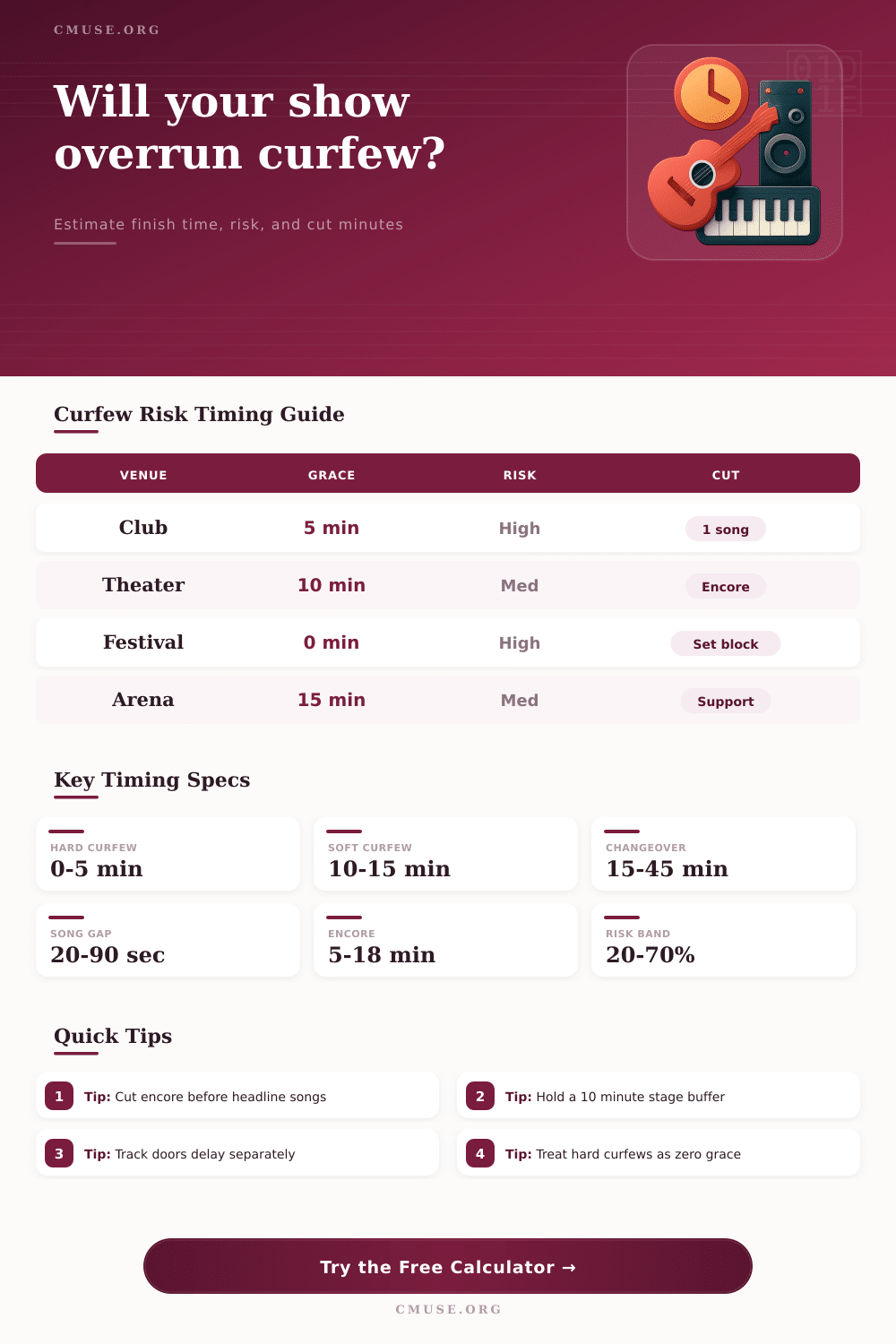
The biggest pitfall in venue scheduling is the timing of the encore. Fans anticipate something special after sitting through what seems like forever; artists wish to exit on a positive note. Unfortunately, being three minutes over your expected end time turns that encore into more of a negative then a plus. It’s clearly shown by the timing table on the page.
If you’re playing a club show, maybe the house will grant you five minutes of leeway before they shut off the juice. At a rented hall, that same tardiness can cost you a half-hour billing block (the loading dock shuts down on the dot). There’s no one-size-fits-all rule about time.
It’s also easy to underestimate the financial exposure. Sure, a flat penalty sounds reasonable, until you learn it will be based off minutes over the grace period. Technical problems that keep you running late can easily cost more than full night’s fee for an opening act. The profit margin for the evening could of been wiped out by a couple hundred bucks in penalties. Production budgets are tight enough that even a few hundred dollars in penalties can erase your profit margin.
Hard curfew? Use no grace at all. Hope is not a valid scheduling tool. But that’s not all you’re considering either: What can get cut? Easy: talk breaks. Shorten up video intros. No big deal. Cutting songs from the core set list creates tension between the production team and the artist because it feels like a choice between artistry and logistics.
Here’s where advance planning comes in. Make those decisions ahead of time. Don’t wait till it’s time to make the final encore call and then go “oh crap, we’re running over!” That’s an emotional decision, not a strategic one. Anticipate a buffer so you can stays within your contractual and legal limits but still deliver the best possible music experience.
Good live music is between rules that are too strict and performances that are too loose. A calculator is not meant to replace your good intuition. It provides data for you to use in conjunction with your intuition. It doesn’t take the place of reading the room or assessing the performer’s energy level. However, it will provide you with a good idea of the percentage of risk involved when making difficult decisions. Knowing precisely how many minutes you have left when the clock is ticking eliminates some potentially expensive missteps.
All things considered, a good show comes off on-time, sounds awesome and everyone gets paid as agreed upon. This is a delicate dance, balancing the minute hand and the music itself.