Drum Solo Length Calculator
Plan a drum feature that fits the song, set, tempo, phrase structure, cue space, and stamina reserve without guessing how many bars the solo will actually occupy.
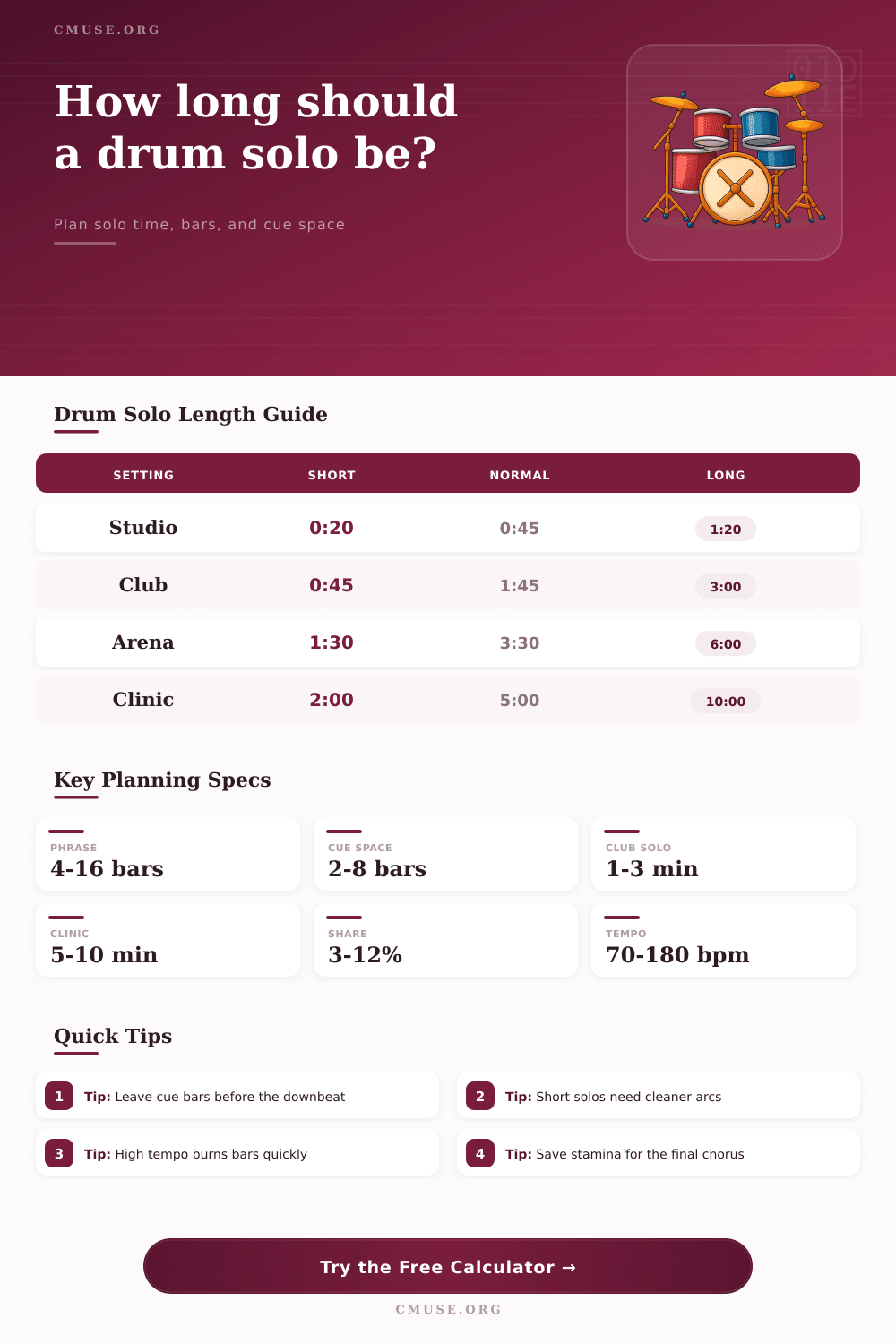
Load a common performance situation, then adjust the tempo, phrase size, cue bars, audience hold, and set share. The calculator turns minutes into playable bars and keeps the solo inside practical length limits for the setting.
Calculation Breakdown
| Setting | Practical short solo | Typical feature | Upper range | Best use |
|---|---|---|---|---|
| Studio take | 10 to 30 seconds | 30 to 75 seconds | About 1:30 | Recorded fills, transitions, or compact song features. |
| Club stage | 30 to 60 seconds | 1:15 to 2:30 | About 3:30 | Groove-forward solos that keep dancers or listeners connected. |
| Festival | 45 to 90 seconds | 2:00 to 4:00 | About 5:30 | Clear peaks, visual cues, and a reliable return to the band. |
| Arena | 1:30 to 2:30 | 3:00 to 6:00 | About 8:00 | Dedicated drum features with lighting, crowd calls, or percussion layers. |
| Clinic | 2:00 to 4:00 | 5:00 to 8:00 | About 12:00 | Demonstration arcs where explanation, motifs, and dynamics matter. |
| Theater cue | 5 to 15 seconds | 15 to 40 seconds | About 1:00 | Button endings, scene changes, and choreographed transitions. |
| Tempo and meter | Bars per minute | 32 bars lasts | 64 bars lasts | Planning note |
|---|---|---|---|---|
| 90 BPM in 4/4 | 22.5 bars | 1:25 | 2:51 | Great for spacious, dynamic storytelling. |
| 120 BPM in 4/4 | 30 bars | 1:04 | 2:08 | Balanced for rock, pop, funk, and fusion features. |
| 160 BPM in 4/4 | 40 bars | 0:48 | 1:36 | Fast tempos need more bars to feel developed. |
| 132 BPM in 3/4 | 44 bars | 0:44 | 1:27 | Waltz and compound feels move through phrases quickly. |
| 110 BPM in 7/8 | 15.7 bars | 2:02 | 4:04 | Odd-meter bars are longer when counted by full cycles. |
| 180 BPM in 2/4 | 90 bars | 0:21 | 0:43 | Marching or cut-time breaks often need many bars. |
| Intensity level | Length adjustment | Stamina load | Phrase advice | Best control point |
|---|---|---|---|---|
| Low groove-first | Can extend 8% | Light | Use 8 or 16-bar arcs. | Dynamic contrast and pocket. |
| Medium mixed ideas | Neutral | Moderate | Use 4 or 8-bar motifs. | Clear setup before the peak. |
| High dense fills | Trim about 12% | Heavy | Use shorter statement blocks. | Leave space after fast passages. |
| Extreme showpiece | Trim about 22% | Very heavy | Alternate chops and breath points. | Save full power for the ending. |
| Preset | Slot | Tempo | Target shape | Useful handoff |
|---|---|---|---|---|
| Jazz Club Trading Feature | 45 min | 148 BPM | Trading eights into a short chorus. | Four bars of comping before the head returns. |
| Funk Breakdown Spotlight | 60 min | 106 BPM | Groove variations with a clean band drop. | Two-bar snare pickup into the vamp. |
| Rock Arena Drum Break | 95 min | 128 BPM | Long-form feature with crowd call sections. | Eight-bar lighting cue before guitars return. |
| Worship Transition Fill | 25 min | 72 BPM | Compact dynamic lift between song sections. | Click-safe four-bar swell into the next downbeat. |
| Studio Session Solo Take | 4 min | 118 BPM | Short composed break that edits cleanly. | One-bar fill into the final chorus. |
| Clinic Demonstration | 50 min | 120 BPM | Motif, orchestration, subdivision, and recap. | Clear cadence before speaking or resetting. |
More is not always more when planning a drum feature. Raw talent isn’t enough. Architecture play its part too. Before picking up those sticks you should of be aware of the exact amount of space you have available. This page’s tool allows you to plot out that space and then fill it to purpose.
Most players plan their thoughts in minutes. This is a mistake. A minute are just an idea until it is tied to meter and tempo. A fast rock track at one hundred sixty beats per minute flies by much quicker different than a slow jazz ballad at eighty beats per minute. A generous-looking two minutes at the lower tempo may only provide eight bars of development time, leaving little room for band to return.
How to Plan a Great Drum Solo
It’s also why we ask for your average tempo and beat structure in that order on the calculator. The calculator then turns your vague time estimates into real musical units. If you’re unsure about whether there’s space for a chorus, you no longer guess. Instead, you see precisely how many phrase will comfortably fit.
But context matters here. At a drum clinic, that three-minute solo could well be the centerpoint of the show, everyone in the audience is there to witness the technique unravel for several minutes. In the middle of a club set, however, that same three minutes would drag. The energy would fade and the attention span of the audience would shrink to nothing.
Like the acoustics of the room, the venue itself dictate the attention span of its patrons. Are you playing a gig in a small bar? People want to talk and dance so make sure your solo is efficient and punchy. An arena, on the other hand, gives you more room to build dynamics, but demands stronger visual cues to prevent energy from lagging.
These reference tables clearly lay out those practical windows without having to depend solely on gut feeling. Another input that is frequently neglected is cue space. In other words, the area between end of one solo and the band’s return to action. If there are no designated bar for the handoff, then your solo turns into a cliffhanger ending. You’ll find yourself wondering when it’s appropriate to reenter, causing the band to rush in or linger awkwardly.
Carving out four to eight bars for this passage isn’t wasting time. It provides structural integrity. It provides you with a definite finishing point. It also provides the other musician with a solid roadmap to follow. You don’t want the audience to think the return of the groove interrupts them; you want it to reward them.
Also keep in mind: Intensity counts. Rapid fills and extreme density will burn stamina faster than they fill time. You can’t play like a crazy person for very long without breathing or losing accuracy. Stretching the length of a solo by going slow, grooving around instead, will not only hold attention but give you something to work with. That’s built-in math right there.
If you pick high-intensity, the suggested length drop a little bit so you don’t kill yourself. Rather than run out of gas midway through the feature, it’s better to go out on a high note and have two bars left. The last part of the equation is phrasing. Music rarely resolves cleanly in random numbers. Naturaly rounding occurs in groups of four, eight, and sixteen bars.
These are the grids we think in; they make your solo sound rounded, professional sounding and composed rather than scatter-gun. If the calculation says fifty bars then you will either round up to sixty four or down to forty eight. It maintains the logic of the music.
This isn’t about playing a certain amount on drums but about building a song in a song. The best solos leave the band improved by the end of them. They create excitement without stealing all of the momentum. If you plan ahead for what will happen, how long it will last, where to cue in and out, and how intense it will be, you won’t worry about the timing.
Now you can concentrate on the expression rather than looking at your watch. The post solo silence feels like it was earned not just endured.