Choir Voicing Spread Calculator
Measure SATB spacing from the lowest bass to the highest soprano, check adjacent voice gaps, and estimate whether the voicing will read as close, balanced, open, or risky.
Choose a starting point that resembles the choral texture, then adjust the four sounding pitches, ensemble size, divisi, room response, and dynamic level for your score.
Full Voicing Breakdown
Total Pitch Span
Counts the semitone distance from the lowest bass pitch to the highest soprano pitch, then converts it into octaves plus remaining semitones.
Total spread = soprano MIDI - bass MIDI
Adjacent Voice Gaps
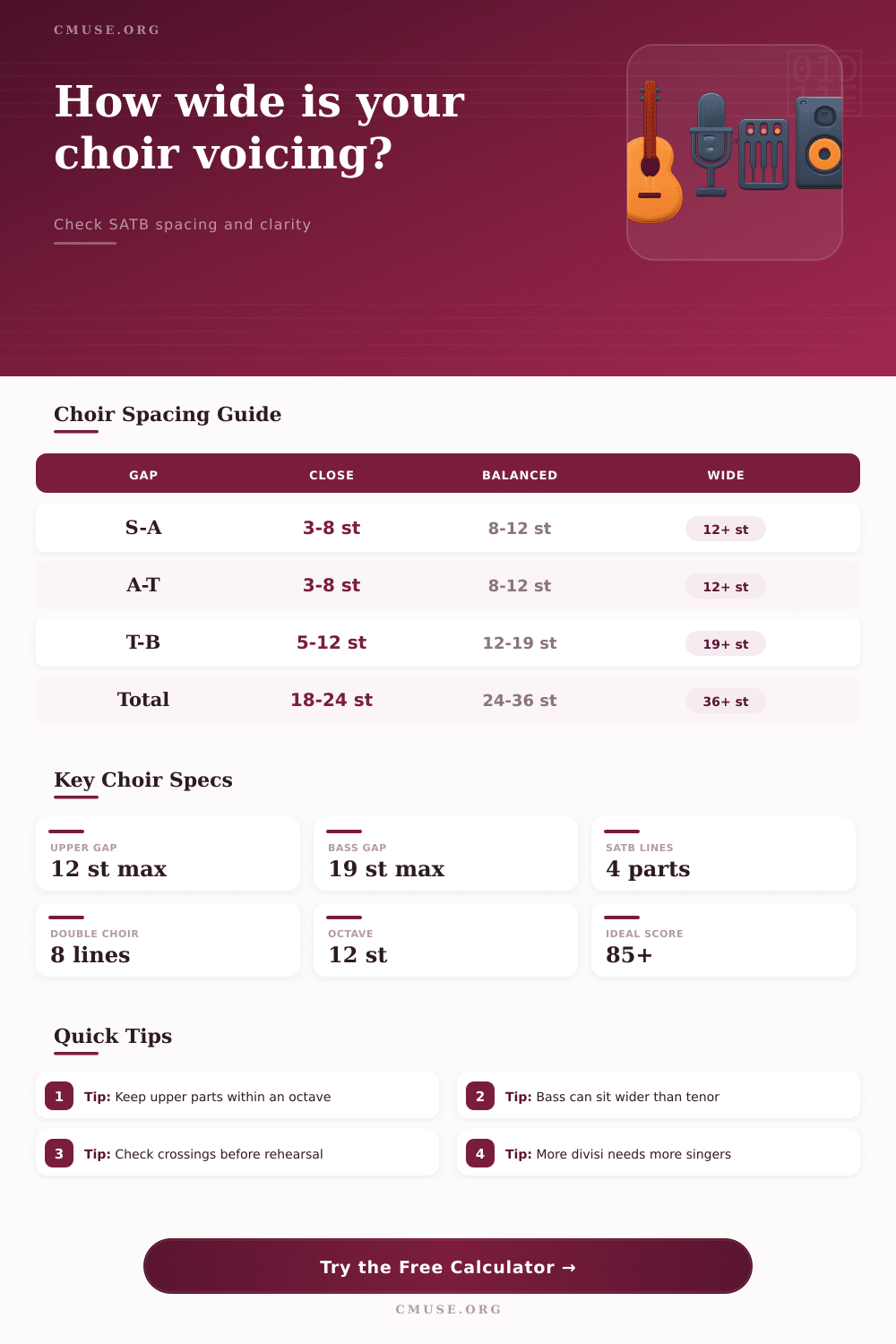
Checks the three structural gaps: alto to soprano, tenor to alto, and bass to tenor. Upper voices are safest when each gap stays within an octave.
S-A, A-T, and T-B gaps are scored separately
Active Line Support
Divides total singers by the arrangement line count and divisi factor. Thin divisi can sound fragile even when the pitch spacing is correct.
Singers per line = singers / active lines
Clarity Score
Starts from 100 and subtracts penalties for crossings, oversized upper gaps, undersupported divisi, exposed tuning, and room/dynamic mismatch.
Score = 100 - spacing, density, and context penalties
12 st
Preferred max gap between upper voices
19 st
Common upper limit for bass to tenor
4-8
Typical structural choral lines
3+
Useful singers per active divisi line
24-36
Balanced SATB total spread in semitones
18-24
Close imitative total spread in semitones
36-48
Large open or cinematic total spread
85+
Strong practical clarity score
| Spacing Point | Practical Target | Watch Zone | Why It Matters |
|---|---|---|---|
| Soprano to Alto | 3-12 semitones | Over 12 semitones | The two highest lines carry text clarity and tuning reference, so wide gaps can make the chord feel disconnected. |
| Alto to Tenor | 3-12 semitones | Crossing or over 12 semitones | The middle pair often defines chord quality; cramped seconds or huge openings both need deliberate handling. |
| Tenor to Bass | 5-19 semitones | Over 19 semitones | Low fundamentals tolerate wider spacing, but too large a bass gap can leave the harmony unsupported. |
| Full SATB Spread | 24-36 semitones | Under 18 or over 48 | Total span shapes whether a chord reads as close, chorale-like, open, or cinematic. |
| Voice Section | Comfortable Center | Extended Area | Voicing Note |
|---|---|---|---|
| Soprano | C4 to G5 | A5 and above | Top notes project strongly; spacing above alto should usually stay readable and singable. |
| Alto | G3 to D5 | F5 and above | Alto lines stabilize inner harmony, especially when they sit close enough to soprano and tenor. |
| Tenor | C3 to G4 | A4 and above | Tenor placement controls whether the voicing feels compact or separated from the upper choir. |
| Bass | E2 to D4 | C2 or lower | Bass can sit farther below tenor, but very low roots need enough singers and clear vowel alignment. |
| Texture | Total Spread | Upper Spread | Best Use |
|---|---|---|---|
| Close / Imitative | 18-24 semitones | 10-18 semitones | Counterpoint, madrigal-like writing, rehearsal rooms, and transparent text delivery. |
| Balanced Chorale | 24-36 semitones | 14-24 semitones | Hymn textures, concert SATB, moderate halls, and general-purpose harmonic support. |
| Open Sonority | 32-42 semitones | 18-28 semitones | Slow harmonic rhythm, stronger dynamics, larger choirs, and resonant spaces. |
| Cinematic Divisi | 36-48 semitones | 20-34 semitones | Expanded divisi, doubled lines, large ensembles, and broad sustained vowels. |
| Ensemble | Typical Singers | Healthy Active Lines | Practical Check |
|---|---|---|---|
| Chamber Choir | 12-24 singers | 4-6 lines | Divisi should be limited unless every split has confident independent singers. |
| Concert Choir | 28-60 singers | 4-8 lines | Balanced SATB and light divisi normally remain clear with good section balance. |
| Symphonic Chorus | 70-160 singers | 8-16 lines | Large open spreads can work well, but diction and inner-line alignment still matter. |
| Studio Choir | 8-20 singers | 4-8 lines | Close microphone capture allows thinner divisi, but exposed tuning becomes less forgiving. |
Confident that everything will blend together correctly, you step up onto the podium and raise your baton. The chord rings out, but something isn’t quite right. Instead of a single sound, it feel like a jumble of independent melodies. Thin. Disconnected.
This is a familiar problem for choral directors, and the culprit is likely voicing spread. It is not simply about hitting the correct note(s), but how those notes relates to one another in space. The term used for this is ‘voicing spread’, how many semitones separate the voices vertically.
What Is Voicing Spread?
If you have a piece where the soprano and alto are quite close, maybe within a fourth or even a third of each other, then that feels coherent on an upper level. However, if that gap stretches more further than an octave, then the sound begin to fracture into pieces. The alto can dissolves under the melody line with the tenor and bass left adrift in the centre without any glue holding them together harmonically.
This isn’t so much about looking at the highest and lowest notes but also the spaces between the lines. Check out the gaps next to one another. It also factors in other practical elements not covered in pure theory. It accounts for divisions, for instance. Dividing one section into two (or even three) separate line multiplies the number of voices being sung and therefore requires a greater number of singers to keep the sound clear and loud.
This is particularly problematic if you’re trying a big span of divisi with a modest-sized choir. Before you open your mouth, the calculator can help you picture the texture problem by approximating the number of singers behind each individual line. Anything less than a certain point and you realize you’d better simplify or add people.
Once you have entered the relevant details into the calculator (above) including ensemble size and your desired pitch range, the maths has been done for you. You won’t have to guess whether your intended texture will reach a dry classroom or a reverent hall.
This is all about how acoustic spaces affect this equation. What sounds well-voiced in one space can become a sloppy muddle in another. Long reverb tails tend to wash the individual lines you’ve worked over into each other as reflections blend them. An open voicing can sound wonderful and grand in a big hall but sound empty and unsupported in a small classroom. Knowing this could of save you frustration when you practice something and then realize it doesn’t work during a performance because the room changed how the sound behaves.
Also absent from a spreadsheet are human factors. Each singer has his/her strengths, tones and comfort zones. A tenor line that sounds good in the middle range might stretch uncomfortably high into the chest voice. It may also require singing up and out of range to balance against loud sopranos. Your ear needs to make the final judgement about what sounds good for the singer’s health and expression, even though the calculator offers you some sort of structuring framework. You don’t merely want to pass a theoretical spacing test; you want something that helps carry the emotion and the text.
Look closely at the bass line. Because of their basic weighting and blend characteristics, lower pitches such as basses can span further from the tenor without leaving an empty hole in the centre of the chord. Yet, stretch it too far and you have lost cohesion for power. It is a compromise between these two elements. Do you want to hear a strong root note even though the inner voices are sparse? Or do you want plenty of voices around the root but the note itself may be slightly weaker? This isn’t about chance; its about purposeful design.
In the end, it is a matter of both art and engineering. How do you arrange your chorus so that your chords stands up structurally before they are even sounded? With this set of tools in hand, you are no longer guessing if the harmonies will work. You know they will hold together under strain.
You go back to the podium confident, raise the baton, and allow the chord to sound out clear, balanced and true. This is the difference between a group singing notes and creating music.