Horn In F Transposition Calculator
Convert horn in F between written pitch and concert pitch, with octave, frequency, interval direction, key relation, range status, and practical note spelling for orchestral parts.
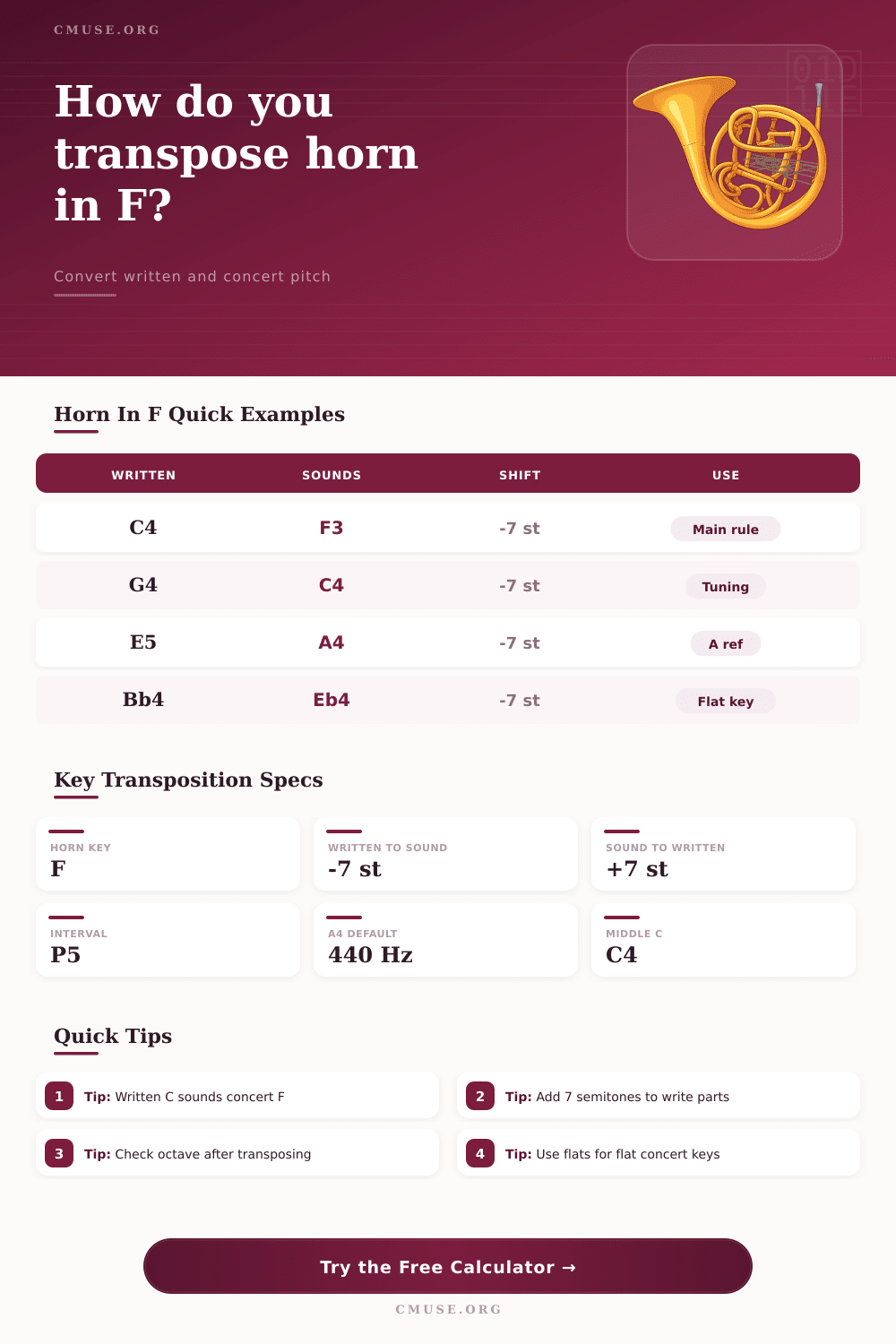
Load a common horn-in-F scenario, then adjust note spelling, octave, tuning reference, and display options. Standard horn in F sounds a perfect fifth lower than written pitch, so written C4 sounds concert F3.
Calculation Breakdown
| Written Horn In F | Concert Sound | Interval Move | Common Check |
|---|---|---|---|
| C4 | F3 | Down perfect fifth | main rule |
| D4 | G3 | Down perfect fifth | Stepwise melody check |
| E4 | A3 | Down perfect fifth | Open harmonic style check |
| F4 | Bb3 | Down perfect fifth | Concert Bb tuning relation |
| G4 | C4 | Down perfect fifth | Middle C sounding result |
| A4 | D4 | Down perfect fifth | Concert D result |
| B4 | E4 | Down perfect fifth | Sharp-side spelling check |
| Concert Pitch | Write For Horn In F | Interval Move | Practical Use |
|---|---|---|---|
| F3 | C4 | Up perfect fifth | Recover written middle C |
| G3 | D4 | Up perfect fifth | Concert score to part |
| A3 | E4 | Up perfect fifth | Chorale inner voice |
| Bb3 | F4 | Up perfect fifth | Flat-key cue writing |
| C4 | G4 | Up perfect fifth | Middle C source note |
| D4 | A4 | Up perfect fifth | Concert D melody |
| Eb4 | Bb4 | Up perfect fifth | Concert Eb passage |
| Concert Key | Horn Written Key | Direction | Spelling Note |
|---|---|---|---|
| C major | G major | Write up a fifth | One sharp in part |
| F major | C major | Write up a fifth | No flats in part |
| Bb major | F major | Write up a fifth | One flat in part |
| Eb major | Bb major | Write up a fifth | Two flats in part |
| G major | D major | Write up a fifth | Two sharps in part |
| D major | A major | Write up a fifth | Three sharps in part |
| Reference | Written Range | Concert Range | Use Case |
|---|---|---|---|
| Student | G3 to E5 | C3 to A4 | Early ensemble writing |
| Standard | F2 to C6 | Bb1 to F5 | Most orchestral parts |
| Advanced | C2 to F6 | F1 to Bb5 | Solo or specialist range |
| Tuning note | G4 written | C4 concert | Quick rehearsal check |
| A reference | E5 written | A4 concert | Frequency comparison |
French Horns have their particular panics: They don’t play the note indicated by three semitones upwards. This not only demonstrates a breakdown of the communication between score and sound; it highlights that French Horn are a transposing instrument. This means they writes one note but hear another. This is historicaly rooted but needs to be accounted for by arrangers. If you understand the shift, it blends instead of clashing. It’s such a simple rule to grasp but one that we all tend to forget in pressured situations.
Simply put: written C plays like an F (a perfect fifth below). Select your desired direction and let calculator do the math. There is no need to count semitones while juggling timbres and harmonies. Let it work out the interval shift for you so you can concentrate on the music itself. It even factors in octave shifts, where most of our mistakes lurks. In other words, it stops those high notes slipping down into the clarinet register!
How to Write French Horn Notes Correctly
For example, the fingering used by horn players follow the pattern of the harmonic series regardless of the key they are playing. They will switch to a Horn in Bb, D or F but retain their finger positions and can play fluently between instruments without needing to learn new fingerings. Notation needs to be written according to the key of the instrument. On a Horn-in-F stand, if you compose concert pitch it will sound a fifth below what was intended.
Entering your concert pitch into calculator gives you right written note along with the correct spelling for flats and sharps. At first, it is less obvious that spelling does matter. Two notes may sounds exactly the same but appear differently on paper; these are known as enharmonic equivalents. Although on piano they might be the same note, in terms of key signature logic, an A sharp is not the same than a B flat. To help parts remain readable while staying in their tonal center, the tool has preference settings for spelling. If you think in terms of written F or concert B flat, then it doesn’t matter when writing horn part in F major; they will use flats, not sharps.
This can cause confusion amongst players trying to work out correct accidentals rather than play intended melody line. It also leads to cluttered staves. Usability is another area where range matters. For a typical orchestra, the range of notes available is from F2 to C6 (written). At the extremes, an advanced player may reach further but they will need to provide large amounts of air support. Write too low and things becomes muddy; too high and things can be difficult to play. The calculator alerts you if your note falls beyond this practical range once it’s been transposed. Think of it like a sanity checker before engraving. It is a reminder that what looks easy may actualy be physically demanding for the performer.
Clarity is what transposition’s all about. If notation is clear in relation to the player’s technical facility then music sounds natural. It isn’t simply a case of pushing notes around. You aren’t just translating them from one key to another, but turning the composer’s intentions into instructions that can be followed. Respect the spelling, get the octave right, get the fifth right. Then the horn sings as intended. The C on the page turns into that concert F and the ensemble locks together.
It could of been easier if you used this tool.