Brass Tubing Length Pitch Calculator
Estimate acoustic and physical brass tube length for a target note, bore size, end correction, temperature, mouthpiece allowance, tuning slide reserve, and cut-long trimming margin.
Load a named starting point for bugle, trumpet, horn, trombone, euphonium, tuba, or small resonator tube work. The calculator uses ideal air-column math plus bore and end corrections, so final instrument tuning should still be trimmed by ear or tuner.
Brass Tube Calculation Breakdown
frequency = A4 x 2^((MIDI - 69) / 12)L = sound speed / (2 x frequency)L = sound speed / (4 x frequency)physical cut = acoustic length - open ends x factor x radiusPlain open-end correction per open end
Approximate sound speed at 20 C
Open-open brass equivalent length
Stopped-open resonator length
Common trumpet bore reference
Common large-bore trombone reference
Typical cut-long trimming margin
Typical crook layout correction range
| Tube Mode | Basic Length Rule | Open Ends | Useful For | Design Caution |
|---|---|---|---|---|
| Open-open straight tube | Half wavelength | Two | Lab pitch tube | Both ends need end correction before cutting. |
| Lip-driven brass equivalent | Half wavelength | One to two effective | Bugle length | Mouthpiece and bell flare shift the playable pitch. |
| Stopped-open tube | Quarter wavelength | One | Panpipe style | The closed end should be airtight and square. |
| Conical or flared section | Equivalent acoustic length | Variable | Horn and bell work | Use flare credit as an approximation, then test. |
| Slide loop section | Path centerline length | Usually none | Tuning slide | Reserve travel before trimming to final pitch. |
| Inside Bore | Instrument Area | Plain End Correction | Metric Equivalent | Practical Note |
|---|---|---|---|---|
| 0.300 in | Small signal tube | 0.183 in per end | 4.65 mm | Small diameter shifts are easy to over-trim. |
| 0.459 in | Trumpet bore | 0.280 in per end | 7.11 mm | Good reference for narrow cylindrical sections. |
| 0.468 in | Cornet / trumpet large bore | 0.285 in per end | 7.25 mm | Slightly larger bore lowers the physical cut length. |
| 0.547 in | Large trombone bore | 0.334 in per end | 8.48 mm | Slide stocking and bell taper dominate final feel. |
| 0.571 in | Euphonium / baritone area | 0.348 in per end | 8.85 mm | Use generous slide allowance on low brass loops. |
| 0.750 in | Tuba branch reference | 0.458 in per end | 11.62 mm | Large bows need layout measurement along centerline. |
| Preset | Target Pitch | Approx Acoustic Rule | Typical Bore Input | Use |
|---|---|---|---|---|
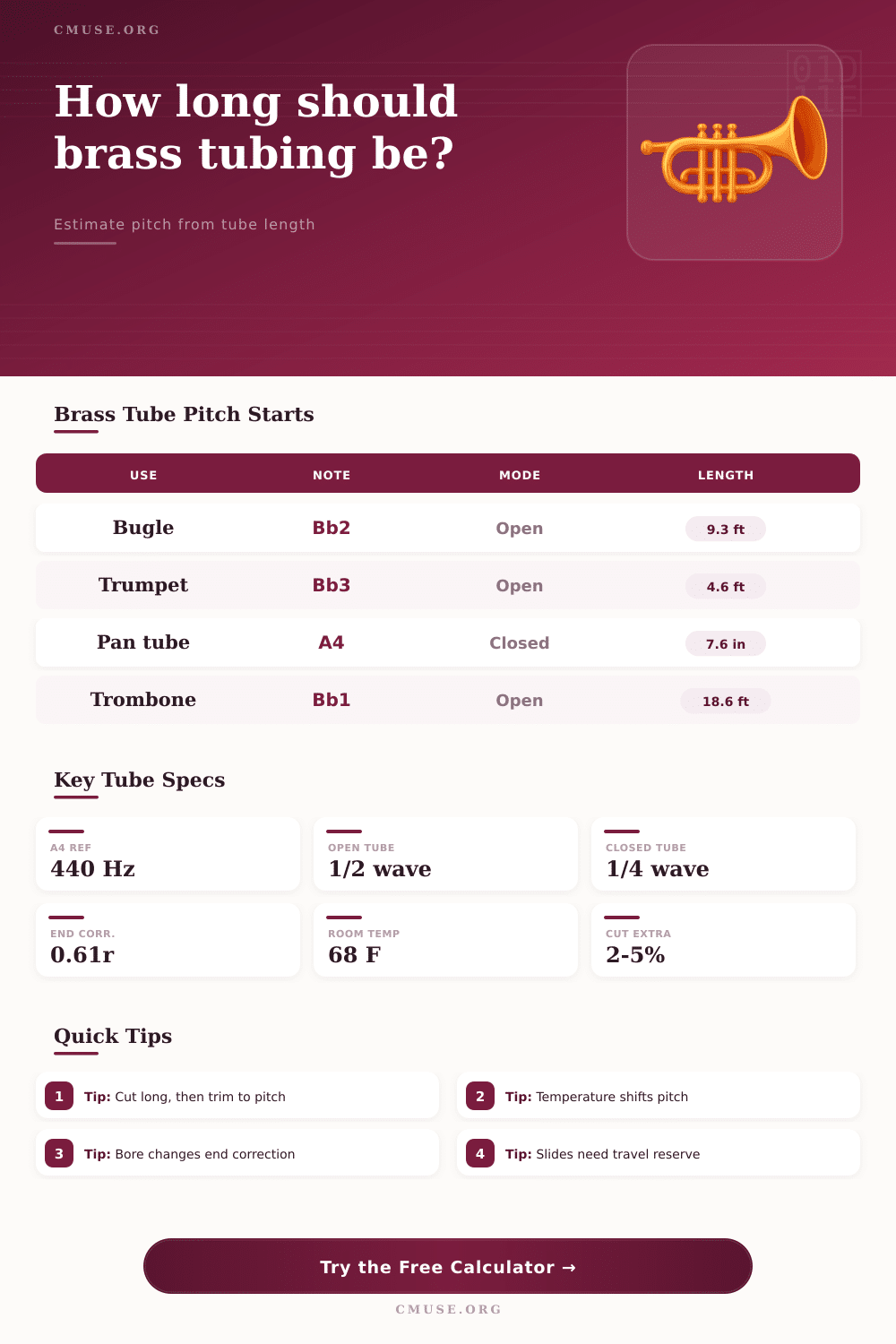
| Bugle Bb Fundamental | Bb2 / 116.54 Hz | Half-wave open tube | 0.459 in | Compact bugle and trumpet-length checks. |
| Trumpet Bb Open Tube | Bb3 / 233.08 Hz | Half-wave upper resonance | 0.459 in | Short resonator and leadpipe demonstrations. |
| Horn F Reference | F2 / 87.31 Hz | Long half-wave equivalent | 0.468 in | Coiled horn-length comparison work. |
| Trombone Bb First Position | Bb1 / 58.27 Hz | Long open brass path | 0.547 in | Slide-path and crook layout estimation. |
| Closed A4 Brass Tube | A4 / 440 Hz | Quarter-wave stopped tube | 0.300 in | Small classroom resonator or pitch pipe. |
| C5 Lab Resonator | C5 / 523.25 Hz | Half-wave open tube | 0.250 in | Short straight tube with two open ends. |
| Air Temperature | Sound Speed | Pitch Effect For Same Tube | Length Effect | Workshop Use |
|---|---|---|---|---|
| 50 F / 10 C | 337.4 m/s | Flatter than 68 F | Tube can trim slightly shorter | Cold shop testing may read low. |
| 59 F / 15 C | 340.4 m/s | About -15 cents vs 68 F | Small correction | Common cool rehearsal room. |
| 68 F / 20 C | 343.4 m/s | Reference condition | Baseline | Good default calculation point. |
| 77 F / 25 C | 346.5 m/s | About +15 cents vs 68 F | Tube can be longer | Warm stage or outdoor room. |
| 86 F / 30 C | 349.5 m/s | Sharper than 68 F | Leave slide pull available | Hot air raises pitch noticeably. |
When cutting brass tubes there is a mixture of maths and pragmatism. In your mind’s eye, you might know exactly what a leadpipe should be like on a trumpet but in practice it doesn’t always work out as you expect. Air columns vibrates at certain frequencies and sound travels at a set speed. If you change the length of column then you get a different note. However, when they is not straight lines (such as when there is no mouthpiece shank or bell flare), equations do not work perfectly in real life.
This is where brass tubing length pitch calculator becomes useful. It brings theory together with world of workshop practice. One common novice error are to equate acoustic length with physical tube length. Rarely, if ever, are these equal. When air vibrates in a tube, it doesn’t simply cease at the edge of metal. There is always a little extra that extends past the open end. This is known as end correction by engineers. How far the end corrects vary according to the bore diameter. A large bore trombone has a wider diameter than say, a narrow bore trumpet. This means the wider bore reach further into surrounding air. Unless you were to cut tubes using raw wavelength equations alone all instruments would play flat. To fix this you need to remove this imaginary length from the actual physical cut. Once you choose your end profile, the calculator do this for you. It allows for variations between plain tube and those with a flared bell. This can make the difference between a working instrument and one that sounds wronger.
Practical Tips for Cutting Brass Tubes
Another major factor to consider when calculating tuning is temperature. While metal appears to be constant, the air within the instrument does change according to temperature. Warm air have a greater speed of sound than cold air. In other words, a tube tuned to sixty eight degrees Fahrenheit will be sharp in hot weather. And it’ll be flat in a cold garage. The next step is to enter what your actual working temperature is. That’s because we are considering the condition of the air in which the tube exist. The tube would of changed pitch if built in a cold shop and played in a warm venue. Leave some room for tuning slides to compensate.
You also need to consider assembly. Many hobbyists forget about extra length added by mouthpieces. These push onto the leadpipe and effectively shorten the vibrating column in relation to overall assembly. So if you have a deep cup on your mouthpiece but you calculate for a straight tube on your calculator, then your pitch is going to go down. The bells also functions as sound extensions. That means they increases the effective length of the instrument without adding all that much physical material. Not taking that into consideration result in tuning slides that are not long enough. What does that mean? Well, when players push their slide out during performances, yours might already be hitting the stops. Why? Because you cut it all down too soon.
Tubes are best cut long, as in longer than specified by the calculator. They will indicate a length to aim for and frequently suggest leaving a little extra to trim down. Do this. Much better to be able to take some metal away than put it back! If you can assemble the instrument, join it together temporarily. Get your basic note out and tune up on that. Take a fraction of an inch at a time. Brass doesn’t like hasty cuts and isn’t good for repairing them either. It’s not as much an exercise in exact science as one of sculpting. Equations give you a base piece of metal; then you carve away at it to get it right. Your ears are the ultimate judge. Be liberal with your cuts. Listen hard. Treat that air column like gold. Let the note ring out on its own.