Tuning Fork Length Calculator
Estimate tuning fork tine length or resulting frequency from target pitch, beam thickness, tine width, material stiffness, temperature, and practical fork-coupling correction.
Choose a named pitch reference, then adjust the tine geometry and material. The calculator uses the first bending mode of a rectangular cantilever tine with a correction for fork coupling and end mass.
Tuning Fork Calculation Breakdown
f = beta^2 / (2 pi L^2) x sqrt(EI / rho A)I / A = thickness^2 / 12L = sqrt(beta^2 x stiffness / (2 pi f))cents = 1200 x log2(actual Hz / target Hz)First cantilever beta value
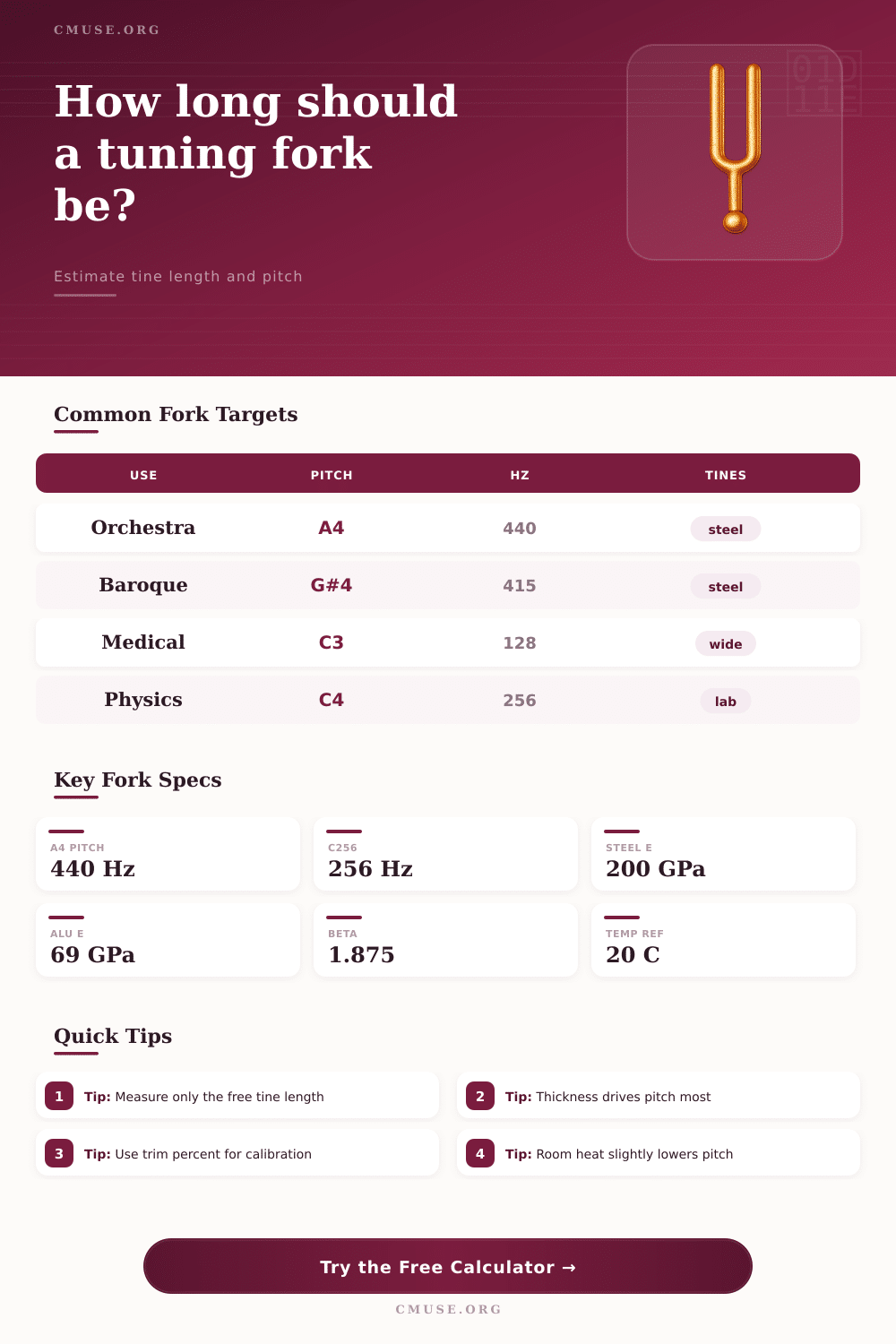
Modern orchestral A4 fork
Physics C reference fork
Common medical C fork
Approximate steel modulus
Approximate 6061 aluminum modulus
Reference temperature for pitch
Rectangular tine I over A ratio
| Fork Reference | Frequency | Nearest Note | Typical Use | Design Note |
|---|---|---|---|---|
| Medical low C fork | 128 Hz | C3 | Exam room | Longer tines and strong handle feel. |
| Scientific C fork | 256 Hz | C4 | Physics lab | Classic reference because octaves stay simple. |
| Piano service A | 220 Hz | A3 | Lower A | More compact than C128 but easier to hear. |
| Baroque pitch A | 415.30 Hz | G#4 / A4 flat | Early music | About one semitone below A440. |
| Modern orchestral A | 440 Hz | A4 | General tuning | Most common compact steel fork target. |
| Choir reference C | 523.25 Hz | C5 | Vocal pitch | Shorter tines; thickness control becomes critical. |
| Watch timing fork | 1000 Hz | B5 +21 cents | Timing | Compact geometry needs careful machining. |
| Material | Young's Modulus | Density | Thermal Pitch Drift | Fork Behavior |
|---|---|---|---|---|
| Hardened carbon steel | 200 GPa | 7850 kg/m3 | -0.011% per C | Bright, durable, and common for tuning forks. |
| Stainless steel | 193 GPa | 8000 kg/m3 | -0.010% per C | Slightly longer tines than carbon steel. |
| Tool steel | 210 GPa | 7800 kg/m3 | -0.010% per C | Stiff response with good sustain after hardening. |
| 6061 aluminum | 69 GPa | 2700 kg/m3 | -0.018% per C | Light and loud, but more temperature sensitive. |
| Cartridge brass | 100 GPa | 8530 kg/m3 | -0.013% per C | Needs shorter or thicker tines for the same pitch. |
| Titanium alloy | 114 GPa | 4430 kg/m3 | -0.008% per C | Light, resilient, and moderately stiff. |
| Geometry Change | Frequency Effect | Length Effect | Mass Effect | Practical Note |
|---|---|---|---|---|
| Increase tine thickness | Raises pitch strongly | Needs longer tines | Moderate increase | Most powerful pitch dimension to control. |
| Increase free tine length | Lowers pitch by L squared | Main tuning lever | Large increase | Remove tiny tip amounts to sharpen a flat fork. |
| Increase tine width | Small ideal effect | Nearly unchanged | Large increase | Improves drive and sustain more than pitch. |
| Add weighted tips | Lowers pitch | Equivalent to longer tine | Increases end mass | Useful for compact lower-frequency forks. |
| Taper tine tips | Raises pitch | Equivalent to shorter tine | Reduces moving mass | Can make response quicker but less forgiving. |
| Warm the fork | Lowers pitch slightly | No physical length change | No mass change | Temperature correction matters for lab checks. |
| Preset | Frequency | Material | Starter Tine Geometry | Why It Helps |
|---|---|---|---|---|
| Orchestral A440 | 440 Hz | Carbon steel | 5.0 mm thick x 8.0 mm wide | Standard tuning fork reference for instruments. |
| Baroque A415 | 415.30 Hz | Carbon steel | 5.0 mm thick x 8.5 mm wide | One semitone lower than modern A. |
| Physics C256 | 256 Hz | Tool steel | 6.0 mm thick x 9.0 mm wide | Common demonstration fork target. |
| Medical C128 | 128 Hz | Stainless steel | 7.0 mm thick x 12.0 mm wide | Long, tactile fork for low-frequency checks. |
| Watchmaker 1000 Hz | 1000 Hz | Tool steel | 3.0 mm thick x 4.5 mm wide | Compact high-frequency timing reference. |
| Bass A110 | 110 Hz | Steel with heavy tips | 8.0 mm thick x 14.0 mm wide | Shows how long low forks become. |
In Your Hand Take a tuning fork. Hold it in your hand and give it a whack on your knee. Out comes a clear and true note. Seems like it hangs there for an eternity.
Maybe you’ve never thought about what makes that little piece of steel sing just once per second at 440 Hertz and not 441 or 439? It is not magic; it is just the mechanics of it all. Essentials, the length and thickness of the tines combined with the stiffness of the material they are made of determine the pitch nearly completely.
How Tuning Forks Work
Ever wondered why sometimes your old fork sounds a bit flat after being in the sun for a while? Or maybe you want to make one yourself? Understanding physics of vibration will help explain it all. The calculator above calculates hard beam equations for you so you do not have to type them out. It then directly links the desired frequency right into the physical dimensions you’ll need to cut.
Thickness of the tine is most important variable. Because a tuning fork tine is basically a rectangular cantilever beam, slight changes in thickness will drastically alter its pitch. This is because that dimension affect how much it resists bending, and resistance to bending is proportional to the square of that dimension. So if you shave off a fraction of a millimeter at the base, the tine will be less stiff, and the pitch will drop. Here more than any other step in the toolmaking process, precision matter.
Width has much less impact on pitch itself; you can have a very narrow tine or you can go pretty wide without really moving the note much as long as thickness remains the same. But width does impact sustain and mass. Wider tines move more air and tend to sound louder, but they are harder to get to vibrate initially.
That’s not all though, there’s another wrinkle here in terms of materials. For one, steel is pretty much what you’d expect because it is very stiff compared to other metals (it’s got a high Young modulus). That means you can get away with making the fork tines short while still having them ring out nicely. You could go for aluminum forks instead, and they will be lighter, but they are more temperamental as well. When warm, aluminum expands, reducing the stiffness of metal and slightly dropping the pitch. So if you’re working in a lab environment where precision matters, you’ll have to factor in ambient temperature.
The way this works is you enter in current ambient conditions into the tool, and it makes up for the likely pitch by taking it into consideration. So no finger-pointing about poor machining skills on your part; it was just a warm day in July.
That leaves us with the last tool: length. If you’ve decided on the type of steel (material) and its thickness, then it’s all about how long you want that section of the tine to vibrate freely. This is what actualy makes a note. That’s where many people make their mistake. How do you know how long to measure? Do you measure from end of the handle, or from where the tine joins the yoke? Hint: the answer isn’t the first one.
If you include the rigid section of the fork in the length measurement, then the calculator will tell you a pitch that is way too high. It’s a bit like getting someone who’s 6’4″ and thinking they’re only 5’8″. The calculator splits out the overall length into two parts; one for the vibrating part and another for the non-vibrating part of the tine. There’s also a tiny adjustment made because the two tines is connected at the bottom. Although we often model them independently, they aren’t entirely independent beams, which slightly alters things.
There’s obviously a balance between these considerations and practicality. Short thin tines work for a high-pitched fork; long fat tines works for a very low-pitched fork. This graphic demonstrates what difference this makes in the geometry of the fork: moving from a reference A440 (orchestral) to a C128 (medical) shows how drastically the geometry shifts in the interface presets. One is precise and compact where the other is bulky and heavy.
With that knowledge about the pros and cons, you will be able to make informed decisions about adjusting thickness versus the length if your first prototype is not tuned. If it’s too sharp, then you’re stuck unless you grind down the sides (changing the structural integrity). If it’s flat you can trim the tips. It’s also easier to leave some extra material than trying to replace a ruined piece of steel.
In short, the beauty of the tuning fork is that it’s simple. Two precisely cut and joined bits of metal create a pure tone that has served to help musicians get their instruments tuned for hundreds of years. Understanding the connection between material, thickness and length gives us a glimpse of how it does what it does. It moves from being a black box to something we see as a part of engineered physics.
It is a chance to get the dimensions correct so that when you hit it, the note rings out just like you know it should if you’re restoring an old fork or creating a new one. And lastly, that math exists to back up your art, not take away your judgment. You should of used the calculator too.