Drum Diameter to Pitch Calculator
Estimate drum head pitch, closest musical note, resonant-head relationship, and approximate lug load from diameter, head type, membrane tension, shell depth, and tuning style.
Load a common drum starting point, then adjust the head, tension, interval, and damping to match the way your kit is tuned. The estimate uses a circular membrane model, so treat the result as a practical pitch target rather than a replacement for listening at the lugs.
Calculation Breakdown
Pitch falls as diameter grows
Pitch rises with tension
Head mass slows vibration
Circular membrane constant
Main size control
A smaller head needs less energy to reach a higher pitch. An 8 in tom can sit near the same note with much lower rim tension than a 16 in floor tom.
Square-root response
Doubling the membrane tension does not double pitch. Because frequency follows the square root of tension, large tuning changes require careful, even turns.
Single vs double ply
A heavier head sounds lower at the same tension. That is why double-ply and hydraulic heads often need more tension to reach the same note.
Top and bottom heads
Matching heads produces focused sustain. Raising the resonant head can add lift, while lowering it can create a deeper decay and stronger pitch bend.
| Drum | Typical Diameter | Practical Batter Range | Common Role |
|---|---|---|---|
| High tom | 8 in / 20.3 cm | C3 to A3, about 131 to 220 Hz | Fast melodic fills, small kit upper voice, or fusion-style high tom. |
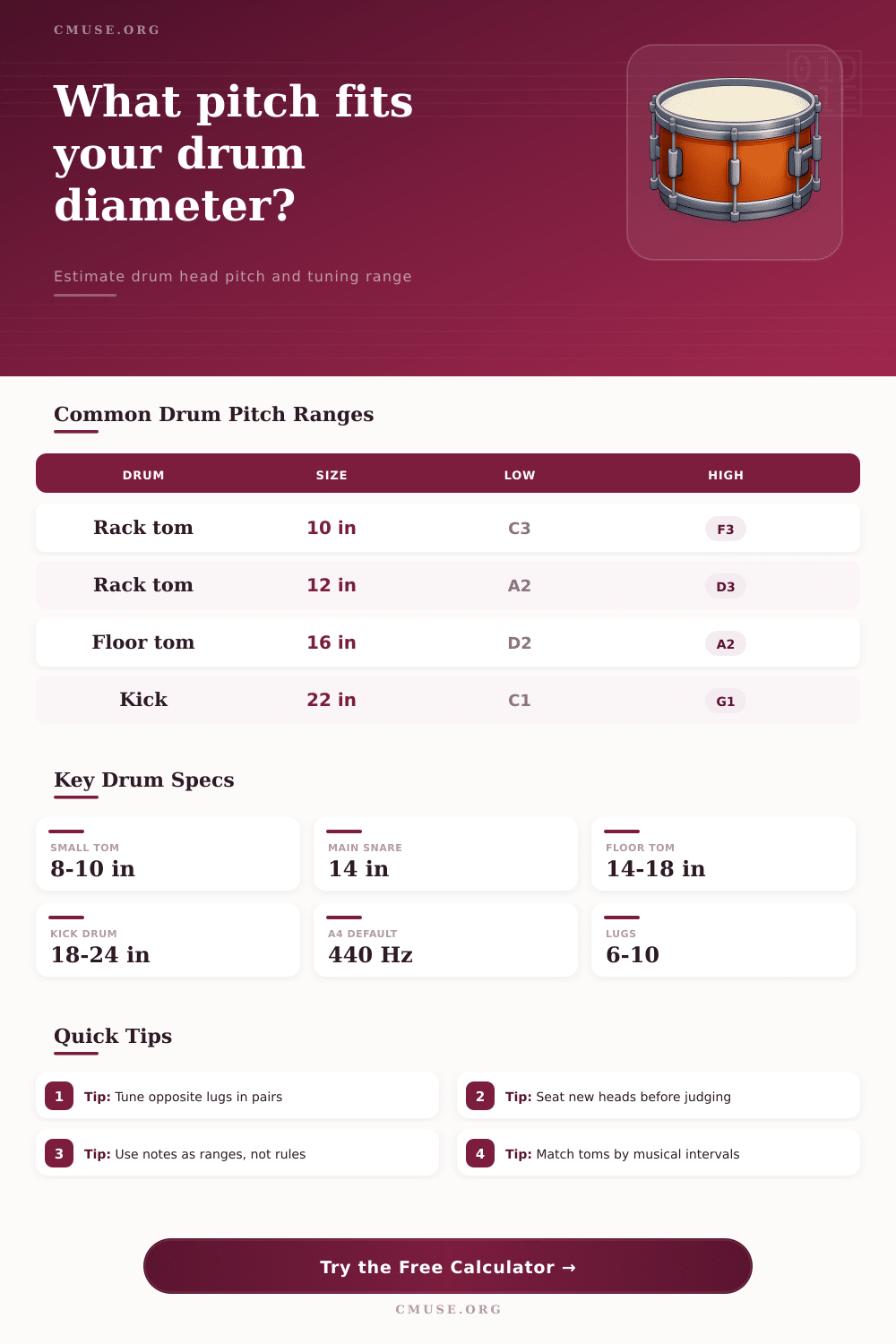
| Rack tom | 10 in / 25.4 cm | A2 to F3, about 110 to 175 Hz | Clear attack with enough body for pop, funk, worship, and studio kits. |
| Main rack | 12 in / 30.5 cm | F2 to D3, about 87 to 147 Hz | Balanced middle tom that can bridge small and large drums smoothly. |
| Low rack | 13 in / 33.0 cm | E2 to C3, about 82 to 131 Hz | Lower rack voice for rock kits or traditional two-rack setups. |
| Snare | 14 in / 35.6 cm | G3 to C4 for batter, often 196 to 262 Hz | Higher head pitch for articulation, snare response, and center crack. |
| Floor tom | 16 in / 40.6 cm | C2 to A2, about 65 to 110 Hz | Deep tom voice with enough definition to speak in fills and grooves. |
| Large floor | 18 in / 45.7 cm | A1 to F2, about 55 to 87 Hz | Low, wide floor-tom response for rock, jazz, and orchestral colors. |
| Kick | 20 to 24 in / 50.8 to 61.0 cm | C1 to G1, about 33 to 49 Hz | Fundamental thump, beater attack, and room coupling more than melodic note. |
| Head Profile | Model Density | Pitch Effect | Best Use In Calculator |
|---|---|---|---|
| Single-ply clear | 0.145 kg/m² | Baseline, open, bright | Rack toms, resonant heads, open floor tom tuning. |
| Single-ply coated | 0.155 kg/m² | Slightly lower and warmer | Snares, jazz toms, brush-friendly batter heads. |
| Double-ply clear | 0.235 kg/m² | Lower at equal tension | Rock toms, controlled attack, harder playing. |
| Double-ply coated | 0.250 kg/m² | Lower, dry, focused | Dry studio toms and loud backline drums. |
| Thin snare-side | 0.060 kg/m² | Very responsive, high | Only for resonant snare-side calculations. |
| Hydraulic head | 0.310 kg/m² | Much lower, short sustain | Controlled tom sounds and low, punchy tuning. |
| Mesh head | 0.095 kg/m² | Higher but less acoustic body | Practice pads, triggers, and quiet acoustic conversions. |
| Interval Plan | Step In Semitones | Example Toms | Sound Character |
|---|---|---|---|
| Minor thirds | 3 semitones | 10 in F3, 12 in D3, 14 in B2, 16 in G#2 | Smooth, compact spread with fewer large jumps between fills. |
| Major thirds | 4 semitones | 10 in E3, 12 in C3, 14 in G#2, 16 in E2 | Balanced melodic motion with clear separation on most kits. |
| Perfect fourths | 5 semitones | 10 in F3, 12 in C3, 14 in G2, 16 in D2 | Wide, musical spread that keeps larger toms from sounding crowded. |
| Perfect fifths | 7 semitones | 12 in D3, 16 in G2, 22 in C2 style relationship | Large cinematic spacing, useful for small kits with fewer drums. |
| Preset | Diameter x Depth | Head And Tension | Typical Result |
|---|---|---|---|
| 8 in piccolo tom | 8 x 6 in / 20.3 x 15.2 cm | Single clear at 36 lbf/in | High tom pitch, often around the upper C3 to G3 area. |
| 10 in rack tom | 10 x 7 in / 25.4 x 17.8 cm | Single clear at 34 lbf/in | Bright rack note with open sustain and easy melodic spacing. |
| 12 in rack tom | 12 x 8 in / 30.5 x 20.3 cm | Single clear at 38 lbf/in | Middle tom range that works as the reference drum in many kits. |
| 14 in jazz snare | 14 x 5 in / 35.6 x 12.7 cm | Coated snare batter at 82 lbf/in | Responsive higher batter note with tight snare-side support. |
| 16 in floor tom | 16 x 16 in / 40.6 x 40.6 cm | Double clear at 35 lbf/in | Low floor voice with a strong fundamental and moderate decay. |
| 22 in rock kick | 22 x 18 in / 55.9 x 45.7 cm | Double clear at 18 lbf/in | Low thump where attack and damping shape the perceived note. |
Perhaps you’ve witnessed a skilled engineer adjusting a drummer’s kit. They tightens a lug here, hopping around the head in a star pattern before finally tuning each beat to come from a single source. Sounds like magic, but it’s physics applied with a wrench. Though only ear judges whether resulting sound was right or not, math of how a drum’s width relates to pitch is very specific. Knowing these rules allows you to abandon guesswork in favor of purposeful tuning.
Instead of making you remember all this, the system use a series of calculations based off membrane vibration theory (a branch of physics) for your own set of drums. What they do is calculate approximate fundamental pitch as well as the weight that each lug should of being capable of taking. To get the most out of these, you don’t have to understand the math behind it at all. Just know what those variables are and it will change the way you think about the kit.
The Science of Drum Tuning
The size of the shell (diameter) is the most important variable here as the smaller the head, the less mass there is to displace so it can be pushed to higher pitches with much less effort then any large floor tom would manage. This is why an eight inch piccolo tom can sing up close to the top end of piano range. In contrast, a twenty two inch kick drum remain hidden in the sub bass without putting itself under strain.
But tension also matter, and it’s not linear. Because pitch rises with the square root of tension, doubling the tension on the hoop only raise the note by a predictable fraction, not double. And this nonlinear response is what makes tuning more difficult when you’re getting tight. As stress on the shell rises very quickly, each turn of wrench produces diminishing returns in terms of how high the pitch becomes. The tool takes this into account so that you can visually see how much tension needs to be applied to reach a particular target note without warping the rim or blowing out the head.
Many drummers ignore another important factor in skin changes, namely head mass. At moderate tension, a single ply clear head vibrate freely and produces a bright, open tone. Two layer of coat can be a lot heavier and if you don’t touch your trusty wrench again the pitch will drop noticeabley. This explains why some kits sounds tighter then others, such as a rock set-up that’s got heavier heads and needs more torque to hit the same notes as a jazz kit with thinner film. The calculator takes this density variation into account so you can directly compare an open tom set-up versus a dry sounding studio set up without having to do any math in your head.
There is one more layer of complexity in a way that colors the character and sustain of the drum: head tuning. Raising the bottom head will give the tone a slight lift and some harmonic complexity. Lowering it deaden the overtones and makes for a short, thuddy sound. Matching the batter and resonant heads result in a focused pitch with longer decay. You can experiment with these relationships digitally via the tool’s interval selector which saves time and prevents that frustrating cycle of overtightening and retuning in the practice room.
In real-world tuning, exact model isn’t quite as precise due to things like air leaks, the shape of bearing edges, and how hard you hit with your beater. Using the calculator provides a theoretical starting point that is an approximation under perfect conditions. You’ll still have to adjust the tensions until they’re evened out by ear. Use your fingers to tap near each lug to ensure that the pitch matches all around the drum. However, knowing what starting frequency should be allows for a more focused approach without randomly tightening or loosening.
It transforms it from a guessing game to a conscious adjustment process. Each turn has a clear goal and it makes a real difference to the resulting music.