Double Kick Speed Calculator
Convert double bass drum tempo into strokes per minute, hit spacing, foot frequency, burst totals, endurance load, target BPM gaps, and clean-speed benchmarks.
Choose a realistic practice or performance scenario, then adjust the tempo, subdivision, pattern, accuracy, pedal response, and endurance fields to match your own double-kick take.
Double Kick Breakdown
SPM at 100 BPM 16ths
SPM at 150 BPM 16ths
SPM at 200 BPM 16ths
Gap at 160 BPM 16ths
Hits per second at 640 SPM
Normal alternating load split
Clean take benchmark
Common speed burst length
Strokes Per Minute
BPM x hits per beatDouble kick speed is normally clearer as total kick strokes per minute than as BPM alone.
Hit Spacing
60,000 / SPMMilliseconds per hit shows how little time each foot has before the next kick note arrives.
Burst Count
bars x beats x subdivisionA four-bar 16th-note run in 4/4 always contains 64 kick notes.
Clean Score
SPM x accuracy x controlThe adjusted score rewards speed that stays even instead of only peak tempo.
| 16th-Note Tempo | Total SPM | Milliseconds Per Hit | Per-Foot Load | Practical Read |
|---|---|---|---|---|
| 90 BPM | 360 SPM | 166.7 ms | 180 SPM each | Foundation |
| 120 BPM | 480 SPM | 125.0 ms | 240 SPM each | Steady rock |
| 150 BPM | 600 SPM | 100.0 ms | 300 SPM each | Metal ready |
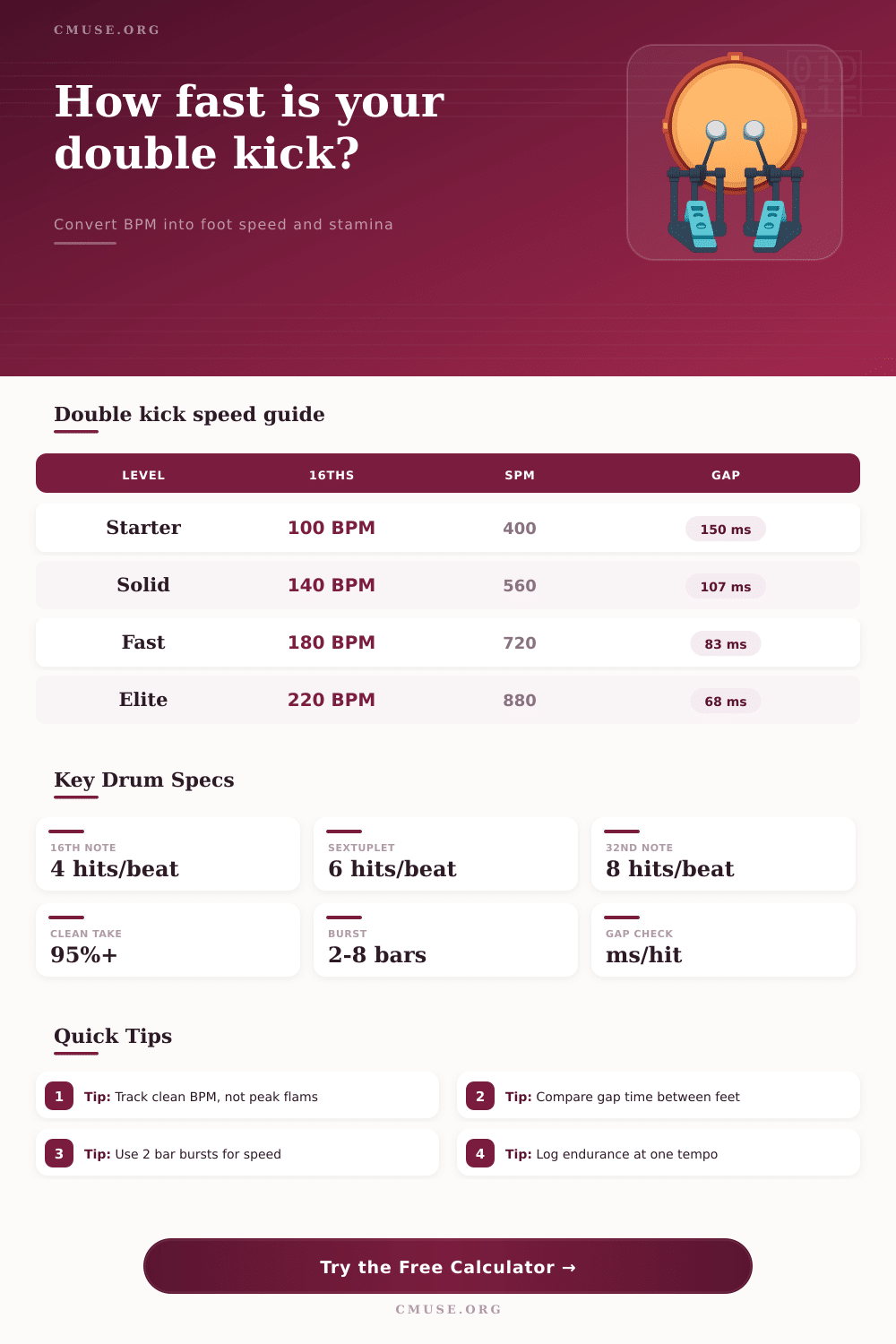
| 180 BPM | 720 SPM | 83.3 ms | 360 SPM each | Fast |
| 200 BPM | 800 SPM | 75.0 ms | 400 SPM each | Advanced |
| 220 BPM | 880 SPM | 68.2 ms | 440 SPM each | Elite clean |
| Subdivision | Hits Per Beat | Speed at 140 BPM | Hit Gap | Typical Use |
|---|---|---|---|---|
| 8th notes | 2 | 280 SPM | 214.3 ms | Groove support and warmups |
| Triplets | 3 | 420 SPM | 142.9 ms | Rolling fills and shuffles |
| 16th notes | 4 | 560 SPM | 107.1 ms | Main double-kick benchmark |
| 16th triplets | 6 | 840 SPM | 71.4 ms | Bursts and extreme fills |
| 32nd notes | 8 | 1120 SPM | 53.6 ms | Short sprint textures only |
| Pattern | Load Split | Clean-Speed Risk | Best Measurement | Watch For |
|---|---|---|---|---|
| Alternating singles | 50 / 50 | Low if feet match | Grid timing and volume | Lead-foot accents drifting louder |
| Heel-toe doubles | 50 / 50 pairs | Medium | Pair spacing and second-hit level | Doubles sounding like flams |
| Swivel singles | 50 / 50 | Medium | Long take consistency | Tension above target tempo |
| One-foot burst | 100 / 0 | High | Single-foot SPM | Comparing it to two-foot speed |
| Offset ostinato | Variable | Medium | Kick placement against hands | Rests hiding uneven recovery |
| Scenario | Tempo And Notes | Total Hits | Endurance Target | Useful Result |
|---|---|---|---|---|
| Two-bar speed check | 180 BPM 16ths | 32 hits | Repeat with full rest | Find clean peak BPM |
| Four-bar phrase | 160 BPM 16ths | 64 hits | Three clean repeats | Song-section readiness |
| Sextuplet fill | 130 BPM 6-note beat | 48 hits in 2 bars | Even pair spacing | Fill clarity under hands |
| Endurance block | 150 BPM 16ths | 1200 hits in 2 min | Consistent volume | Stamina benchmark |
| Extreme sprint | 220 BPM 16ths | 88 hits per 6 sec | Short and relaxed | Top-speed test |
Set the metronome to a comfortable one hundred and sixty beats per minute and sit down behind the kit. Begin hammering away at those sixteenth notes with both feet. Let that solid rush of momentum build beneath your legs. Sure, it sounds fast enough for most standard metal or rock tracks, but does it realy feel fast? And more importantly, how many strokes are you really laying down each minute? Will you be able to maintain this intensity without your form collapsing into a muddy mess before the end of the song?
That uncertainty marks the point where raw feeling turns into measurable data. That is exactly why serious drummers needs a clear way to measure double kick speed. By entering your tempo and subdivision into this calculator above, you eliminate the need to convert and calculate coefficients, saving you the guesswork. That vague idea of “fast” becomes an actual amount of strokes per minute, the millisecond gaps between each one, and how much effort it’s asking your legs to endure for a specific amount of time.
Why You Need to Measure Your Double Bass Speed
All you have to do is pick your foot pattern (assuming you’re not using both), decide if you’re playing straight sixteenth notes or maybe tighter triplets, and input your existing tempo. From there, it spits out precisely how many total hits you’ll perform in a four-bar phrase, as well as how much work is being done by each foot. Rather than letting the pride of “I can reach a high BPM number” cloud things, it factors in control and accuracy, providing you with a pure speed score that shows what’s actualy happening versus theoretical peak performance.
The traditional way of measuring speed is with the metronome click which most players focus on completely. When comparing foot techniques or other subdivision, however, BPM is a misleading measure. You can be playing at a specific tempo but feel like you’re doing entirely different things if you alternate single strokes vs running through a heel-toe motion. To illustrate this, the page has a reference table that shows how the milliseconds between hits reduce as you push into the faster territory. At one-hundred-and-forty BPM, you have well over a-hundred-milliseconds to recover and reset your pedal. By two-hundred-twenty BPM, it’s below-seventy-milliseconds.
This is where folks go astray. They’ve lost all recovery time and assume they’re training speed. What they’re really training is tension. While raw reflex speed does play a part in being able to pull off a double kick, stamina matters much more. Sure, maybe you can blast out two bars of extremely fast kicks on a warmup, but what about keeping them crisp throughout a whole verse? That’s a completely different physical challenge.
This calculator handles it by letting you input how long you want your bursts to be and how long you can keep up that same level of cleanliness before tiring. With this information, you can get an idea of how many hits you’ll have to be able to maintain cleanly while still not losing your form. Losing a bit of accuracy (less than 95%) will show up on the adjusted score. This shows you when you’re no longer pulling something clean enough to use in a live or recorded situation. A sloppy take isn’t likely going to cut it.
Your choice of technique depends based off the ceiling. For quicker sixteenth notes, ankle motion is most efficient and fast, but for those bigger accents at slower tempos, you use full leg power. There are heel-toe techniques as well that enable you to play with greater density (without raising the number of pedals), however, they present a new level of coordination. As illustrated in the breakdown section, what you choose also loads up each foot differently. This means if one foot is carrying much more than the other, your foot will become exhausted sooner on that side. Maintaining balance between two is most important when considering longevity in fast-paced style playing.
Once you are using these metrics in practice, it alters the way you work on developing your sessions. Rather than pushing harder and faster till you fall apart, you find the spots where the gap-time shrinks too far for what you’re doing to perform cleanly. You recognize that even though you might go fast as a bat out of hell, the consistency; not the speed itself, is what matters for the musical performance. If your accent wanders off-course, or the ghost notes dissapears… then the speed doesn’t matter.
So in closing, becoming a master at doubles kicks is not about chasing the biggest numbers on the screen; it is about realizing how much each millisecond you save during kick recovery costs you. Taking as serious an analytical look at your footwork as you do your hand technique creates a foundation you can rely upon under pressure. Your answer returns to the original question: Is my speed really fast? Now you have the data to back it up. The meter ticks over, the feet react and suddenly you are no longer wondering what’s going on underneath the snare drum.