Blast Beat Tempo Calculator
Convert blast beat BPM into hand strokes, foot strokes, combined stroke rate, phrase totals, and endurance load for traditional, bomb, gravity, hammer, skank, and hyperblast drumming.
Load a named extreme-drumming scenario, then adjust the subdivision, foot pattern, hand execution, accuracy margin, and hold time. Rates are calculated as physical strokes, so simultaneous two-hand or double-kick choices increase the total workload.
Blast Beat Breakdown
Hand strokes per minute
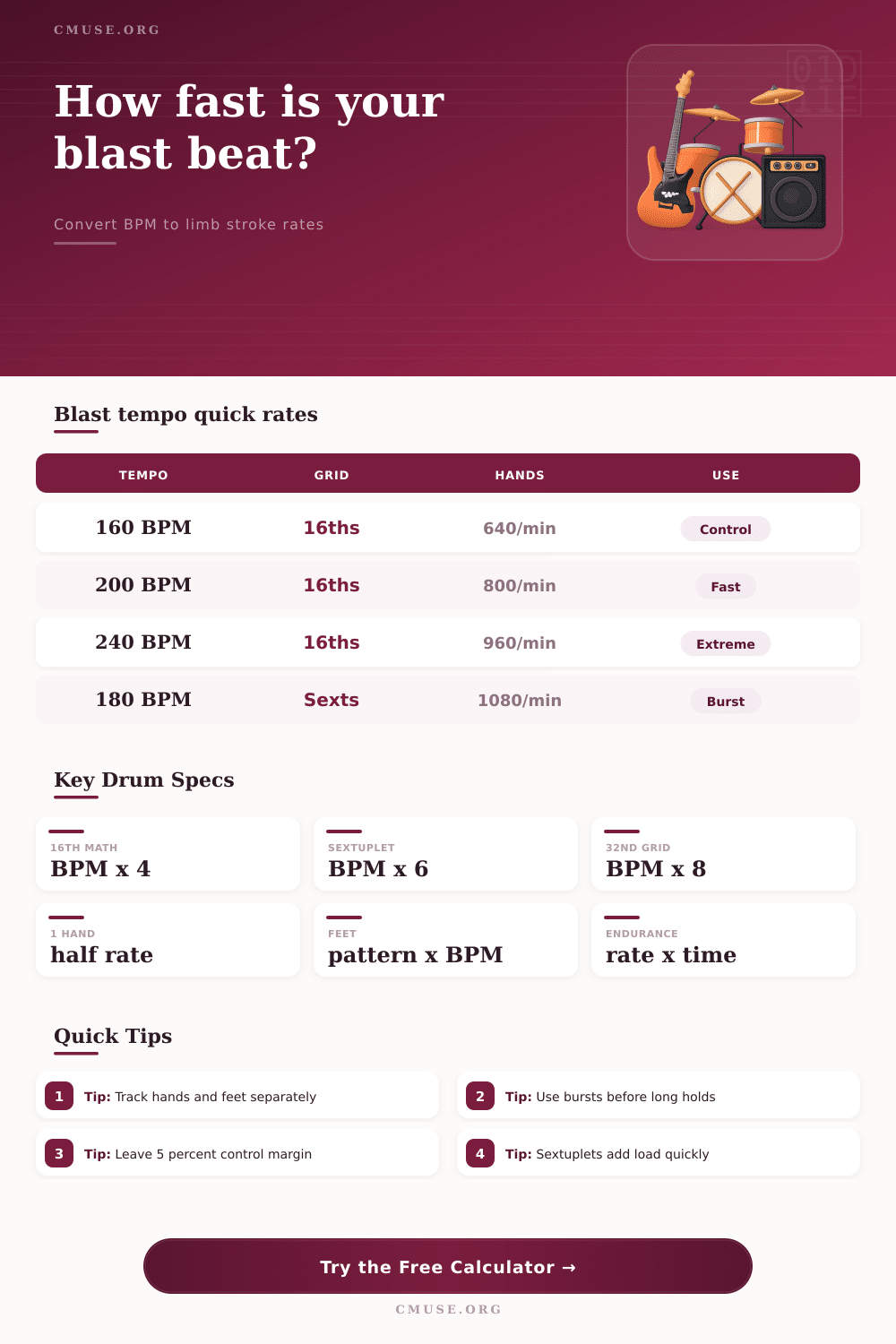
Written tempo becomes hand workload by multiplying BPM, notes per beat, and the selected hand factor.
hand SPM = BPM × subdivision × hand factor
Kick strokes per minute
Feet are counted separately because many blasts pair 16th-note hands with quarter, 8th, or 16th-note kick patterns.
foot SPM = BPM × kick hits per beat
Combined stroke rate
Total physical rate combines hands and feet, then converts the minute value into strokes per second.
total SPS = (hand SPM + foot SPM) / 60
Phrase load
Active seconds, rest percentage, and accuracy estimate how many clean strokes the drummer must deliver.
clean strokes = total SPS × active sec × accuracy
| Style | Typical Grid | Hand Factor | Kick Pattern | Best Reading |
|---|---|---|---|---|
| Traditional | 16ths or triplets | 1.00, alternating | Quarter to 8ths | Balanced snare/cymbal singles with clear pulse. |
| Skank blast | 8ths or 16ths | 0.75 to 1.00 | Quarter to 8ths | Use when the punk pulse matters more than pure density. |
| Bomb blast | 16ths | 2.00, both hands | 16th double kick | Highest combined workload because hands land together. |
| Gravity blast | 16ths or sextuplets | 1.15 to 1.35 | Quarter to 16ths | Lead-hand share often rises because the snare rebounds. |
| Hammer blast | 16ths | 2.00, locked hands | 8ths or 16ths | Strong for short walls, very demanding over long holds. |
| Hyperblast | 16ths, 32nds, bursts | 1.00 to 1.25 | 16ths or sextuplets | Watch combined SPS and active phrase length first. |
| Tempo | 8ths | Triplets | 16ths | Sextuplets | 32nds |
|---|---|---|---|---|---|
| 140 BPM | 280/min | 420/min | 560/min | 840/min | 1120/min |
| 180 BPM | 360/min | 540/min | 720/min | 1080/min | 1440/min |
| 200 BPM | 400/min | 600/min | 800/min | 1200/min | 1600/min |
| 240 BPM | 480/min | 720/min | 960/min | 1440/min | 1920/min |
| 280 BPM | 560/min | 840/min | 1120/min | 1680/min | 2240/min |
| Combined Rate | Typical Feel | Useful Drill | Risk Signal | Calculator Focus |
|---|---|---|---|---|
| 8 to 14 SPS | Controlled practice tempo | Long holds, relaxed motion | Rushing accents | Check even hand split. |
| 14 to 20 SPS | Fast but trackable | 30 to 60 second holds | Kick drift | Compare hands versus feet. |
| 20 to 28 SPS | Extreme song tempo | Short sets and rests | Volume collapse | Use control-margin BPM. |
| 28 to 40 SPS | Specialized burst zone | 5 to 15 second bursts | Tension or missed notes | Limit active phrase load. |
| Scenario | BPM | Subdivision | Hand Rate | Foot Rate | Use In Calculator |
|---|---|---|---|---|---|
| Warmup single-stroke blast | 150 | 16ths | 600/min | 300/min | Build relaxed mechanics before speed work. |
| Classic grindcore passage | 210 | 16ths | 840/min | 420/min | Check if phrase load stays clean for 30 seconds. |
| Black metal ride blast | 190 | 16ths | 760/min | 380/min | Use cymbal accent spacing to show pulse strain. |
| Death metal double-kick blast | 240 | 16ths | 960/min | 960/min | Combined SPS reveals the full limb demand. |
| Sextuplet fill burst | 180 | Sextuplets | 1080/min | 540/min | Good for short transition fills and sprint drills. |
Attempting to play at two-hundred beats per minute will require looking beyond the tempo alone. The tempo alone doesn’t tell you anything about physical effort required to hit that amount of beats per second. What I mean by this is that two-hundred beats per minute isn’t going to tell you how many times you has to hit a drumhead with your hand.
Take a moment and pull out a calculator, translate those complex numbers into concrete rates of physical exertion. Doing this lets you break it down and know precisely what your body parts will be expected to do. Blasting away at speed is one thing and playing cleanly at speed is another. The former is a burst of adrenaline while the latter are a test of your structural integrity in your shins and wrists.
Why Counting Strokes Helps You Play Faster Drums
At two hundred beats per minute a basic sixteen note subdivision is equal to eight hundred strokes per minute by your hands alone. Add in double bass pedals that kick out eighth notes and now you’re striking out at four hundred more with your feet. The choice of style preset sets the baseline of limb interaction. On a traditional alternating blast, your hands stays evenly timed but a bomb blast has both hands striking together each beat. This immediately doubles the hand factor.
On paper it might sound small but hit a snare and hi hat together full force nine hundred times a minute. Within seconds your shoulder tension will be through the roof. You can tweak all this stuff with tool and make it play like you’re learning the song, at exactly its density. If you are practicing a gravity blast where your lead hand do more work, tweaking the share percentage reveals just how lopsided that fatigue becomes.
The bottleneck of extreme drumming isn’t solely raw speed, but rather ability to endure. Sure, maybe you can maintains a hyperblast for five seconds without losing form. But how many? How long can you sustain that until fatigue set in? The duration input provides an estimate of total clean strokes within a certain time frame to help you see phrase load. Since real songs breathe, it also factors in rests. It include stops and starts.
What happens when you ignore the breaks during your practice? You end up with inaccurate endurance expectations. And then you’re on a take and suddenly you fail because your grip gave out at measure forty-two from cumulative fatigue you never planned for. It also considers accuracy. You can set the clean note percentage so it accounts for human error. Pros miss notes when they play realy fast on long blast passages too.
The calculator takes this into account, and final stroke count is based off reaching a realistic goal rather than theoretical perfection. This is a good test to realize that playing loud isn’t necessarily the same thing than playing precisely. The second factor is the choice of subdivision. At any given pace, sextuplets feel much quicker than sixteenth notes. That’s because there are more events per beat in the sextuplets, plus you have to exert far more precise motor control over your playing.
The table on this page breaks down the rates so you can compare them side by side. You’ll notice that if the drummer wants something fast but isn’t prepared to play with mechanical precision of thirty-second notes then they’ll swap to triplets. Finally, err on the side of caution. The control margin function provides an additional percentage buffer over your intended tempo. This is essential during a recording session.
You should of be able to play two hundred and ten in the practice room so you can comfortabley play two hundred on tape. An additional five percent will relax you when it matters, as relaxation is key to increasing speed. Tension kills. Having precise knowledge about your stroke rates empowers you to know how far you can go, when you can push and when you really do have some room to spare. Panic becomes planning.