Drum Fill Subdivision Calculator
Build tempo-aware drum fills by mapping the subdivision grid, fill length, note spacing, sticking rate, kick anchors, cymbal resolutions, and drum-to-drum orchestration balance.
Choose a named fill shape, then adjust tempo, length, subdivision, sticking load, kick placement, and tom spread. Each preset calculates immediately.
Fill Breakdown
Grid Slots
Entered Hits
Hand Notes
Foot Or Cymbal
Notes Per Sec
Grid Density
Accent Share
Speed Load
| Subdivision | Notes Per Beat | Spacing At 100 BPM | Spacing At 140 BPM | Best Use |
|---|---|---|---|---|
| Quarter notes | 1 | 600 ms | 429 ms | Big open pickups, tom punches, beginner fills. |
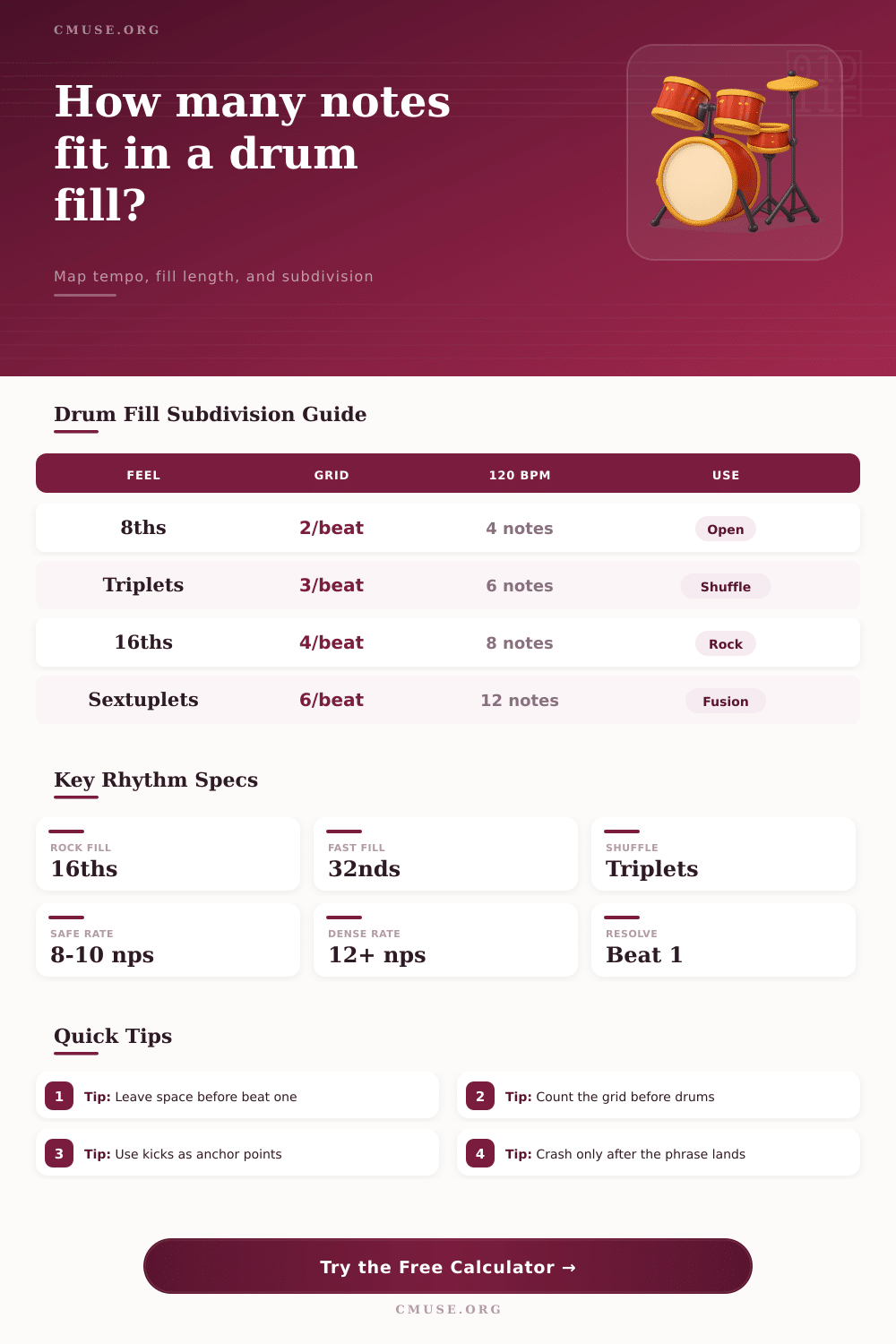
| Eighth notes | 2 | 300 ms | 214 ms | Rock, punk, country, and direct transition fills. |
| Triplets | 3 | 200 ms | 143 ms | Shuffle, blues, swing, gospel, and rolling phrases. |
| Sixteenth notes | 4 | 150 ms | 107 ms | Common rock and pop fills with clear hand alternation. |
| Sextuplets | 6 | 100 ms | 71 ms | Linear fills, fast tom runs, and fusion bursts. |
| Thirty-seconds | 8 | 75 ms | 54 ms | Short bursts, metal pickups, and brief hand flurries. |
| Orchestration | Typical Share | Sound | Subdivision Match | Watch Point |
|---|---|---|---|---|
| Snare-led fill | 40 to 70 percent snare | Sharp, centered, rudimental. | 16ths, triplets, 32nd bursts. | Too many accents can flatten the groove. |
| Rack-to-floor toms | 45 to 80 percent toms | Melodic descent across the kit. | 8ths, 16ths, sextuplets. | Leave room for the floor tom to land. |
| Kick-anchored linear | 15 to 35 percent kick | Modern, syncopated, punchy. | 16ths and sextuplets. | Foot rate can outrun the hands at high BPM. |
| Ghost-note pocket | 20 to 50 percent ghost notes | Funky, quiet, detailed. | 16ths and swung 16ths. | Keep ghost notes much softer than accents. |
| Cymbal punctuation | 1 to 4 cymbal hits | Big phrase markers. | Any grid. | Crashes work best after the fill resolves. |
| Fill Type | Length | Grid | Notes In 4/4 | Practice Target |
|---|---|---|---|---|
| One-beat pickup | 0.25 bar | 16ths | 4 notes | Place the last note before the crash. |
| Half-bar answer | 0.5 bar | 16ths | 8 notes | Start on beat 3 and resolve on 1. |
| Full-bar rock fill | 1 bar | 16ths | 16 notes | Use four-note groups around the kit. |
| Triplet turnaround | 1 bar | Triplets | 12 notes | Count trip-var across each beat. |
| Sextuplet burst | 0.5 bar | Sextuplets | 12 notes | Keep it short unless tempo is low. |
| Two-bar feature fill | 2 bars | 8ths or 16ths | 16 to 32 notes | Build dynamics instead of filling every slot. |
| Feel | Count Pattern | Hand Approach | Kick Role | Resolution |
|---|---|---|---|---|
| Straight 16ths | 1 e and a | Alternating R L R L works cleanly. | Optional anchors on beat starts. | Crash or snare on beat 1. |
| Triplet roll | 1 trip let | Use R L L or R L R groupings. | Kick can replace one hand note. | Land after the last triplet group. |
| Sextuplet burst | 1 ta la ta la ta | Use six-note hand groups or linear pairs. | Kick can start or end each six. | Best as a short pickup. |
| Thirty-second flash | Eight slots per beat | Keep hands low and relaxed. | Use sparingly at high tempo. | Stop early enough to breathe. |
| Ghosted funk fill | 16th grid | Accents high, ghost notes low. | Kick reinforces syncopation. | Return to pocket instead of overplaying. |
While isolated a drum fill might sound great, when you step back into the groove it all go to hell. It’s never realy a technique problem. Your feet is in place. Your hands are just fine. Your timing isn’t bad at all. What happens is usually math. Either you’ve overloaded the bar with too much info or you’ve spread that info out in such an uneven way that it becomes a rhythmic mess that doesn’t entertain as much confuse.
Because drumming is a structure of time, you don’t want to put too many notes in a wall before figuring out how many notes can go there. The calculator above will do that math for you but knowing what those numbers mean will change how you practice.
Why Your Drum Fills Do Not Sound Good
Beginning at the bottom then: What we’re really talking about here is rhythmic resolution, or put another way, the subdivision grid. If you set your metronome to 120 beats per minute, you have four subdivisions (sixteenth note) per beat, giving you lots of space within each to travel around the kit without feeling rushed. Jump up now to thirty-second notes and you find yourself with eight subdivisions per beat. That’s a lot less time (in milliseconds) between strikes.
Short bursts can generate a certain amount of energy, but if you try to keep it going for a whole bar, you will produce nothing more than noise during your fill. On the page I’ve included a reference table that clearly illustrates what happens as tempo increases, making the space between each hit tighter and tighter. Thirty-second notes at 140BPM are almost unplayable if you’re attempting anything more than a brief pick up.
It is why most drummers don’t pay attention to this relationship until they fall flat on their face in a live performance. Then it dawns on them that their fill didn’t take into account the actual speed of the song. Ideas tend to go to die in orchestration. For instance, you can have a great rhythm idea, but if you play everything on the snare drum it ends up sounding like a single hit instead of a phrase.
You can visualize it like this: It tracks how much you’re playing on each tom and balances the snare with the toms and the ratio of hand hits to foot hits. Foot load. What makes a classic rock fill work? It create a descending melody across high tom, the mid tom and the floor tom, anchored by the kick which anchors the beat. By looking at what you put in, you’ll see that 70 percent of your notes is going on one drum. That is why the balance score warns you.
People misunderstand variety. Variety isn’t about hitting more drums. Variety is about using different drums to accent different parts of the phrase. The foot doesn’t just keep time, it provides punctuation that allows the hands to breathe.
The other massive part of making a fill feel human is the inclusion of accents and even ghost notes. Sixteen equal volume sixteenth notes evenly across the grid will sound robotic. By adding ghosts notes, soft taps that live inside the groove but don’t draw attention to themselves, you have factored into calculator. This is a key element of gospel and funk drumming. You’re not after the number of notes played; you’re after the number of notes left unaccented. Adding ghosts or reducing the density tells the drummer they need to think about the dynamic rather than simply how hard the note is hit. Ten notes with two accents can be more exciting than twenty loud hits as the ear craves contrast.
Lastly, think about where you land. Where does each fill lead to? Typically this is beat one of the next measure. Let’s say your phrase lands on the “and” of four. That means you hit the crash cymbal too late in relation to the bar line. Unintentionally, this can push the pulse forward.
By planning out where you want the phrase to resolve, you make sure there is somewhere for all of that energy you’ve created to go. Is it going to be an open crash or a choked cymbal stop? Either way, that last note is your period at the end of your sentence. It’s what completes the thought. Without it, the audience is left hanging there and thinking did they really forget to return to the verse or end the song.
Practice the calculations before sitting down at the kit. Map out the drum hits in your head or on paper, clap the subdivision, check it against the tempo and see where you are based off each other. Then when you do pick up the sticks, you’ll find the fill doesn’t sound so much like a scramble for notes but a deliberate statement. You’ve already worked through the puzzle and as such, you can play confidently.
It’s not about filling every empty space, it’s about ensuring every note has earned its place in the bar.