Double Stroke Rate Calculator
Convert double-stroke roll tempo, note value, sticking, bar length, surface response, and practice duration into stroke rate, hand rate, spacing, and total repetitions.
Load a real drumming scenario, then adjust the drum surface, subdivision, rebound share, and phrase length to match your practice pad, snare drum, kit part, or marching exercise.
Calculation Breakdown
strokes per beat
strokes per bar
strokes per phrase
double pairs per phrase
planned accents per phrase
spm from target
estimated active work share
rate category
Roll rate
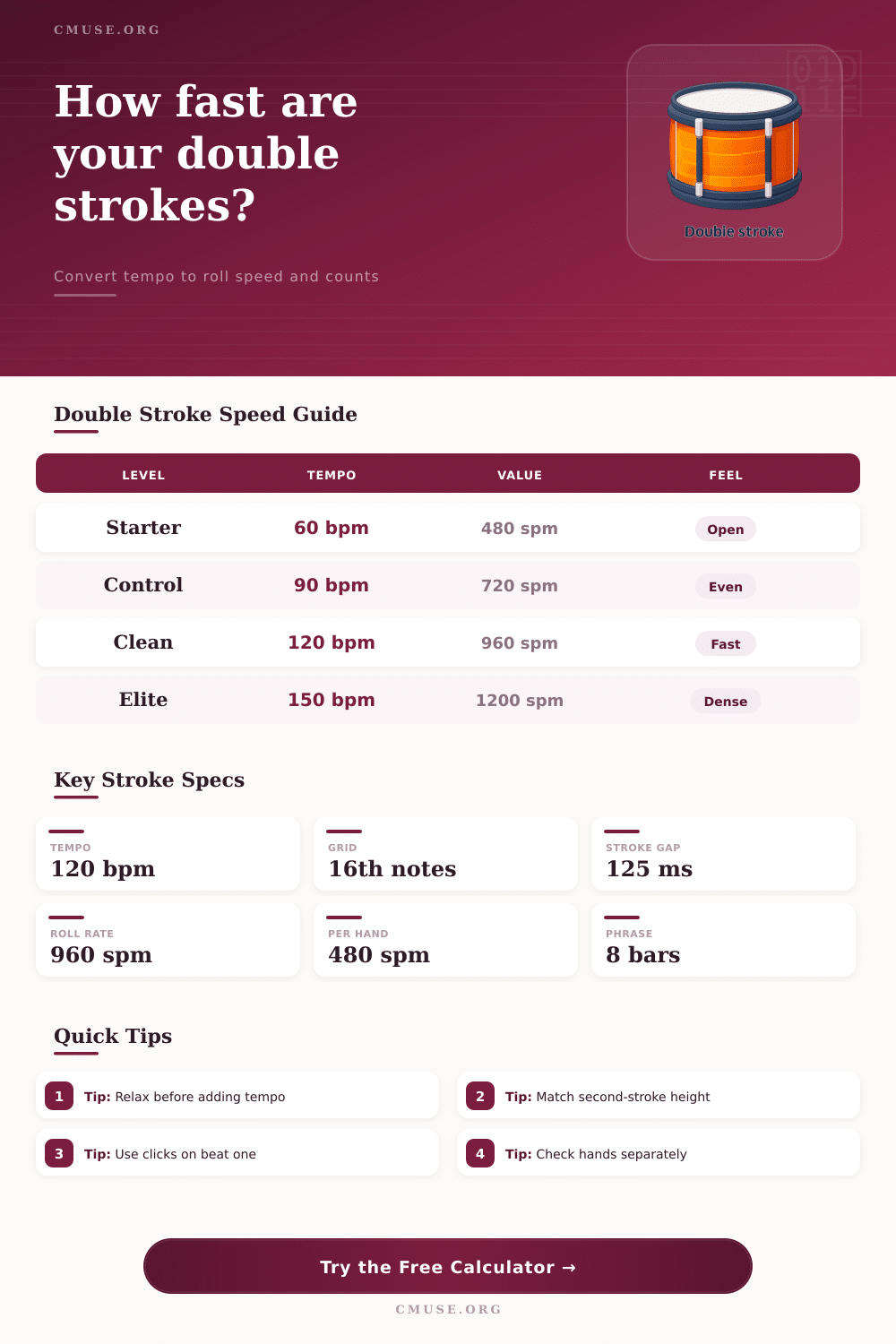
BPM x strokes per beatEvery tap in RRLL is counted, so 120 bpm sixteenth-note doubles equal 480 strokes per minute before note-density changes.
Spacing
60000 / strokes per minuteThe millisecond gap shows how tightly the taps are spaced; smaller values demand cleaner rebound timing.
Hand rate
Roll rate / active handsTwo-hand doubles split the workload between right and left; one-hand drills assign the full rate to one side.
Phrase count
Bars x beats x strokes per beatThe phrase count helps compare an 8-bar drumline exercise, a 4-bar kit fill, or a timed endurance block.
| Subdivision | Strokes Per Beat | SPM At 90 BPM | Stroke Gap | Typical Double-Stroke Use |
|---|---|---|---|---|
| Eighth notes | 2 taps | 180 spm | 333 ms | Slow open-roll checkpoints and relaxed hand matching. |
| Triplet eighths | 3 taps | 270 spm | 222 ms | Swing phrasing, triplet grids, and rudimental spacing checks. |
| Sixteenth notes | 4 taps | 360 spm | 167 ms | Most pad warmups, snare roll builders, and kit fills. |
| Sixteenth triplets | 6 taps | 540 spm | 111 ms | Rudimental roll flow, shuffle diddles, and fast hand control. |
| Thirty-seconds | 8 taps | 720 spm | 83 ms | Closed rolls, quick fills, and advanced rebound control. |
| Practice Level | Sixteenth BPM | Roll Rate | Per-Hand Rate | Listening Check |
|---|---|---|---|---|
| Starter control | 60 bpm | 240 spm | 120 spm | Both notes of each double sound equal and unforced. |
| Practice pad clean | 90 bpm | 360 spm | 180 spm | Second stroke is not crushed or late after the rebound. |
| Rudimental steady | 120 bpm | 480 spm | 240 spm | Accent grid remains stable when volume changes. |
| Fast open roll | 150 bpm | 600 spm | 300 spm | Hands stay relaxed and rebound remains centered. |
| Advanced burst | 180 bpm | 720 spm | 360 spm | Short bursts speak clearly before endurance is added. |
| Surface | Response Factor | Rebound Feel | Best For | Rate Caution |
|---|---|---|---|---|
| Gum rubber pad | 1.00 | Balanced | Daily timing, evenness, and metronome work. | Do not allow pad bounce to mask weak second strokes. |
| Medium snare drum | 1.05 | Natural | Transfer from pad to acoustic drum sound. | Listen for snare response changing between hands. |
| Marching snare | 0.92 | Very quick | High-tension clarity and drumline endurance. | Speed can feel easier than the control actually is. |
| Floor tom | 1.22 | Slow | Kit movement and low-rebound recovery. | Lower the tempo until both taps speak evenly. |
| Pillow pad | 1.35 | Minimal | Finger and wrist conditioning at modest tempo. | Avoid forcing fast doubles with excess tension. |
| Project | Starting Inputs | Primary Result | Secondary Result | Use Case |
|---|---|---|---|---|
| 8-bar open roll | 80 bpm, 16ths, 4/4 | 320 spm | 128 strokes | Clean sound match across a full phrase. |
| Tap roll check | 112 bpm, triplets, 4/4 | 336 spm | 96 strokes | Drumline timing with accent control. |
| Kit fill burst | 140 bpm, 32nds, 1 bar | 1120 spm | 32 strokes | Short fill density before moving drums. |
| Concert roll pad | 72 bpm, 32nds, 4 bars | 576 spm | 128 strokes | Smooth closed-roll texture at quiet dynamics. |
| Endurance block | 100 bpm, 16ths, 10 min | 400 spm | 4000 strokes | Measure fatigue without changing tempo mid-block. |
Then you grab a practice pad and metronome and begin practicing double stroke roll. You select a tempo of ninety beats per minute and begin tapping out sixteenth notes. What you hear sound good; it’s smooth and even. Chances are, however, that your dominant hand is rushing ahead and the weak hand are dragging behind and crushing its rebounds.
Speed isn’t merely moving the beat faster, it’s about getting two hands to create equal sounds at ever-smaller increments of time. Input your selected tempo and subdivide to let the calculator do all the math for you. This free you from guessing whether you are actualy increasing your speed or just covering up imperfections by playing louder.
Why Evenness Is More Important Than Speed
While most drummer will conceive their work in terms of ‘beats per minute’, these figures represent the pulse rather than density of the number of times they produce a stroke. If you choose to play sixteenth notes at a tempo of ninety bpm you agree to tap the practice pad four separate times within each beat. Across both hands, that equates to a total of three hundred and sixty individual strokes per minute. Even though it might sound doable, what you haven’t considered yet is that there is one hundred and eighty unique movements required from each hand in that timeframe.
Your brain doesn’t process this as one long movement; instead, you’re asking two different limbs to work together at speed with distinctly different muscle memory pattern for how you perform the downstrokes and upstrokes. Many players don’t consider surface response as a critical factor. Gum rubber pads responds consistently through long playing sessions and provide balanced rebound. High-tensioned marching snares may appear faster as they return the stick more aggressively in your hand. It’s often easy to think you’ve upgraded your technique rather than just getting used to a new physical environment.
You’ll see from the reference table on this page that response factors change the perceived difficulty of a particular tempo. Over-reliance on a bouncy surface can result in fragile technique that falls apart when transferred to another instrument with a lower rebound such as a pillow or perhaps a floor tom.
At nearly all stages of development, speed alone isn’t as important than evenness. This is where the calculator does some measuring, working out the milliseconds between each tap of the stroke. It’s a lifetime in terms of how the brain processes it when you’re tapping at lower tempos with more than three hundred milliseconds between hands. You’re pushing yourself towards a thousand-plus strokes per minute and now the space has narrowed to a span of milliseconds, with sixty milliseconds or less between each tap.
There’s no room for compensation here. If you miss the rebound and the next strike is in less then a tenth of a second, you can’t muscle it into place. It must be clean enough to work with the physics instead of against it.
The other factor affecting the strategic nature of practice time is amount of time spent practicing. In a ten-minute slot played moderately, you’ll have thousands of repetitions under your belt. This reinforces whatever endurance you may have but will amplify any technical flaws present in your foundation. You might rush through the left hand during the first minute. By the time you’re done with your set, you’ll have rushed it two thousand times. Thinking about how many strokes you do per second helps clarify what the calculator shows; repeating anything inaccurately becomes effective error training.
These are not numbers on a screen to be chased. They are meant to create a trusty engine in your hands. It is a double stroke roll that maintain itself under varying circumstances: change the speed, alter the dynamics, or walk on different surfaces and it will hold up. Control should of lead to speed, not the other way around.
If you play cleanly at three hundred and sixty strokes per minute, pushing it to five hundred will be an exercise in refinement, not reinvention. Begin slowly so that each subsequent stroke is equal in both volume and tone. Check the results with the data. If the numbers say you are fast but the sound says you are uneven, trust the sound. If not, believe the sound. If you let the clock trick you, it will always lie.