Roll Stroke Count Calculator
Count the stick strokes, hand balance, accents, buzz contacts, and phrase density for snare, tenor, timpani, cymbal, and drum set rolls.
Choose a named roll situation, then adjust tempo, bar count, subdivision, sticking, buzz density, accents, and safety buffer for your exact part or practice drill.
Calculation Breakdown
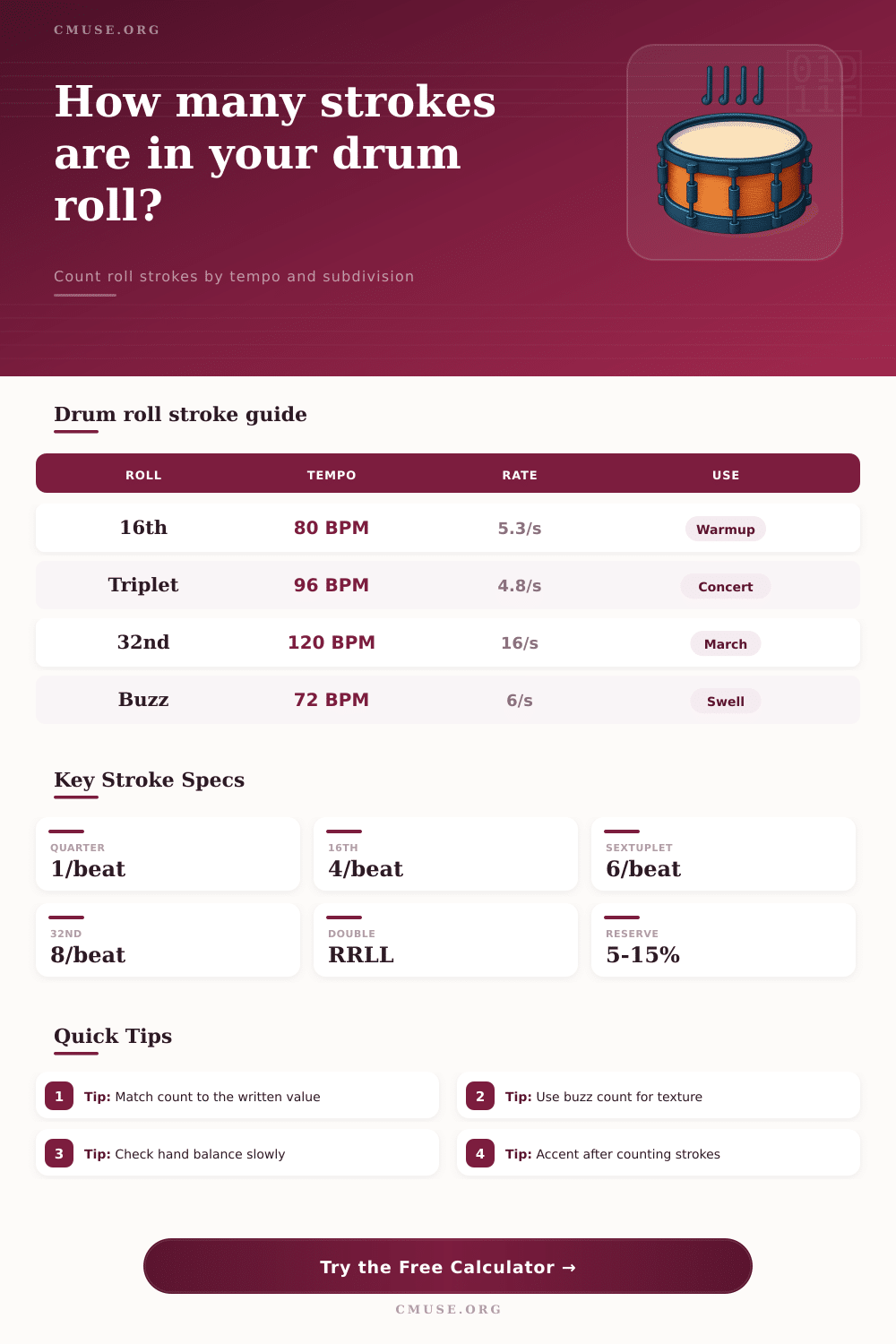
4/beat
sixteenth-note roll count at quarter-note tempo
6/beat
sextuplet count for dense rudimental rolls
8/beat
thirty-second count for fast open rolls
RRLL
standard open double stroke cycle
RLLRR
common five-stroke phrase shape with release
3x
typical buzz contact estimate per hand motion
10%
normal added practice buffer for clean endings
12/s
watch zone for many open roll practice tempos
| Written subdivision | Strokes per beat | Strokes per 4/4 bar | Example at 100 BPM |
|---|---|---|---|
| Quarter notes | 1 | 4 | 1.7 strokes per second |
| Eighth notes | 2 | 8 | 3.3 strokes per second |
| Eighth-note triplets | 3 | 12 | 5.0 strokes per second |
| Sixteenth notes | 4 | 16 | 6.7 strokes per second |
| Quintuplets | 5 | 20 | 8.3 strokes per second |
| Sextuplets | 6 | 24 | 10.0 strokes per second |
| Thirty-second notes | 8 | 32 | 13.3 strokes per second |
| Thirty-second triplets | 12 | 48 | 20.0 strokes per second |
| Roll family | Counting approach | Useful result | Practice note |
|---|---|---|---|
| Single stroke roll | Every written note is one alternating contact | Total strokes and hand balance | Best for checking maximum clean speed. |
| Open double stroke roll | Count each R or L contact in the RRLL cycle | Total contacts and phrase cycles | Useful for rudimental control and rebound evenness. |
| Buzz or press roll | Count written stick motions plus estimated buzz contacts | Audible contact estimate | Use a realistic bounce value instead of chasing exact grains. |
| Five stroke roll | Four roll notes plus one release note | Phrase repeats and leftover strokes | Accent placement depends on where the release lands. |
| Seven stroke roll | Six roll notes plus one release note | Phrase repeats and ending control | Works well for two-beat and pickup figures. |
| Nine stroke roll | Eight roll notes plus one release note | Longer release phrase count | Common when rolls stretch across larger beat groups. |
| Tremolo roll | Count alternating contacts on one surface | Sustained density per second | Useful for timpani, mallets, and cymbal rolls. |
| Scenario | Tempo and length | Subdivision | Written stroke count |
|---|---|---|---|
| Snare 16th warmup | 80 BPM for 30 seconds | Sixteenth notes | 160 strokes before buffer |
| Concert buzz swell | 72 BPM for 8 seconds | Eighth-note triplets | 29 strokes before buzz contacts |
| Four-bar marching roll | 120 BPM, four bars of 4/4 | Thirty-second notes | 128 strokes before buffer |
| Two-beat drum set fill | 132 BPM, half bar of 4/4 | Sixteenth notes | 8 strokes before buffer |
| Slow open double drill | 60 BPM, eight bars of 4/4 | Sextuplets | 192 strokes before buffer |
| Timpani sustain roll | 88 BPM for 12 seconds | Thirty-second notes | 141 strokes before buffer |
| Accent interval | Meaning | Good use | Counting caution |
|---|---|---|---|
| Every 4 strokes | One accent per sixteenth beat group | Basic grid practice and barline control | Can feel too square for concert buzz rolls. |
| Every 6 strokes | One accent per sextuplet beat group | Rudimental rolls and triplet-based phrases | Check that the release stroke does not shift the phrase. |
| Every 8 strokes | One accent per half bar in 4/4 sixteenths | Open double stroke endurance sets | Hand assignment changes with odd total counts. |
| Every 12 strokes | One accent per four triplet beats | Concert rolls with broad pulse shaping | Useful as a musical guide, not a hard volume rule. |
| Every 16 strokes | One accent per 4/4 bar of sixteenths | Phrase endings and marching checkpoints | Keep the last release stroke clean and intentional. |
Planning prevents you from running out of momentum when performing by ensuring you know exactly how many strokes is needed for the full duration of a passage. It sounds as if you think you know how far you can stretch a passage. But until you have counted number of physical contacts against the abstract musical space, you aren’t going to trust your muscle memory. This tool on this page turns that abstract space into hard physical labour. It helps you ensure that what the audience hears isnt dead air they notice.
Rolls is quite straightforward mathematically but lots of people still muck it up as they only think about speed rather then for how long. Firstly work out how many strokes you can place within time signature. If you are playing a piece in 4/4 at an even pace of 96 bpm using sixteenth notes, you have a certain number of contacts to achieve per beat. Simply multiply that figure by however many bars there is to be played. That’s your starting point.
How to Plan Your Drum Rolls
When you add in considerations such as hand fatigue, accents and sticking pattern to music, it isn’t simply a case of counting. The calculator will do the mathematical multiplication for you based off the tempo you enter plus the subdivision you choose. This eliminates any potential calculation mistakes you might make while rehearsing.
Those are the numbers, but what’s your sticking? How do you apply them? If you use an alternating single-stroke roll, work load is even across both hands. However, you’ll need to flick your wrists at speed and break notes down tightly. A double-stroke roll feel heavier but requires rebound control that can fails if you rush the setup. Enter these considerations into the tool, and they creates a split in right and left-hand contact. The key to endurance comes from this balance; too much workload on one side mean stroke consistency breaks down. Before you go out and practice, check this balance to avoid sounding like an amateur in a large hall or on a recording.
Because buzz relies on stick tension and friction, not clearly defined rebounds, it add another layer of complication: buzz rolls. The number of buzz contacts per stroke is a ballpark figure for how dense the texture might be. Unlike counting actual press roll grains (open strokes), you’ll have to go by how much physical effort it takes to maintain that texture for thirty seconds compared to ten seconds. That will help you know when a light bounce is more appropriate for a swell, versus a heavier press for a climax. These are intentional dynamics, not accidental ones.
The use of accents brings the roll to life in the music. Planned accents provides a beat that connects with other instrument in the music. Against a sea of sixteenth notes, if you accent every eighth stroke, you mark the beat. This adds some texture to the sound while keeping drummer grounded. As can be seen from the tool’s reference table, varying accent intervals alter character of the roll. Your playing sounds controlled and professional when used as a structural guide for accents.
Lastly: leave yourself a buffer on the count. In performance things dont always go to plan. You may wish to prolong a phrase for drama or need a few more strokes to get over a stumble. Leave yourself another 10-15 percent of strokes on your mental map so that you can account for this in the moment and still maintain a place. Better to be too prepared then to look down at your feet once more.
As soon as you are familiar with the figures, they vanish; only the sound will remain. You should of planned better if it feels uncomfortably. It was actualy quite moddern approach.