Odd Meter Grouping Calculator
Build practical accent maps for 5, 7, 9, 11, 13, and other uneven meters by turning pulse groupings into bar timing, phrase cues, and countable rehearsal patterns.
Choose a named meter feel, then adjust the grouping, tempo, denominator, phrase length, and accent plan. The calculator checks whether the grouping matches the meter numerator and maps the resulting pulse grid.
Grouping Breakdown
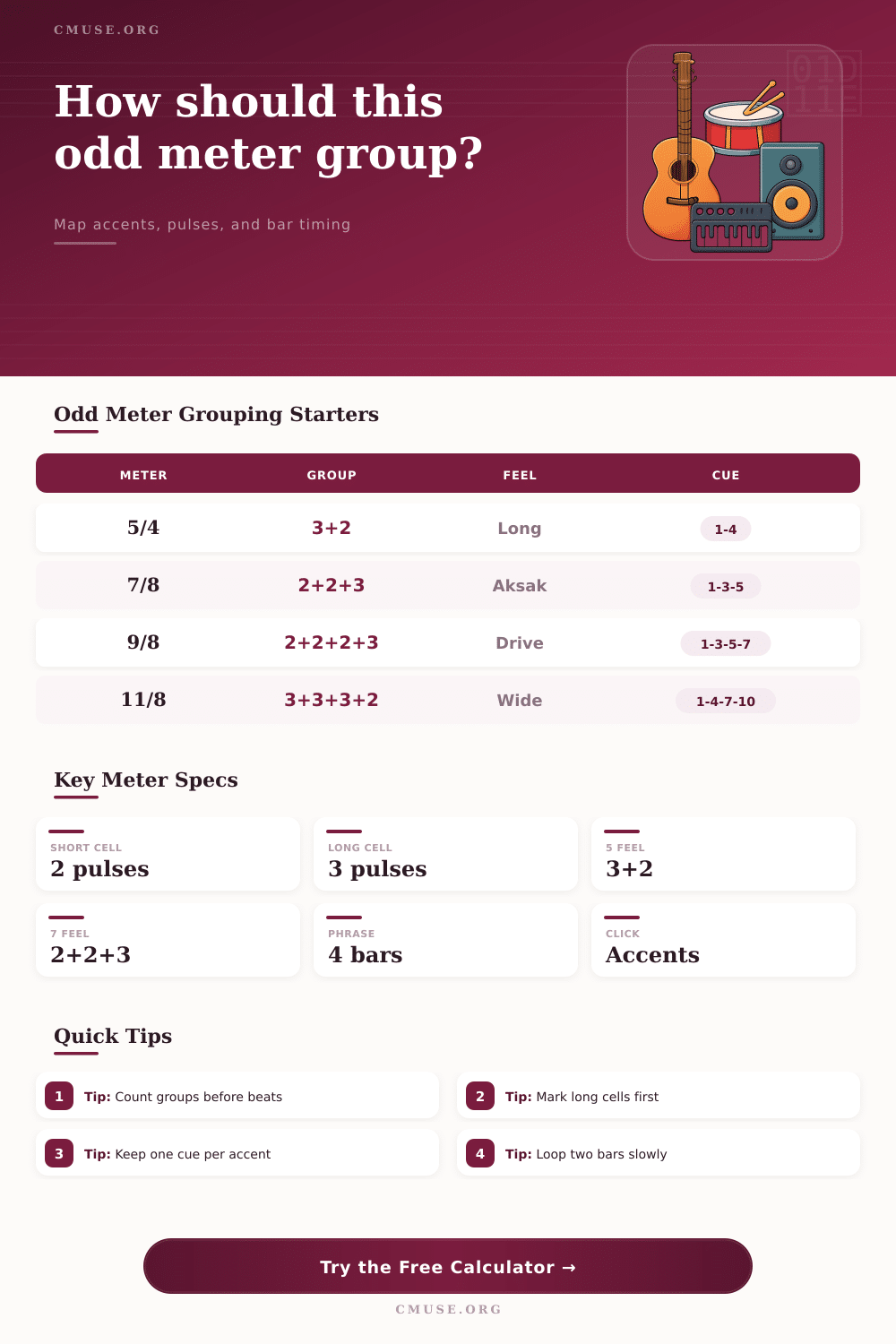
| Meter | Common Groupings | Primary Feel | Best Count Cue | Practice Note |
|---|---|---|---|---|
| 5/4 | 3+2, 2+3, 2+2+1 | Two large beats or five steady quarters | 1 2 3 / 1 2 | Keep the two-cell phrase calm before adding syncopation. |
| 5/8 | 2+3, 3+2 | Quick short-long or long-short lilt | 1 2 / 1 2 3 | Clap the long cell so the bar does not rush. |
| 7/8 | 2+2+3, 3+2+2, 2+3+2 | Three-cell additive pulse | 1 2 / 1 2 / 1 2 3 | Move the long cell to change the whole groove shape. |
| 7/4 | 4+3, 3+4, 2+2+3 | Broad phrase rather than fast dance pulse | 1 2 3 4 / 1 2 3 | Conduct groups first, then subdivide only difficult bars. |
| 9/8 | 3+3+3, 2+2+2+3, 2+3+2+2 | Compound or additive depending on accents | 1 2 / 1 2 / 1 2 / 1 2 3 | A 9/8 bar can be smooth or sharply uneven. |
| 11/8 | 3+3+3+2, 2+2+3+2+2, 4+4+3 | Long phrase with a closing short cell | 3 3 3 2 | Name the accents instead of counting eleven every time. |
| Pulse BPM | Pulse Length | 7 Pulses | 9 Pulses | 13 Pulses |
|---|---|---|---|---|
| 90 BPM | 666.7 ms | 4.667 s | 6.000 s | 8.667 s |
| 120 BPM | 500.0 ms | 3.500 s | 4.500 s | 6.500 s |
| 144 BPM | 416.7 ms | 2.917 s | 3.750 s | 5.417 s |
| 168 BPM | 357.1 ms | 2.500 s | 3.214 s | 4.643 s |
| 210 BPM | 285.7 ms | 2.000 s | 2.571 s | 3.714 s |
| Accent Density | Example Grouping | Best For | Risk | Rehearsal Fix |
|---|---|---|---|---|
| Low density | 4+3 in 7/4 | Slow melodic phrases and broad conducting | Players may lose the small subdivisions. | Add a quiet inner pulse during practice. |
| Medium density | 2+2+3 in 7/8 | Dance-like odd meters and tight rhythm section parts | The long cell can compress at faster tempos. | Accent only group starts, then remove the click. |
| High density | 2+2+3+2+2 in 11/8 | Fast additive patterns and riff-based writing | Too many cues can sound choppy. | Combine cells into larger phrase accents. |
| Compound feel | 3+3+3 in 9/8 | Flowing triplet-based music | May not sound odd unless phrase accents shift. | Mark phrase downbeats every two or four bars. |
| Preset | Meter | Grouping | Accent Starts | Use When |
|---|---|---|---|---|
| 5/4 Jazz 3+2 | 5/4 | 3+2 | 1, 4 | A slow groove needs two clear body pulses. |
| 7/8 Balkan 2+2+3 | 7/8 | 2+2+3 | 1, 3, 5 | The long cell should pull into the next downbeat. |
| 7/8 Prog 3+2+2 | 7/8 | 3+2+2 | 1, 4, 6 | A riff opens with weight then steps forward quickly. |
| 9/8 Aksak 2+2+2+3 | 9/8 | 2+2+2+3 | 1, 3, 5, 7 | The bar needs drive before a stretched ending. |
| 13/8 Split 3+3+2+2+3 | 13/8 | 3+3+2+2+3 | 1, 4, 7, 9, 11 | A longer phrase must stay countable at tempo. |
Odd meters is considered a mathematical problem for most musicians. To solve it they count out each beat. They tap their foot across five or seven pulse. They hope to force themself onto the downbeat with sheer willpower. That hardly ever works.
Seven eighth notes do not sound like one thing to the human ear. Rarely does a 7/8 feel like seven equal steps. It feels more like 2+2+3 or 3+2+2. The groove come from the gap between what we hear (cells) and what we count (pulses).
How to Play Odd Time Signatures
If you compose music in an uneven time signature, don’t worry about counting to thirteen. Worry about how much weight goes into which part of the bar. But what happens after you establish these groups? That’s when the calculator kicks in.
After entering the number of bars (or any other numeral), you type in the group pattern: 3+3+3+2. The calculator plots location of the accents. It also calculates the total length of that four-bar phrase at whatever tempo you entered. Rehearsal cues are worthless if players has conflicting mental maps of time.
If the guitarist is mentally hearing an accent on beat six and the drummer hears it on beat five, the groove goes splat. Seeing the accent events graphically lines up the band beforehand so you can record with confidence. Abstract rhythmic ideas becomes real timelines that everyone agrees on.
So take 5/4 compared to 5/8. Five pulses each but with different beats. With 5/4, each one is wider, broadly divided into quarters (hence its name). Think of that as grouped into 3+2. It is a long stretch with a quick resolution.
The pulse in 5/8 are faster. It is often divided into eighths. And it is a tighter 3+2. Lilt instead of stride. Now look at the switchable denominator on the calculator. Toggle it to see what happens to the seconds per bar duration when pulse width change.
At 160 BPM, a 7/8 bar lasts around 1.75 seconds. Short. No time for hesitation. Immediate cell knowledge required.
On the page I’ve put together a reference table of common meters such as 13/8 and 9/8. On paper they can be daunting. Often nine eighths is seen as three lots of three. This makes it sound similar to a triple meter. It can also be felt as 2+2+2+3, which pushes toward the final beat. This alters the whole feel of the song.
In the 9/8 time, 3+3+3 feels rolling and smooth. 2+2+2+3 feels insistent and jagged. Neither is right or wrong but simply paints a different color. The important thing is consistency. Pick your cell structure and stick with it throughout the phrase. Alternating from 2+3 to 3+2 every bar just confuses the ear rather then surprising it.
Practice slowly. Playing fast doesn’t internalise an odd meter. Speak the groups out loud. Two-two-three. Make sure there is a clear pause between each. Let your body tell you where it want to step. That’s the feeling that you transfer to the music.
The calculator confirms that your spoken count matches the notation. But it never replaces the feeling. It gives you the framework but not the soul. Set the accent strength and use this feature to replicate how a click track might help or hinder your rhythm section. Learning could of benefit from having a heavy accent on each group. If you don’t turn it off, it will often kill the swing while you are performng.
This is the bottom line. Odd meters simply add additional steps based off what would otherwise be an ordinary meter. They takes slightly longer to plan out during the writing process. This leads to less guesswork in the rehearsal room. Once you grasp the stacking of cells, the numerals dissolve. Rhythms turns into phrases. Why? Because you’ve created a map that resonates in your hands, your mind, and your limbs, resulting in flowing music.
Return to our 2+2+3 example. Repeat it. Sense the push. That’s when it all starts to groove.