Additive Meter Calculator
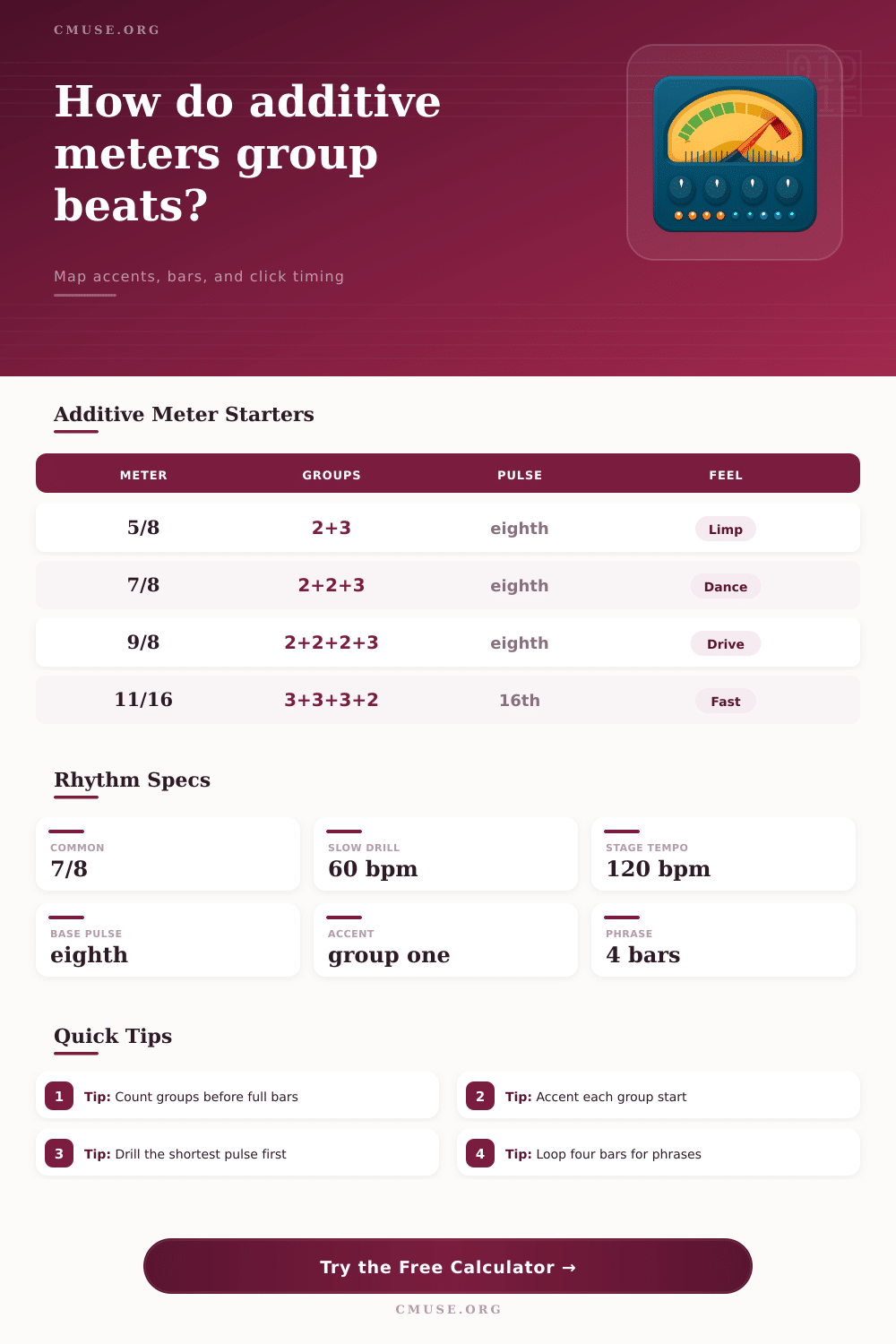
Convert grouped meters such as 2+2+3 or 3+3+2 into accent maps, bar length, phrase duration, pulse timing, and metronome practice targets.
Choose a named rhythm feel, then edit the grouping string, denominator, tempo, phrase length, and click plan. The grouping must use positive numbers separated by plus signs.
Calculation Breakdown
7/8
Written meter
3
Accent groups
476 ms
Base pulse
18/min
Bars per minute
| Meter | Common Grouping | Count Shape | Typical Use |
|---|---|---|---|
| 5/4 | 3+2 or 2+3 | Long-short or short-long | Jazz standards, film themes, progressive grooves |
| 5/8 | 2+3 or 3+2 | Two quick feet plus one long step | Fast dance-like phrases and compact riffs |
| 7/8 | 2+2+3, 3+2+2, 2+3+2 | Two short groups and one long group | Balkan rhythm, art rock, fusion, percussion studies |
| 9/8 | 2+2+2+3 or 3+2+2+2 | Four uneven pulses | Asymmetric dance grooves and bright ensemble lines |
| 11/8 | 3+3+3+2 or 2+2+3+2+2 | Long chain with a short turn | Progressive rock, modern chamber writing, ostinatos |
| 13/8 | 3+3+2+2+3 | Mixed long and short cells | Extended riffs and through-composed rhythmic cycles |
| Pulse BPM | Pulse Length | 7/8 Bar | 11/8 Bar |
|---|---|---|---|
| 60 BPM | 1000 ms | 7.00 s | 11.00 s |
| 90 BPM | 667 ms | 4.67 s | 7.33 s |
| 120 BPM | 500 ms | 3.50 s | 5.50 s |
| 150 BPM | 400 ms | 2.80 s | 4.40 s |
| 180 BPM | 333 ms | 2.33 s | 3.67 s |
| Goal | Click Mode | Accent Focus | When To Use |
|---|---|---|---|
| Learn the meter | Every base pulse | Group starts | First rehearsals and slow technical work |
| Feel the groove | Group starts only | Downbeat plus cells | Once the group order is memorized |
| Internalize time | Bar downbeat only | Phrase arrival | Advanced ensemble or solo practice |
| Clean fast runs | Two subdivisions | Even spacing | Sixteenth-note meters and rapid passages |
| Preset | Meter | Grouping | Practice Target |
|---|---|---|---|
| Take Five 5/4 | 5/4 | 3+2 | Keep the long group relaxed, then clip the two-beat answer. |
| Balkan 7/8 | 7/8 | 2+2+3 | Place weight on pulse 1 and allow the final cell to breathe. |
| Rondo 9/8 | 9/8 | 2+2+2+3 | Maintain even short cells before the long turnaround. |
| Prog 11/8 | 11/8 | 3+3+3+2 | Count three long cells, then snap the final two pulses. |
| 15/16 Run | 15/16 | 4+4+3+4 | Use subdivision clicks until the accent map locks. |
Most musicians learn time signatures as static fractions before they ever learn that rhythm is realy about how those fractions breathe. One-two-three-four becomes four-eighths. Seven-eighths looks like just a number or a fraction on a page. You look inside yourself for an internal metronome to count one, two, three…seven. It’s stiff.
It’s missing the point: additive meters are more about feeling the distinct grouping of notes and pulses rather than the total pulse count. Knowing that two-plus-two-plus-three sounds different physically than three-plus-two-plus-two make all the difference between a driving groove versus a mechanical stumble, even if the top number remains unchanged.
How to Learn Additive Meters
An additive meter calculator breaks down grouped rhythms into concrete timing references to help you learn with more structure than just intuition. It removes some of the anxiety around losing one’s place in an asymmetric bar by mapping out length of each phrase and where the accents land. The tool works like a calculator that breaks a grouping into sections based on their duration after you enter the group. For example, if you enter 2+3 for a 5/8 measure, it gives you length of each segment based off your tempo. The visual breakdown converts the vague feeling of rhythm into measured time intervals that you can then practice with a metronome.
The choice of pulse denominator is therefore critical because it determines the rate of your inner metronome. Working from an eight-note base unit means that each group in your sequence will move at a comfortabley moderate pace where individual events are easily articulated. Drop that pulse denominator into sixteenth-notes at the same tempo though and the groups whizz past one another unless you have had the foresight to practise slowly first. The calculator explains this trade-off clearly by shrinking or expanding the bar length to match whichever note value you select as your pulse.
The point is that a strategy that works for a novice will eventually be maddening for an experienced player and it’s important to adjust practice tactics as your understanding deepens. At first, program your click track to sound on every pulse in the bases, providing a security blanket so you never feel rushed moving from one group to another. Once you’re able to hear the accent pattern in your head without needing to look at the beat counter, change the metronome to only signal the beginning of each group. This will force you to learn the subdivisions by heart. Finally, eliminate everything but the downbeat of the entire phrase, challenging yourself to see if you actualy know how the rhythm is constructed or are simply dependent on outside clues.
A common error among many players is to treat all accents as equal in emphasis, so they squash the groove and make the meter more mathematical than musical. What are you to emphasize. What’s the heavy and what’s the light? For example, the 2+2+3 pattern often lands on the final three-beats, making them longer and thereby heavier while the first two beats is lighter and quicker. Accent each beat identically and you eliminate this narrative arc and have instead a robotic loop devoid of human feel. Compare the various styles in the calculator’s reference tables. Different styles use these patterns differently, ranging from the loose swing of jazz fusion to the driving bounce of Balkan rhythms.
Another common source of confusion with additive meters is how tempo alters them. When practiced slowly, they are often easy to manage because each pulse has plenty of time for reflection and deliberate hand placement. However, at faster tempi, these pulses combine into larger blocks of gestures and you begin to feel rather than count individual notes in the phrase. This change is fundamental to learning complex meters as it guides you towards the point when mental counting stops and physical feeling take over.
Music doesn’t stop on the dot of seven beats so if you extend your practice loops to include four or eight bars then it conditions your ear to pick up on the repeating pattern of accents further out. This gives greater forward movement that holds the listener’s attention, even with an unusual time signature. It also prepares you for performing live, where you may have to connect with fellow musicians who are perhaps not glued to the conductor.
Working with these additive meters truly becomes powerful when you break away from the four beat symmetrical grid that seems to dominate most moddern music. If you can accept these lopsided groupings, you will open yourself to a new world of rhythmic possibility. The listener will hear something fresh and unexpected compared to more traditional rock or pop structures. Initially, it takes some time to learn these groupings, but soon they become second nature and bring an added, unique voice to what you are playing.
Begin slowly. Use clear accents. Let the logic of the grouping lead your hands until your ears is finally in full control. The aim is not only to perform correctly, but also to make those odd meters sound as natural as breathing again. You should of gone back to that initial feeling of groove instead of arithmetic.