Metric Modulation Tempo Calculator
Convert a shared rhythm into a new tempo marking, compare pulse ratios, and check how the modulation changes bar length, click values, and conductor count.
Choose a named modulation pivot, then adjust the note values, tuplet spacing, meters, and rounding. Each preset recalculates the new tempo from the pulse that stays constant across the change.
Tempo Breakdown
Basic beat duration formula
Standard triplet compression
Common quintuplet modulation
Best unit for DAW checks
Conductor and cue comparison
Rounded practice tempo target
Rhythm that remains unchanged
Old tempo compared with new tempo
Old Rhythm Duration
Convert the old tempo unit into seconds, then scale it by the old rhythm value and tuplet spacing.
old pulse sec = 60 / old BPM * old rhythm / old tempo unit * tuplet space / tuplet count
New Tempo
The shared pulse, multiplied by the selected grouping, becomes the duration of one new tempo unit.
new BPM = 60 / (old pulse sec * pulses per new beat)
Tuplet Ratio
A tuplet value is shorter or longer than its written note according to notes played over notes replaced.
3 eighths in 2 eighths: each pulse = eighth * 2 / 3
Bar Duration
Meter length is calculated in quarter-note equivalents, then divided by the current tempo unit.
bar sec = 60 / BPM * meter quarter length / tempo unit
| Modulation Name | Old Pulse | New Count | Tempo Effect | Typical Use |
|---|---|---|---|---|
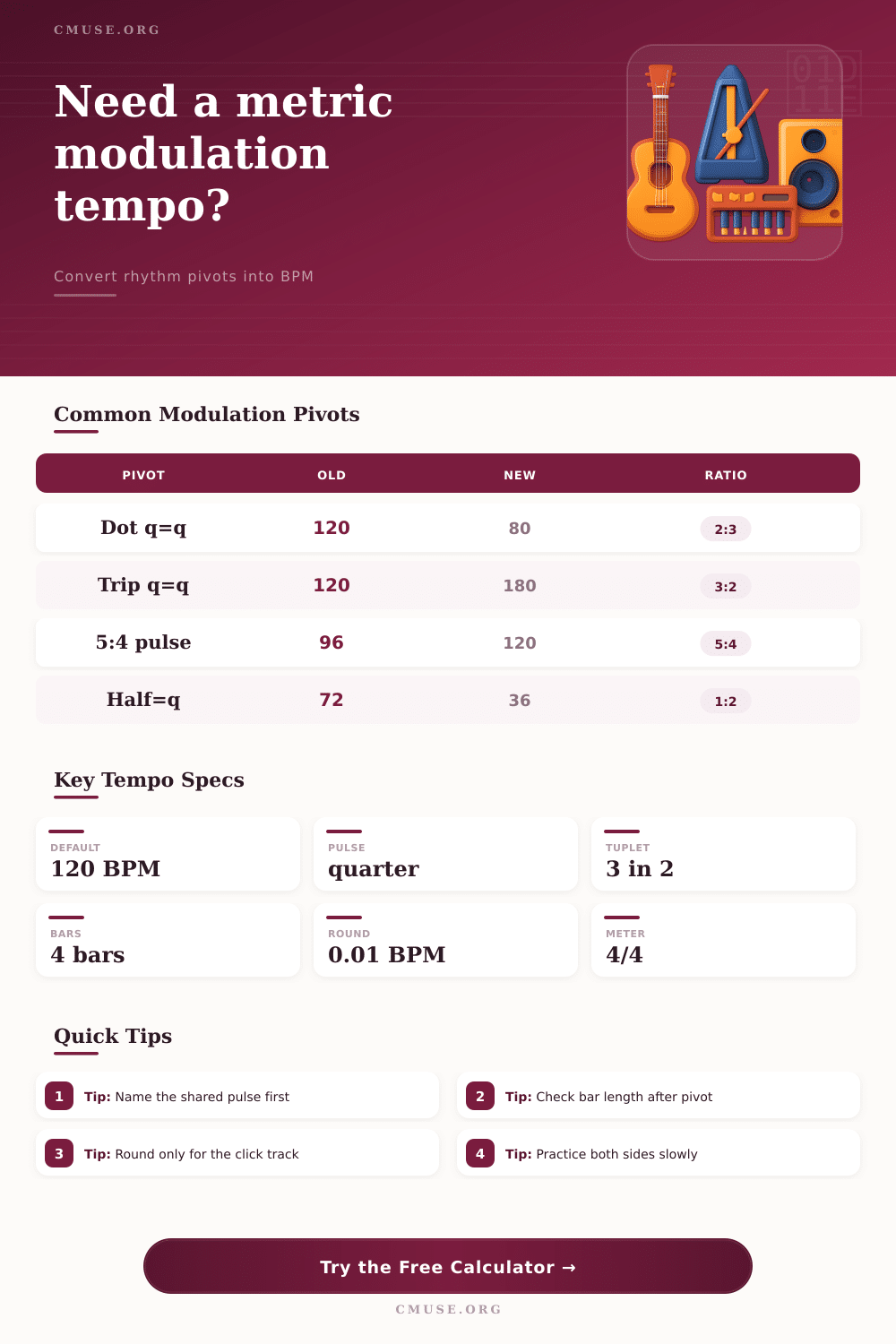
| Dotted quarter equals quarter | Dotted quarter at quarter BPM | Quarter note | New BPM = old BPM x 2/3 | Move from 4/4 into a slower 3-feel without losing the long pulse. |
| Quarter triplet equals quarter | Quarter-note triplet | Quarter note | New BPM = old BPM x 3/2 | Make triplet energy become the new straight beat. |
| Five over four pivot | Quintuplet quarter | Quarter note | New BPM = old BPM x 5/4 | Move into a slightly faster tempo with a clear shared subdivision. |
| Three over two cross pulse | Three pulses over two beats | Quarter note | New BPM = old BPM x 3/2 | Turn a polyrhythm layer into the next section's beat. |
| Half note broadening | Half note | Quarter note | New BPM = old BPM x 1/2 | Open a fast passage into a broader half-time section. |
| Old Tempo | Quarter | Dotted Quarter | Quarter Triplet | Five In Four Quarter |
|---|---|---|---|---|
| 60 BPM | 1000 ms | 1500 ms | 667 ms | 800 ms |
| 72 BPM | 833 ms | 1250 ms | 556 ms | 667 ms |
| 96 BPM | 625 ms | 938 ms | 417 ms | 500 ms |
| 120 BPM | 500 ms | 750 ms | 333 ms | 400 ms |
| 144 BPM | 417 ms | 625 ms | 278 ms | 333 ms |
| Preset | Starting Mark | Shared Pulse | New Mark | Practice Note |
|---|---|---|---|---|
| Dotted Quarter Equals Quarter | quarter = 120 | dotted quarter | quarter = 80 | Count old 1-and-a as the new beat. |
| Quarter Triplet Becomes Quarter | quarter = 120 | quarter triplet | quarter = 180 | Sing three evenly across two old beats. |
| Five Over Four Carter Pivot | quarter = 96 | quintuplet quarter | quarter = 120 | Mark the first and fifth partial before moving. |
| Half Note Broadening | quarter = 72 | half note | quarter = 36 | Let every other old beat become the new click. |
| Seven Over Six Bridge | quarter = 84 | septuplet quarter | quarter = 98 | Use a slow subdivision drill before full tempo. |
| Click Goal | Best Rounding | When To Use | Risk | Check |
|---|---|---|---|---|
| Notation proof | 0.01 BPM | Preparing a score or tempo map | Numbers may look too fussy for players | Verify bar duration in seconds. |
| Studio click | 0.1 BPM | DAW grid or overdub setup | Tiny drift across long cues | Check the cue span after rounding. |
| Rehearsal mark | 0.5 BPM | Readable printed parts | Exact ratio is slightly softened | Keep the modulation equation nearby. |
| Live count-off | 1 BPM | Conductor or drummer cue | Complex ratios may blur | Practice the shared rhythm alone first. |
Often viewed as a theoretical exercise intended to confuse musician, metric modulation in reality is more like a dialogue between two distinct rhythmic languages. It’s only through the translation function of common pulse that musical groove continues unbroken as switch occurs. By redefining what a beat are, you can change tempo so the music seem to suddenly slow down or speed up while ticking of the clock stays at exact same rate.
This turning point demands attention not just to the tempo marking but to length of the carried-over sound itself. Once you know what note value remain unchanged during the switch, the calculator (above) do the rest for you. Everyone begins with an estimate of a new BPM according to how something “feels,” but until you synchronize existing rhythm, it’s all subjective. Because the beat lengthen when we move from a standard quarter note at 120BPM to a dotted quarter pulse, for example, resulting tempo will fall accordingly. The way the tool explain it is: take time value of your initial note, then multiply it by new beat grouping ratio.
How to Use Metric Modulation
For those who don’t like working in fractions, realize that a triplet will sound quicker than a straight eighth note because there are three notes packed into equal time. Another error made here is to not take notice of change of meter at all. Often a modulation accompany a change of time signature that alters the number of beat in each measure, although playing speed remains unchanged. Even if you are playing at same pace, phrasing will change radically if one bar becomes a three beat bar instead of a four.
Here’s where table on the page give a clear indication of what happens to length of the bar as the meter changes along with the tempo. For the drummer or conductor who must know precisely when new section arrives, this can be a tiny detail but an important one. Not considering length of the bar may mean you gets the speed correct but the downbeat wrong.
Where this becomes problematic is when tuplets come into play as they compress time, not stretch it. In moddern jazz fusion and classical music, an example of a quintuple note on a four-beat bar causes an interesting friction that can make groove special. When you enter these values, the system calculate the precise millisecond duration of that shared pulse so your click track can match it perfectly. Here rounding is critical, and digital audio workstations can has trouble with irrational tempo figures. Two decimal places for your BPM keeps grid in line with your playing without drifting out across a longer cue.
On the other hand, always start practicing at pivot point with accent there. Without knowing end of an existing groove, you would of never be able to internalize a new one. Practice splitting the pulse shared by both old and new tempos, then put it back together. That’s how you build the neural pathway to switch on stage seamlessley.
Use the breakdown cards to quickly double-check that your new tempo is correct, but ultimately, your ears are judge of what sounds musical. What is useful about metric modulation is that it enable dramatic changes without sudden cuts. By counting the same clock in different ways, we can allow a piece to breathe out and slow down into slower section or pick up pace and speed up into more faster part. Tempo becomes a relative idea instead of an absolute one.
This provides you with control over time, allowing you to stretch and compress musical moment so easy that it is difficult for the ear to detect. In short, accurate calculation matter, and so does smooth execution. What you are aiming for is that audience feels the change in energy but doesn’t realise how you got there. Everything hinges on this common pulse which becomes like a fixed point of reference while scenery shifts around it.
When you view rhythm as something fluid rather than fixed, these changes become more then just difficult exercises; they become powerful tools for telling stories. The calculator can help plot out the route but it’s your timing that brings you on the journey.