Shuffle Feel Ratio Calculator
Convert tempo, swing percentage, subdivision grid, microtiming offset, accent shape, and humanize range into exact long-short groove timing for shuffle and swung parts.
Choose a starting feel, then adjust the timing. Each preset sets the tempo, subdivision, swing percentage, blend, push or pull, accent contrast, humanize window, quantize return, and sample rate.
Timing Breakdown
| Timing Feel | Long Share | Long:Short Ratio | Triplet Position | Practical Use |
|---|---|---|---|---|
| Straight grid | 50% | 1.00:1 | Not swung | Rock, pop, electronic, and tight doubled parts. |
| Subtle lift | 54% to 58% | 1.17:1 to 1.38:1 | Before triplet center | Light jazz phrasing, brushed drums, and relaxed comping. |
| Medium swing | 59% to 64% | 1.44:1 to 1.78:1 | Near soft triplet | Balanced pocket when straight quantize feels too stiff. |
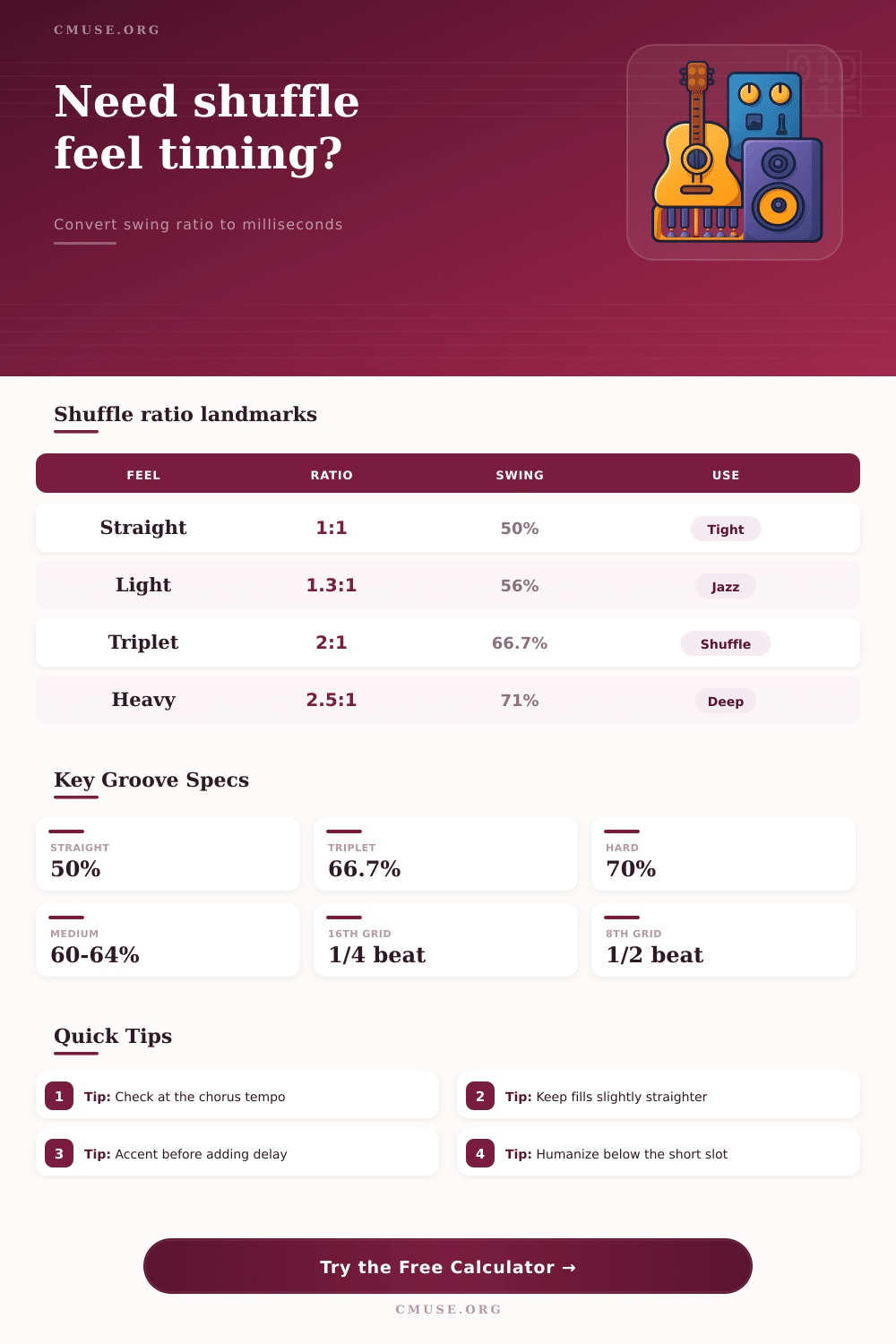
| Triplet shuffle | 66.7% | 2.00:1 | Exact two-to-one split | Classic shuffle, 12/8-adjacent grooves, and walking patterns. |
| Heavy shuffle | 69% to 73% | 2.23:1 to 2.70:1 | Past triplet center | Deep loping drums, aggressive boogie feels, and slow blues. |
| Tempo | Eighth Pair | 60% Swing | 66.7% Shuffle | 16th Pair |
|---|---|---|---|---|
| 72 BPM | 833.3 ms | 500.0 / 333.3 ms | 555.6 / 277.8 ms | 416.7 ms |
| 90 BPM | 666.7 ms | 400.0 / 266.7 ms | 444.4 / 222.2 ms | 333.3 ms |
| 110 BPM | 545.5 ms | 327.3 / 218.2 ms | 363.6 / 181.8 ms | 272.7 ms |
| 130 BPM | 461.5 ms | 276.9 / 184.6 ms | 307.7 / 153.8 ms | 230.8 ms |
| 160 BPM | 375.0 ms | 225.0 / 150.0 ms | 250.0 / 125.0 ms | 187.5 ms |
| Grid Choice | Pair Duration | Best For | Risk | Starting Range |
|---|---|---|---|---|
| Swung eighth-note pair | One quarter note | Shuffle drums, walking bass, comping, and blues rhythm parts. | Can drag if the short note gets too small. | 58% to 68% |
| Swung sixteenth-note pair | Half of a quarter note | Funk hi-hats, ghost notes, picked guitar, and keyboard stabs. | Heavy ratios become cramped at fast tempos. | 54% to 62% |
| Half-time eighth-note pair | Two quarter notes | Slow beats where the lilt spans a wider pocket. | Large off-grid delay can blur ensemble entrances. | 56% to 64% |
| 12/8 dotted-quarter pair | One dotted quarter feel cell | Ballad rolls, slow shuffle phrases, and triplet comping. | Too much quantize return removes the rolling feel. | 63% to 69% |
| Swung thirty-second pair | One eighth of a quarter note | Fast programmed details and percussion ornaments. | Humanize can exceed the short slot quickly. | 52% to 58% |
| Project | Tempo Area | Subdivision | Swing Share | Accent And Humanize |
|---|---|---|---|---|
| Small jazz trio comping | 90 to 150 BPM | Swung eighth pair | 58% to 64% | 2 to 4 dB accent with 4 to 8 ms humanize. |
| Medium blues shuffle | 80 to 125 BPM | Swung eighth pair | 64% to 69% | 3 to 6 dB accent with short-note consistency. |
| Funk sixteenth pocket | 88 to 118 BPM | Swung sixteenth pair | 54% to 60% | Keep humanize low so ghost notes remain readable. |
| Half-time soul groove | 62 to 90 BPM | Half-time eighth pair | 56% to 63% | Use late push-pull sparingly on comping parts. |
| Grid-based electro shuffle | 115 to 135 BPM | Swung sixteenth pair | 56% to 61% | Quantize return can keep loops phase-consistent. |
In recording sessions, the grid are frequently at war with the music. The song grooves along fine, you hit all the notes, everything is on time, but the groove sound dead. There’s no naturaly swing or rhythm there that has the listener nodding his/her head without consciously knowing why. This is where producers tend to go to the swing parameter on their digital audio workstation and guess around in percentages till things feel right.
But how does that percentage translate into real sound waves? A percentage alone tell you nothing about how that timing translates to actual sound waves. You need to know the exact millisecond gap between notes to trust your ears. All you can do is trust what your ears are telling you, and that requires knowing exactly how many milliseconds exist between those notes.
How Swing Affects Your Music Timing
Plug in your desired swing share and tempo into this calculator above. After it runs the math, it converts those abstract percentages into concrete timing values. If you have set up a subdivision grid, the tool will do the rest of the math for you. It will calculate how long the long slot need to be and the matching short slot.
Many engineers will go so far as to set the swing value at 50 or 60 percent, which again is only half the equation. How much do you want to humanize the resulting rhythm after? And what about the push-pull timing of each note? Until you see the millisecond breakdown, you’re really just taking a stab in the dark. You won’t know if your shuffled eighth notes lands somewhere near a triplet feel or something looser.
This one’s where people go awry. Swing is not simply ‘moving the note(s) late’. It’s about the relationship between the two durations. In the case of the standard triplet shuffle, the ratio is a precise two-to-one with each note accounting for exactly sixty-six-point-seven percent of the total measure. That provides a neat and clean rhythm.
Move slightly below that triplet value into the fifty-eight to sixty-four percent range, and you’ll find yourself in lighter jazz territory; more relaxed and swinging. Move above that (above seventy percent), and things starts to become loping and heavy, pushing the groove forward in a manner that can be awkward without a helpful drummer. The table on the page spells all this out and shows what each percentage equate to musically.
What does this mean? Well, one thing it means is that not all instruments responds equally well to swing. A heavier long-short split with a big accent works beautifully on a blues shuffling guitar rhythm section. However, it would of been too much on hi-hats in a funk groove, where a subtle fifteen-millisecond delay on the short note can make everything sound just right. On the other hand, a deeper shuffle ratio applied to fast sixteenth-note patterns can make everything sound muddy and cramped for time.
Being able to adjust the subdivision grid down as far as thirty-second pairs ensures that your timing offsets are always proportional to the length of each note so that if the swing percentage becomes too aggressive, the short notes won’t vanish into silence. Interestingly, this brings me back to accent as well. Making even the smallest increase in volume on that long note can make a small swing percentage seem much stronger then it actualy is. Don’t always assume that pushing your timing extremes will be necessary when your dynamics are also supporting the phrase.
Adding one more wrinkle is humanizing, which adds random variations within a window. Now if you open that window up too far you lose any cohesion with your groove and it gets sloppy instead of loose. Tighten the random variation just far enough so that the underlying pocket is still intact. The balance of feeling and precision creates great timing.
It is enough to stick to the grid so the group stays together while having just the right amount off to be felt as human. Knowing those numbers takes the guess work out of editing. Instead of hoping it sounds good, you can dial into the type of vibe you are looking for. Now that you know exactly how far apart your long note is from your short note in samples, you can make tweaks comfortabley.
What results is a groove that sounds like it’s moving forward, not rushing, but still grounded in data yet guided by ear. The subtle lilt in pro recordings frequently has come down to this very moddern mathematical relationship between space and time.