Double Dotted Note Calculator
Convert any double-dotted rhythm into beat length, seconds, MIDI ticks, bar coverage, and practical notation equivalents for rehearsal, scoring, and DAW editing.
Choose a named notation scenario, then adjust tempo, meter, note value, tuplets, repetitions, ties, and tick resolution. Every preset recalculates immediately.
Calculation Breakdown
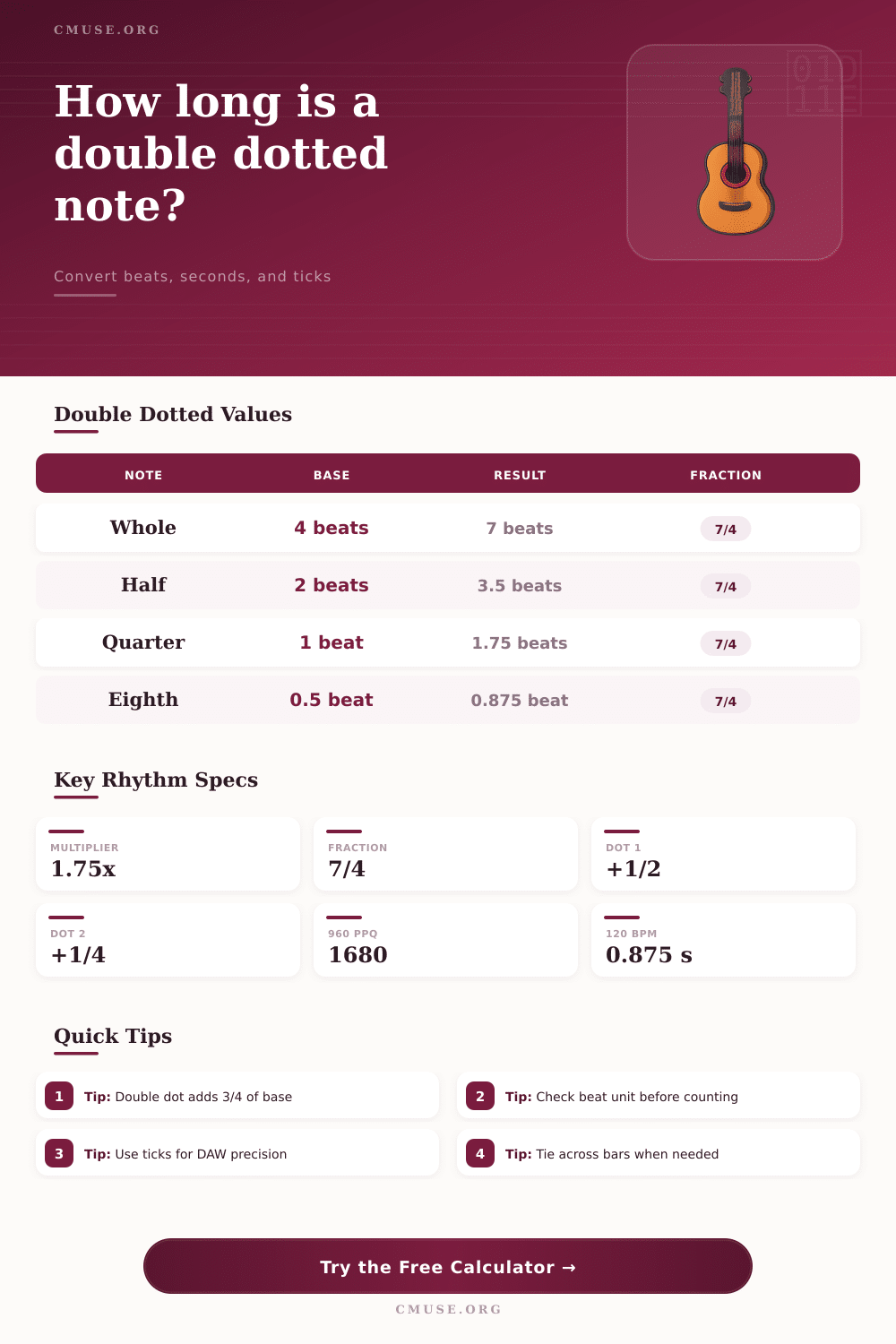
1.75x
Total multiplier
7/4
Base note fraction
+50%
First dot adds
+25%
Second dot adds
Notation Length
A double-dotted note equals the original value plus half of it plus one quarter of it.
base x 7 / 4Seconds
Convert the selected BPM beat unit into seconds, then multiply by the calculated beat-unit length.
beats x 60 / BPMMIDI Ticks
Quarter-note duration maps directly to PPQ, so other note values scale from the quarter.
quarter beats x PPQMeasure Share
Bar coverage compares total quarter-note duration with the current time signature length.
value / bar length| Written value | Quarter-note beats | Equivalent subdivision | 960 PPQ ticks |
|---|---|---|---|
| Double-dotted whole | 7 | whole + half + quarter | 6720 |
| Double-dotted half | 3.5 | half + quarter + eighth | 3360 |
| Double-dotted quarter | 1.75 | quarter + eighth + sixteenth | 1680 |
| Double-dotted eighth | 0.875 | eighth + sixteenth + thirty-second | 840 |
| Double-dotted sixteenth | 0.4375 | 16th + 32nd + 64th | 420 |
| Double-dotted 32nd | 0.21875 | 32nd + 64th + 128th | 210 |
| Tempo marking | DD quarter | DD eighth | DD half |
|---|---|---|---|
| 60 BPM | 1.750 s | 0.875 s | 3.500 s |
| 72 BPM | 1.458 s | 0.729 s | 2.917 s |
| 90 BPM | 1.167 s | 0.583 s | 2.333 s |
| 120 BPM | 0.875 s | 0.438 s | 1.750 s |
| 144 BPM | 0.729 s | 0.365 s | 1.458 s |
| 180 BPM | 0.583 s | 0.292 s | 1.167 s |
| Meter | Bar length | Good double-dotted use | Notation warning |
|---|---|---|---|
| 2/4 | 2 quarter beats | DD quarter fills 87.5% | Often needs release note |
| 3/4 | 3 quarter beats | DD quarter leaves 1.25 beats | Watch beat 3 clarity |
| 4/4 | 4 quarter beats | DD half spans 87.5% | Tie if crossing beat 3 |
| 6/8 | 6 eighth beats | DD eighth is 1.75 eighths | Clarify compound grouping |
| 9/8 | 9 eighth beats | DD quarter equals 3.5 eighths | May blur dotted pulse |
| 12/8 | 12 eighth beats | DD half equals 7 eighths | Prefer ties at main beats |
| PPQ setting | DD quarter | DD eighth | DD sixteenth |
|---|---|---|---|
| 120 PPQ | 210 ticks | 105 ticks | 52.5 ticks |
| 240 PPQ | 420 ticks | 210 ticks | 105 ticks |
| 480 PPQ | 840 ticks | 420 ticks | 210 ticks |
| 960 PPQ | 1680 ticks | 840 ticks | 420 ticks |
| 1920 PPQ | 3360 ticks | 1680 ticks | 840 ticks |
| 3840 PPQ | 6720 ticks | 3360 ticks | 1680 ticks |
For the most simple rhythm, as a rule of thumb, a dotted note is worth half the duration of preceding note plus an additional half. But what about double dots? They don’t easily subdivide into halves, creating rhythmic friction in more complex time signatures such as 12/8 or 6/8; naturaly-feeling to one ear but mathematically awkward to the other.
Once you enters note values and tempo into the calculator above it will do all the maths for you and save you from any mental gymnastics when preparing your scores.
How Double-Dotted Notes Work in Music
So we have idea of fractional accumulation. The first dot lengthens preceding note by half. The second dot is half of what is left, making it a quarter of initial note. Combined this give an extra three-quarters of a note value. Therefore, a double dotted quarter note equals a single and three-quarter beats. Not one, not two, but something in-between. Something within the no-man’s-land on the grid. And this time is important because it forces the performer to sustain a sound over a beat boundary where a breath or an accent is often physically expected.
For arrangers and composers this affects time signatures. A double-dotted quarter note if thought about in relation to eighths will take up 87.5% of a measure in 4/4 time. But when compared to quarters, there’s a clear gap left behind. If you want to completely fill out that available area with conventional binary subdivisions you’ll need to use either triplets or ties. The meter fit reference on this tool illustrates precisely where those values fall as related to the barline and can help avoid accidentally overflowing into next bar, cluttering your score with unwanted tie markings. Notation appears cleaner and is easier to read, especially for those who have to sight-read by using the patterns they see instead of doing math.
It’s frequently more useful for digital audio work users (and producers) to convert the beats to MIDI ticks instead. Most sequencers operates on pulses per quarter note, usually 960 PPQ in professional settings today. At this resolution, a double-dotted quarter note equals precisely 1680 ticks. Why does that matter? When you’re editing audio regions or trying to align layers, having the correct tick offset will eliminate small timing issues that build up over time. This is important if you’re attempting to program against a feel of something played live. The calculator puts these abstract measures of beats into concrete terms of timing, closing the gap between production and notation.
How does tempo alter the feel of these rhythms? If you play a slow adagio pace then a double dotted half-note is a held breath; if you’re playing at a brisk allegro then it’s a rapid syncopation that tests your co-ordination. The seconds conversion option clarifies the issue as you’ll be able to read in real-time on the clock. How many more seconds until the next beat. It is handy when trying tricky entrances and also teaching less confident rhythmic learners about concept of subdivisions.
Then there are compound meters. For example, the beat unit in 6/8 is often a dotted note rather than a straight quarter note. If we add the double-dotted note then the relationship change as the underlying pulse has already been divided by three. Using the calculator you can change the beat unit setting on the BPM and make it work for that fact. Perhaps you write in dotted-quarter pulses but have the metronome ticking out every eighth note. That way what happens on paper reflect what is happening in performance and you don’t try and force a square peg into a round hole.
One pitfall is to not count the second dot correctly. You might of been tempted to assume this adds another half value, which overstates the total duration. Don’t forget; it’s just a quarter of the original amount. When accuracy counts it does matter; it’s little, but it makes a difference.
The other problem I have encounter comes when two or more parts are performing contrasting rhythms at the same time in an ensemble. The string section may be on double-dotted quarters while the brass players is simply on straight halves. In this situation, the points of alignment are crucial. Thinking about how the two rhythmic patterns will line up before you start helps avoid drifting out of time.
In short, learning to read music with double-dots means letting go of your binary mind-set for a three-part one. You must accept that not every rhythm can sit easy within an easy-to-grasp grid. The numbers involve using a calculator, while the musical part involves recognizing the feel of these lengths in context. When engraving a choral score or editing a DAW session, having a firm grasp of where the note finishes enables you to phrase with intent. No more guesswork, just confident note placement. Rhythmic complexity becomes expressive clarity.