Subdivision Per Beat Calculator
Convert tempo, meter, tuplets, swing feel, bar length, accents, and practice duration into exact subdivision spacing, note rate, event counts, and rhythmic workload.
Load a named rhythm scenario, then edit the tempo, meter, subdivision count, swing ratio, accent spacing, bar count, and practice duration. The calculator works for metronome programming, drum practice, strumming grids, and DAW rhythm checks.
Subdivision Calculation Breakdown
Beat duration
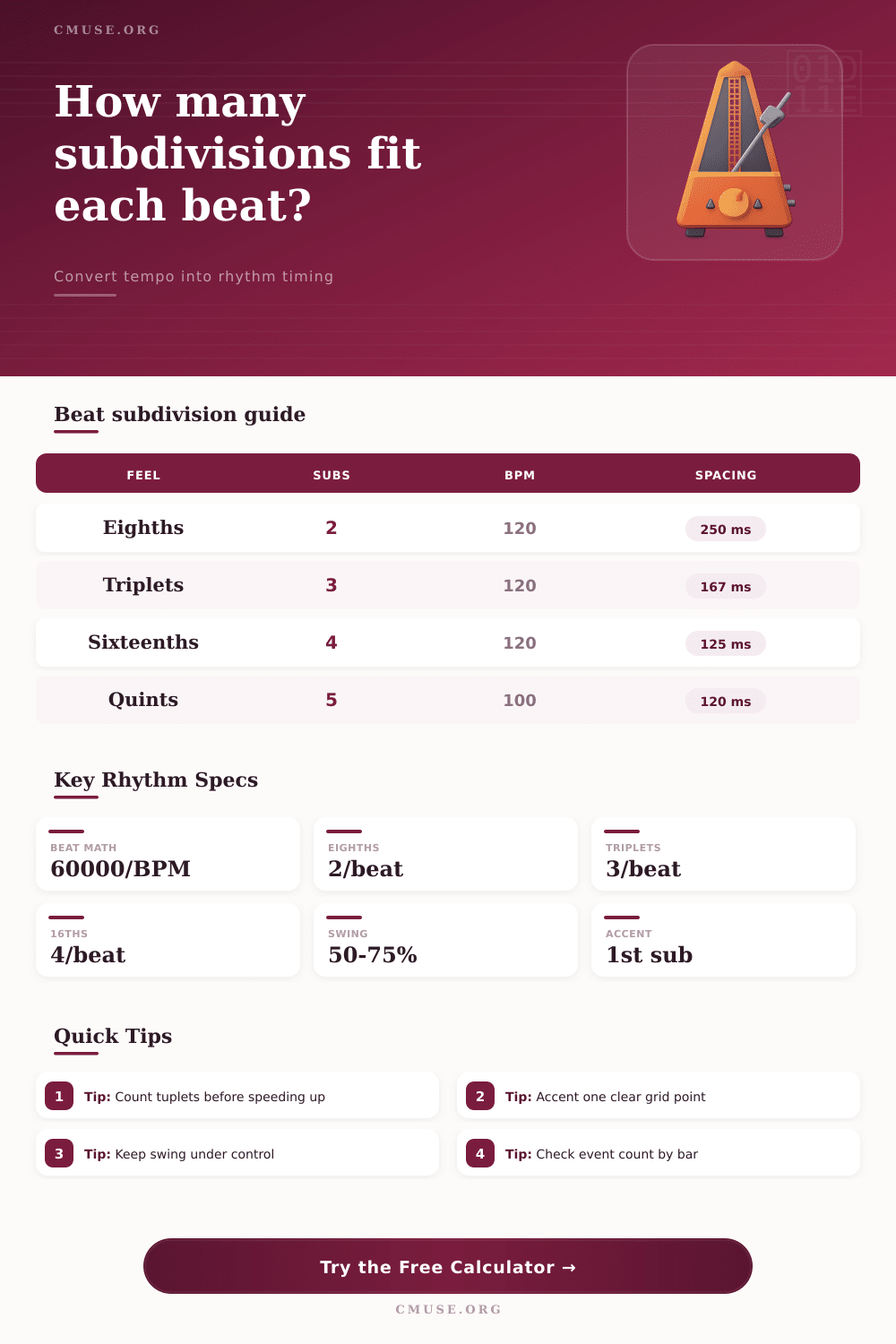
beat ms = 60000 / BPMEvery subdivision calculation starts with the length of one counted beat.
Subdivision spacing
sub ms = beat ms / subsThis gives the straight grid before swing or offset is applied.
Event count
events = bars x beats x subsTuplets can create fractional math, then the display rounds to useful counts.
Note rate
notes/sec = BPM x subs / 60Use this to compare grooves, picking studies, and drum sticking workloads.
Eighth-note subdivision in quarter-note time
Triplet subdivision or compound pulse split
Sixteenth-note funk, pop, and drum grid
Quintuplet timing and five-note groupings
Sextuplets or two triplets inside one beat
Thirty-second-note pulse under quarter beats
Straight equal spacing for pairs
Classic triplet-based swing pair
| Subdivision | Subs Per Beat | At 80 BPM | At 120 BPM | Common Musical Use |
|---|---|---|---|---|
| Quarter-note pulse | 1 | 750 ms | 500 ms | Basic click |
| Eighth notes | 2 | 375 ms | 250 ms | Rock and pop strumming |
| Eighth-note triplets | 3 | 250 ms | 166.7 ms | Shuffle, swing, blues |
| Sixteenth notes | 4 | 187.5 ms | 125 ms | Funk, drums, picking |
| Quintuplets | 5 | 150 ms | 100 ms | Odd grouping practice |
| Sextuplets | 6 | 125 ms | 83.3 ms | Drum fills and rolls |
| Thirty-second notes | 8 | 93.8 ms | 62.5 ms | Fast articulation |
| Meter | Beat Unit To Enter | Beats Per Measure | Typical Subdivision | Counting Note |
|---|---|---|---|---|
| 4/4 common time | Quarter note | 4 | 2, 3, 4, 6, or 8 | 1 and 2 and, or 1 e and a |
| 3/4 waltz | Quarter note | 3 | 2 or 4 | 1 and 2 and 3 and |
| 2/2 cut time | Half note | 2 | 2 or 4 | Big half-note pulse |
| 6/8 compound | Eighth note | 6 | 1 or 3 by feel | Six eighths or two dotted quarters |
| 7/8 additive | Eighth note | 7 | 1, 2, or 4 | Group as 2+2+3 or 3+2+2 |
| 12/8 shuffle | Eighth note | 12 | 1, 2, or 3 | Four compound beats with triplet motion |
| Notes Per Second | Feel Category | Spacing Range | Practice Focus | Typical Example |
|---|---|---|---|---|
| Under 3/s | Relaxed | 333 ms or wider | Reading, placement, tone | Slow eighth-note comping |
| 3 to 6/s | Steady | 167 to 333 ms | Groove consistency | Medium eighths and triplets |
| 6 to 10/s | Technical | 100 to 167 ms | Clean subdivision control | Sixteenths around 100 to 150 BPM |
| 10 to 14/s | Fast | 71 to 100 ms | Endurance and evenness | Sextuplets or fast sixteenths |
| Over 14/s | Extreme | Under 71 ms | Short bursts, relaxed mechanics | Thirty-second-note picking studies |
| Preset | Tempo And Meter | Subdivision | Swing | Practice Use |
|---|---|---|---|---|
| Straight Eighth Groove | 96 BPM in 4/4 | 2 per beat | 50% | Clean strumming and basic groove placement. |
| Funk Sixteenth Grid | 104 BPM in 4/4 | 4 per beat | 50% | Ghost notes, syncopation, and drum-kit grids. |
| Shuffle Triplet Feel | 112 BPM in 4/4 | 3 per beat | 66.7% | Blues shuffle and triplet ride practice. |
| Five Over Four Study | 80 BPM in 4/4 | 5 per beat | 50% | Odd tuplet accuracy over a steady pulse. |
| 6/8 Compound Pulse | 72 BPM in 6/8 | 3 per dotted feel | 50% | Compound meter grouping and rolling accents. |
| Metal 32nd Picking | 140 BPM in 4/4 | 8 per beat | 50% | Short technical bursts and endurance checks. |
Think of a metronome clicking in your ear while you play a complicated riff on guitar or drums. You have the pulse locked, but what happens between each click? There’s rhythmic potential here that can help your groove lock in nicely, or it can throw you off time.
For most musicians, feeling the pulse isn’t the issue. Most people learn that easily. The problem is trying to divide this area precisely. This is particularly true with odd subdivisions such as quintuplets. Applying a swing feel makes it tricky too. Swing distorts straight grid and makes it more organic. This is something many players guess at. I’ve heard it all before. Set your metronome to whatever feels comfortabley. Hope for the best; you’ll squeeze those extra notes in, right? Yeah…until exactness becomes necessary. That’s when precision counts.
How to Use a Rhythm Calculator for Better Practice
A subdivision calculator does all of math for you. Simply input your preferred tempo and grouping style, and let the calculator do the rest. You no longer need to visualize milliseconds. No more fretting over technique either, thank goodness.
What are you going to do? Enter the beats per minute. Determine if main pulse will be eighth notes or quarter notes. Next, determine the number of subdivision per beat. The tool converts abstractions in music to concrete time intervals. It tells you exactly how long in milliseconds every event is apart on the grid.
Binary and ternary are two words that trip up many novice players. Binary divisions splits the beat in halves, creating the familiar eighth and sixteenth note patterns that drive pop and rock music. This creates common eighth and sixteenth note patterns used in rock and pop music. Ternary divides the beat into three equal sections, which gives rise to blues, shuffle and swing styles.
When you adjust the swing percentage on the calculator, that rigid grid is distorted. The first note of each pair will be longer, and second note will be shorter. Fifty percent maintains an even division. Move it closer to sixty-seven and it starts to imitate classic triplet feel heard in jazz standards. A slight change of figures makes all the difference. However, it also radically alters physical action demanded of your feet or hands.
Another point here is to account for how much work your practice routine involve. This one is often overlooked by many musicians until they’re all tuckered out and sloppy. Think about it: if you spend ten minutes practicing picking thirty-second notes at blistering speed, then you’ve got a huge amount of strokes on your hands. Ten minutes doesn’t seem long, but the number of strokes are staggering! The calculator calculates exactly how many times you’d have to repeat it.
How? Multiply the notes per second by length of time you practice it. In other words, it will help you realize that a twenty-minute session at moderate pace might require less endurance than a five-minute drill at extreme speeds. Not only does it cause you to consider efficiency over sheer volume, but it causes your repetitions to be clean and controlled instead of frantic and fatigued.
Another level of complexity comes from odd meter and poly-rhythms. Without a reference, this is a challenge for the standard ear to take in. Five notes against four beats? It require a completely different mental approach. There are no natural anchor points that occurs every second or third note.
With this tool, you can model such groupings. See exactly how they align with the underlying pulse over several bars. Spot the places where the accents fall. Work out whether your phrase drifts into a longer cycle or neatly resolves at the bar line. That visual confirmation closes the gap between knowing it in theory and being able to play it. This gives you the confidence to try new patterns without fear of losing the beat.
In other words, rhythm is simply doing math in real-time while under pressure. By taking the guesswork out of when and where to play, it frees the mind to think about feel, tone, dynamics, and so on instead of staying in survival mode. I wonder when I should hit this note or that one. Will I be just slightly early or late? Instead, you’ve calibrated your inner clock to match something outside yourself. Something that makes sense based off what you want to accomplish.
The subdivision per beat calculator gives you precision targets that take what was otherwise vaguely intended and make it tangible. Practice can become intentional versus rote. And once you know precisely where the grid points are, then it’s simply relaxation and muscle memory in how you fill those spaces in between. One measured interval builds upon another and tight grooves emerges.