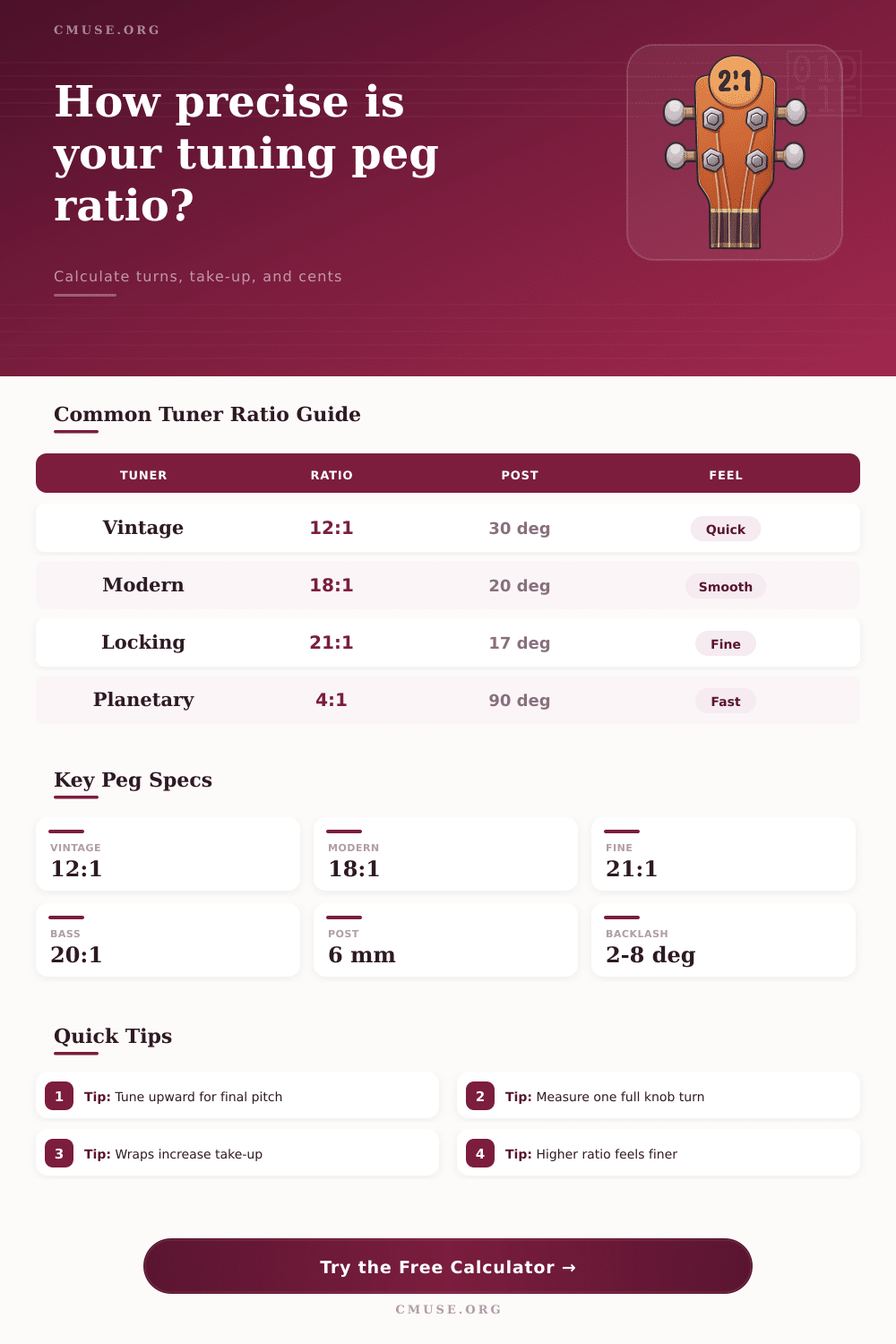
Tuning Peg Ratio Calculator
Estimate how a tuning machine ratio converts knob movement into post rotation, string take-up, pitch correction, backlash allowance, and practical turn resolution.
Load a realistic tuner setup, then adjust the ratio, post diameter, wrap buildup, backlash, and measured cents per full knob turn. The ratio controls the mechanics; the cents-per-turn input captures how your actual string reacts on the instrument.
Calculation Breakdown
18:1
Selected Ratio
20.0°
Post Per Turn
0.217
Cents Per Degree
4.6°
Knob For 1 Cent
1.19
mm Per Turn
4°
Backlash
2.17
Cents Per Nudge
23°
Target Travel
Gear Ratio To Post Rotation
A tuner marked 18:1 needs eighteen knob turns for one complete post revolution. Higher ratios make each hand movement rotate the post less.
post degrees per knob turn = 360 / ratio
String Take-Up Per Turn
The active winding diameter is the bare post plus visible wrap buildup. More wraps increase circumference and make each post degree pull more string.
take-up = pi x effective diameter / ratio
Pitch Resolution
The most reliable pitch result comes from measuring one full upward knob turn with a tuner, then scaling that response to small knob movements.
cents per nudge = cents per turn x knob degrees / 360
Backlash Allowance
If you reverse direction, some knob travel can be dead motion before the gear teeth and string tension settle into useful post movement.
useful degrees = max(0, knob movement - backlash)
| Tuner Type | Typical Ratio | Post Rotation Per Turn | Practical Use |
|---|---|---|---|
| Friction Peg | 1:1 direct drive | 360° per knob turn | Violin-family pegs; fast but relies on peg fit and hand control. |
| Planetary Peg | 4:1 to 5:1 | 90° to 72° | Common on banjos; preserves peg look while slowing the post. |
| Vintage Guitar | 12:1 to 15:1 | 30° to 24° | Quick tuning feel; small knob nudges can be slightly coarse. |
| Modern Sealed | 16:1 to 18:1 | 22.5° to 20° | Balanced guitar feel for most electric and acoustic setups. |
| Fine Ratio | 20:1 to 21:1 | 18° to 17.1° | Helpful for sensitive strings, tremolo bridges, and careful intonation checks. |
| Instrument Profile | Typical Cents Per Knob Turn | Usual Ratio Range | Resolution Comment |
|---|---|---|---|
| Electric guitar plain string | 70 to 110 cents | 12:1 to 21:1 | Plain strings often react quickly, especially near pitch. |
| Electric or acoustic wound string | 45 to 85 cents | 14:1 to 21:1 | Wound strings usually need more knob travel for the same pitch change. |
| Bass guitar string | 20 to 55 cents | 17:1 to 24:1 | Large posts and long strings make the movement feel slower but stable. |
| Nylon classical or ukulele | 35 to 95 cents | 12:1 to 16:1 | Stretch and settling can matter more than the gear ratio alone. |
| Violin-family friction peg | 160 to 320 cents | 1:1 direct | Very responsive; fine adjustment often comes from tailpiece tuners. |
| Scenario | Ratio | 10° Knob Nudge | 5-Cent Correction |
|---|---|---|---|
| Vintage electric plain string | 12:1 | 2.8 cents | 18° knob travel |
| Modern 18:1 guitar tuner | 18:1 | 2.2 cents | 23° knob travel |
| Fine 21:1 locking tuner | 21:1 | 1.9 cents | 26° knob travel |
| Bass clover tuner | 20:1 | 1.0 cents | 50° knob travel |
| Banjo planetary tuner | 4:1 | 4.4 cents | 11° knob travel |
| Measurement | How To Capture It | Why It Matters | Good Practice |
|---|---|---|---|
| Actual gear ratio | Count knob turns for one post revolution. | Stamped ratios can differ from practical post movement. | Mark the post with low-tack tape before counting. |
| Effective post diameter | Measure across the string layer after stable wraps. | Extra wrap diameter increases string take-up per post turn. | Use the same wrap count you normally tune with. |
| Cents per knob turn | Measure with a tuner after one smooth upward turn. | It includes string gauge, bridge friction, scale, and tension. | Repeat twice and use the average if the reading jumps. |
| Backlash angle | Reverse the knob and note dead travel before pitch changes. | Backlash changes small downward corrections most. | Finish tuning upward to keep the gear loaded. |
Your hands aren’t necessarily at fault for having to tune your guitar so hard; the issue lies with the gear ratio of tuner itself. You turn the knob ever so slightly and the string jumps way too much. You try turning it a little bit less but nothing happens. It’s hidden within the guts of the machine.
Once you know the ratio, you play differenty. The ratio How many times must the knob rotate for the post to turn once? If it’s 12:1, then with each hand movement, the post will move fairly fast. That can be helpful if you’re adjusting things by large amounts or stretching new strings. However, there’s also a price to pay for that speed. For each little nudge of your thumb, the pitch shift more and more and it becomes difficult to land right on the note.
Why Your Guitar Is Hard to Tune
At a 21:1 ratio, however, this is slowed way down. For each degree your hand turns, the post will not move as much. At first it may feel sluggish but this is where resistance helps as you have greater control over the small pitch corrections.
Once you know what kind of set up you have, you can plug it into the calculator above and let it do the math for you so you don’t have to guess at change in string length per turn. Of course, there’s more than just that physical aspect of instrument. You should also consider the diameter of the post the string wraps around. Each time you wrap the string around the post you are building up layers and that adds to total circumference of the wrapped part of the string. A bigger circle has more string pulled in each time it rotates, so even though it may be a high-ratio tuner, it will still behave different than if the post is thick versus thin, or whether you’re using 3 wraps vs. 2.
The tool takes all of that into account and allows you to input additional buildup and it’ll show you exactly how much it’s taking up in terms of length. People often forget about backlash until they actualy experience it. That little bit of nothing space between the teeth of your gears enables the knob to rotate without forcing the post right away. And this gap of dead travel shows itself clearly as you go back the other way. Tuning from below to pull the string up to pitch works great. However, trying to go back to sharpen a note can be difficult. This is because there is all that dead travel to fight through before you begin to loosen the string. More times than not you find yourself overshooting the new pitch. Always tune from below, pull the string up to pitch and don’t let it fall into position. That way the string is always under tension on the gears and the issue of play isn’t a question at all.
The other aspect of this is gauge of strings. For example, a bass guitar string has often got a fairly thick wound onto the core, whilst a high E string can be just plain steel. What happens when you turn that tuner knob is that the thicker strings reacts less violently to subtle movement, whereas the thinner ones will react much more significantly. You may turn it with same amount as the low E and get a pitch change of two cents, whereas on the high E string it’s ten cents. The calculator needs to know the pitch change you measured per turn. This allows results to account for the difference between an instrument’s acoustic properties and technical details of tuner spec.
In practice you want a resolution that suits your manner of playing. Do you dive bomb around the fretboard? Then perhaps you like fast tuners that recover quickly. Are you playing delicate classical passages? Then you’ll want best possible control. One size does not fit all. Some people like the feel of vintage 12:1 machines. Nothing compares to them. They are direct and alive. Others prefer precision and stability of the moddern 18:1 or 21:1 geared tuners that lock an instrument into tune with ease. The page has a chart of some common specs so you can compare them side-by-side.
Notice how low the ratios are for banjo planetary pegs? Makes sense; it’s a very tight string instrument requiring fast tuning changes under high tension. But then again, that’s the point. It’s all about energy management. The string wants to move. The tuner is either accelerator or the brake. And there’s the correct ratio for every situation. Just as there is an appropriate gear for merging onto the highway, crawling up a hill in first gear isn’t going to work.
Once you understand how those mechanics are translating to movement of pitch, you cease to fight the instrument. You begin to work with it. The knob stops being an obstacle between you and the note. Instead, it becomes an extension of your ear. That smooth connection turns a frustrating tuning session into something you can rely on as part of your routine.