String Break Tension Limit Calculator
Estimate whether a guitar, bass, acoustic, or nylon string has enough break-load margin for the selected gauge, scale length, pitch, bend, condition, and playing load.
Load a realistic starting point, then adjust the scale, gauge, material, note, bend amount, safety factor, and string condition. Results are estimates for setup planning, not a destructive test rating.
Calculation Breakdown
Target note
Gauge entered
Target factor
Break model
T = UW x (2 x L x F)^2 / 386.4
Load = area x tensile psi x core share
Frequency = F x 2^(semitones / 12)
Factor = adjusted break load / peak tension
| String construction | Typical load-bearing part | Model tensile range | Best use in this calculator |
|---|---|---|---|
| Plain music steel | Full string diameter | 290k to 330k psi | Plain guitar E, B, G and mandolin trebles |
| Plain stainless steel | Full string diameter | 260k to 300k psi | Bright plain strings with slightly lower estimate |
| Nickel wound steel core | Core wire carries most break load | 300k to 325k psi core | Electric wound guitar and bass strings |
| Phosphor bronze wound | Steel core below bronze wrap | 285k to 315k psi core | Steel-string acoustic wound strings |
| Flatwound steel core | Core plus high-mass wrap estimate | 295k to 320k psi core | Jazz guitar, bass, and smooth wound sets |
| Nylon treble | Full nylon filament | 45k to 60k psi | Classical plain trebles and low-tension checks |
| Overpull or bend | Frequency ratio | Tension ratio | Practical meaning |
|---|---|---|---|
| 50 cents | 1.029x | 1.059x | Small sharp tuning error or light vibrato peak |
| 1 semitone | 1.059x | 1.122x | Common blues bend or tuner overshoot |
| 2 semitones | 1.122x | 1.260x | Whole-step bend with a clear load increase |
| 3 semitones | 1.189x | 1.414x | A minor-third bend needs serious headroom |
| 4 semitones | 1.260x | 1.587x | Extreme bend or accidental over-tightening |
| Scenario | Scale and gauge | Pitch check | Typical concern |
|---|---|---|---|
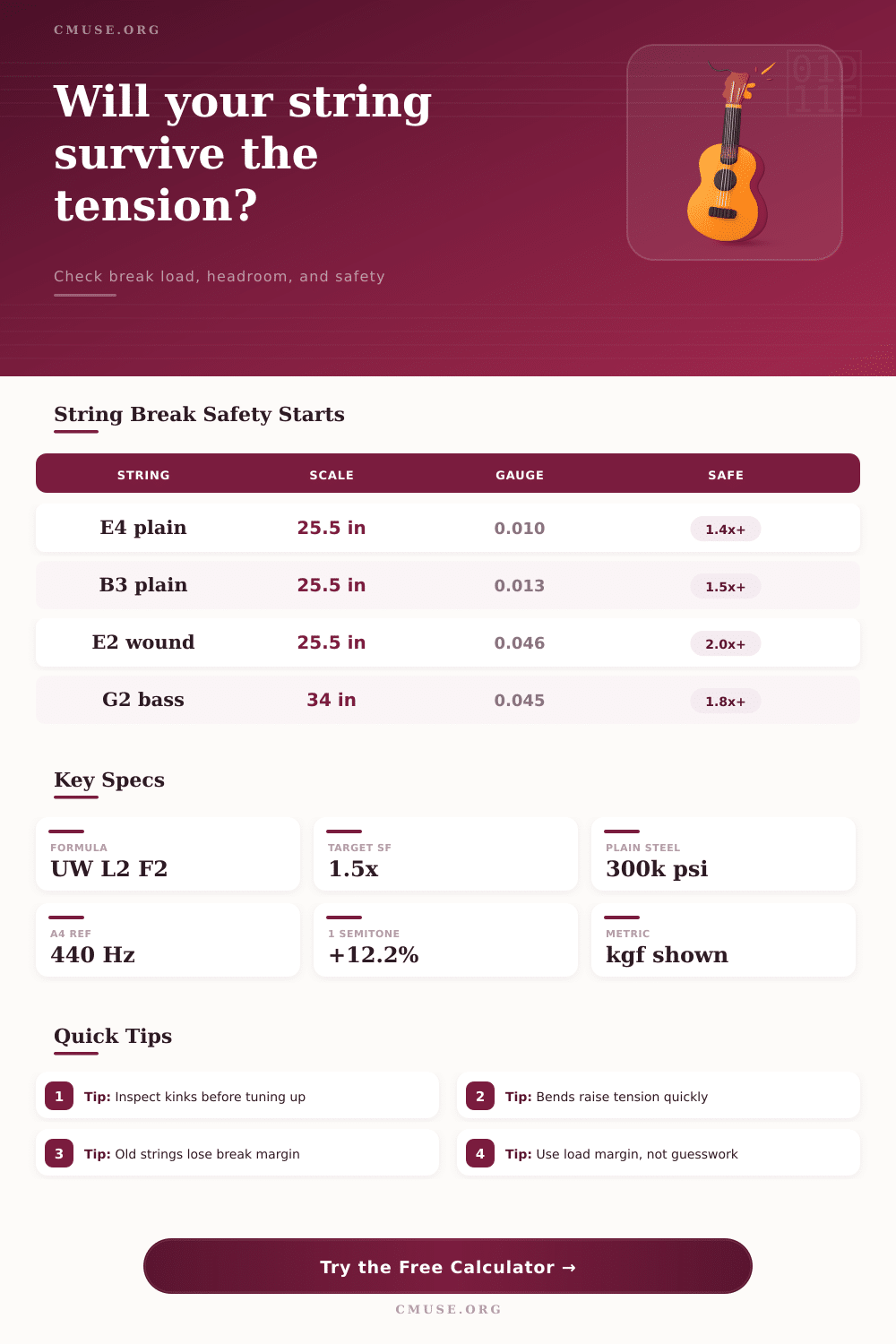
| Electric high E | 25.5 in, 0.010 plain | E4 at 440 Hz | Breaks from tuner overshoot or saddle burrs |
| Whole-step B bend | 25.5 in, 0.013 plain | B3 plus 2 semitones | Peak load matters more than resting pull |
| Acoustic top E | 25.4 in, 0.012 plain | E4 at 440 Hz | Higher gauge reduces safety margin |
| Bass G string | 34 in, 0.045 wound | G2 at 440 Hz | Core strength, not outer gauge, limits break |
| Classical treble E | 650 mm, 0.028 nylon | E4 at 440 Hz | Nylon stretch and material rating dominate |
| Actual factor | Status | What it means | Setup response |
|---|---|---|---|
| 2.00x or higher | Comfortable | Plenty of room for normal tuning and bends | Still inspect nut, saddle, and tuner contact points |
| 1.50x to 1.99x | Usable | Reasonable margin for fresh strings and smooth hardware | Tune slowly and recheck after stretching |
| 1.25x to 1.49x | Watch | Small overshoots can eat the remaining margin | Use lighter gauge, lower pitch, or less bend range |
| Below 1.25x | Risky | Peak load is close to the modeled break load | Change the setup before tuning to that target |
The string player hates to hear it. It is not the howl of feedback or the buzz of a fretted note. It is the sudden sharp crack that tears through air as you bend a note with abandon or turn a tuner up one click too far. In an instant you’re out of tune, out of time and probably out of temper.
String breakage for most players are random. It is a matter of cosmic spite or manufacturing defects. It almost never happens that way. The physics is usually predictable but only if you drop the guesswork and start measuring. After inputting your gauge and scale length, the calculator (above) do the rest of the work, saving you time with conversion factors and coefficients.
How to Stop Your Strings from Breaking
That’s great, but knowing what all that means are equally important. Strength of the string and its cross-sectional area determine each string’s breaking point. Two strings might both be plain steel high E strings, yet have vastly different alloy compositions and temperings that would result in one snapping under forty pounds of tension more than the other holds through fifty. Because you can choose whether to use nylon, wound, or plain steel strings, you’re accounting for these difference in the tool. When you’re right up against the edge of a set in a live performance, it makes a difference, and it’s a little thing that counts.
The tension doesn’t operate in isolation. When you tune a string, you are stretching it until downward force matches the frequency required for that pitch. If you raise the pitch one semi-tone, the tension rise about twelve percent. If you go up two steps in total, you’ve now increased the tension on that string by almost thirty percent. Players often concentrate on the resting tension of the string and neglect the transient spikes generated from aggressive picking, bending notes, trying to tune above a string’s natural frequency in hope it will stretch quicker. Those is the points of failure. It is not at rest. To see what these temporary forces do use the bend amount field and try the playing load field too so you can get an idea of the actual peak stress applied instead of simply the idle condition.
There’s always safety in numbers. A safety factor (in engineering terms) are the ratio of your breaking load to your working load. If it’s 1:1, then you’re pushing up against something that will break. We don’t want to do that with our musical instruments, we want a margin of safety. It’s all spelled out nicely on the page in the reference table there which explains why a new string may have plenty of wiggle room, while a corroded or worn one may be right near the edge.
Corrosion is a stress concentrator; it creates micro-cracks where tension spreads. A kink at the tuner post can do the same. That’s why the condition input isn’t just some nice-to-have feature; it’s a critical variable. Even though an old string may feel fine-tight, it’s likely lost significant amounts of its strength if it show signs of wear.
But then there’s material. Whether they is plain or wound makes a big difference in how they react. When you look at wound strings, the outside wrap bears almost no tensile load. It all happens in the steel core inside the string. Which means two wound strings that has the same outside diameter can have wildly different break strengths depending on the size of their cores. Nylon trebles are an additional headache since they’re far more stretchy than steel and have strength derived from polymers instead of the moddern metal fatigue limit. This is where the tool takes account of how it’s built and adjusts its calculations accordingly so you get a good sense of what it’s actualy experiencing.
The figures aren’t gospel, they’re guidelines. Get down to one and a half points below and you’re playing Russian roulette. Before your next rehearsal, drop back on the bend range, change the gauge or tune the instrument down to bring the tension firmly into the safe zone where all that snaps is the energy in your performance rather than the equipment keeping it intact. You should of checked the math first.