Custom String Set Calculator
Estimate total tension, per-string pull, balance spread, and tuning stress when mixing gauges for guitar, bass, violin, baritone, and extended-range instruments.
Enter gauges from highest string to lowest string, and enter notes in the same order. The formula uses unit weight, scale length, and frequency: tension equals unit weight times vibrating length and pitch squared.
Calculation Breakdown
| String | Note | Gauge | Frequency | Tension | Balance |
|---|---|---|---|---|---|
| 1 | E4 | .009 | 329.63 Hz | 13.1 lb | Calculate |
386.4
Imperial gravity divisor
2 x L x F
Vibrating wave term
1.122x
One semitone tension factor
10-20%
Common set spread target
| Instrument Set | Scale | Typical Total | Average String | Useful Reading |
|---|---|---|---|---|
| Electric 9-42 E standard | 25.5 in / 64.8 cm | 80-90 lb | 13-15 lb | Light, easy bends |
| Electric 10-46 E standard | 24.75-25.5 in | 95-110 lb | 16-18 lb | Medium all-purpose feel |
| Drop D 10-52 | 25.5 in / 64.8 cm | 100-115 lb | 17-19 lb | Firm low sixth string |
| Acoustic 12-53 light | 25.4 in / 64.5 cm | 155-170 lb | 26-28 lb | Higher bridge load |
| Four-string bass 45-105 | 34 in / 86.4 cm | 165-185 lb | 41-46 lb | Even modern bass range |
| Violin medium set | 12.9 in / 32.8 cm | 48-55 lb | 12-14 lb | Responsive bowed feel |
| Material Family | Plain String Model | Wound String Factor | Best Use | Calculator Note |
|---|---|---|---|---|
| Nickel wound electric | Steel treble | 1.18 x steel area | Electric guitar | Balanced default |
| Stainless wound | Steel treble | 1.21 x steel area | Bright electric sets | Slightly firmer output |
| Phosphor bronze acoustic | Steel treble | 1.26 x steel area | Acoustic guitar | Higher wound-string mass |
| Nickel bass wound | Wound core | 1.34 x steel area | Bass strings | Accounts for large wraps |
| Classical nylon | Nylon treble | 1.45 x nylon area | Classical guitar | Lower density core model |
| Violin synthetic | Solid or wrapped | 1.55 x core area | Bowed strings | Approximate set comparison |
| Preset | Notes High To Low | Gauges | Scale | Reason To Check |
|---|---|---|---|---|
| Strat 9-42 E Standard | E4 B3 G3 D3 A2 E2 | .009-.042 | 25.5 in | Light bend-friendly baseline |
| Short Scale 10-46 | E4 B3 G3 D3 A2 E2 | .010-.046 | 24.75 in | Shorter scale softens the set |
| Drop D 10-52 | E4 B3 G3 D3 A2 D2 | .010-.052 | 25.5 in | Low string needs support |
| Baritone 13-62 B | B3 F#3 D3 A2 E2 B1 | .013-.062 | 27 in | Lower tuning with longer scale |
| 7-String 10-59 | E4 B3 G3 D3 A2 E2 B1 | .010-.059 | 25.5 in | Checks added low string balance |
| 5-String Bass 45-130 | G2 D2 A1 E1 B0 | .045-.130 | 34 in | Low B tension varies widely |
This calculator estimates comparative string tension from gauge, scale length, pitch, and material family. Exact tension can vary because wound-string core diameter and wrap construction are not standardized.
Remember what it’s like to finally order up a custom set of strings, take them home, carefully install them on your guitar and then discover your low E sounds like a steel cable tied around your finger and your high string feel like slippery noodles? It happens to us all eventually, most likely due to our habit of considering each string individually without accounting for how they works together to oppose the pull of the guitar neck.
The custom string set calculator calculates total pull, estimated gauge tension, and balance spread. This allows players to preview mixed string sets, scale lengths, and tunings so they can makes adjustments before setting up their guitar.
How to Choose the Right Guitar Strings
What it all boils down to though is the fact that wire thickness isn’t the only factor involved with tension. Tension exist in the combination of the thickness of the wire, the tuning you’re aiming for, and how far that string needs to stretch from the nut to the bridge. In other words, a short-scale instrument doesn’t place as much strain on a set as a full-size twenty-five inch electric guitar mainly because strings vibrate less. By inputting what you’re hoping to tune your guitar to and its scale length into the calculator above, you’ll save yourself the hassle of having to guess whether your bridge can withstand drop-D tuning or not.
The first place most people look when beginning to choose strings is at the gauge number on the package. Nine to forty two may sound lightweight, but if your guitar has a twenty seven inch scale as is common on a baritone guitar, then those string gauges will appear slack and floppy. This is because there is more distance for them to stretch over to get to standard pitch. However, if you put heavy strings on a shorter scale guitar you’ll have a board that is stiff and won’t bend. This makes it unplayable.
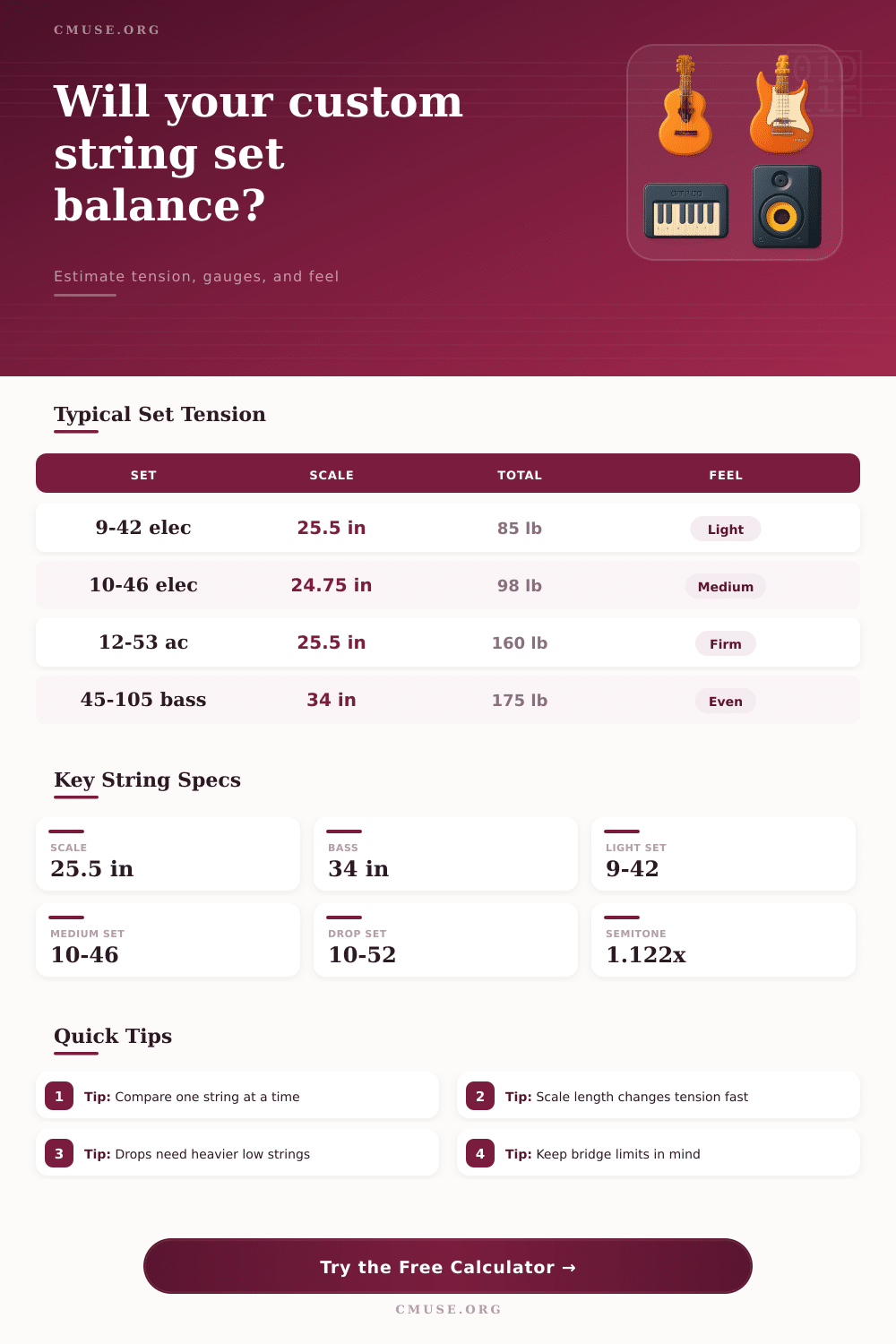
The reference table on the page shows you the typical range of tensions on a variety of setups. Here you can see that a light set of strings on an acoustic has nearly twice the total pull compared to a light electric set. That explains why acoustics require stronger necks and even reinforced tops, as well as why they produce so much volume. It’s not just about volume, it’s about surviving structurally.
This is also where string material density becomes important. Because nickel wound strings are lighter than their stainless steel counterparts, you may opt to go up a size or two on a nickel string to achieve an equivalent tension than a thinner stainless string. And again, the tool has accounted for those material families with its own density factors going on behind the scenes. So when you’re experimenting with swapping out from a bronze set to a nickel set, don’t be concerned about your neck angle changing three degrees overnight. Even though it feels different under your fingertips, you’re still comparing apples to apples in terms of pull.
For everyday playing comfort, though, maybe the most valuable result is the balance spread. This informs you of the evenness in tension on all your strings. If the number is low, it means each one is feeling similar under finger pressure; fretting hand fatigue is less likely and chord changes will be smoother. If the spread is high, it means some strings are pulling much harder than others, a common result of mixing non-standard gauge strings to suit alternate tunings. This is not always bad, but it is something you have to deliberately adapt to because you may want that lower string firmer for rhythm stability while accepting a looser feel on the highs.
Keep in mind, however, that overall tension affects the shape of the guitar. Pulling with high tension on strings will move the neck forward and make it need more truss rod relief. Too little tension lets the neck straighten back out and fret buzz can occur when action is set too low. The advantage here is anticipating this movement without ever picking up a screw driver. If your new set suggests there will be an additional twenty pounds of total pull as opposed to what you’re using now, you should of planned to tweak your truss rod and probably also lift the bridge a bit to accommodate.
All in all, it’s a balancing act of hardware limitations, feel, and tone. Ideally, there should be some tension to allow for good sustain and clear intonation. However, it shouldn’t be so tight that bending becomes too difficult or starts to lift the neck plate. The numbers point you to a safe area but your fingers will have the final say on whether it really works. Start with the math, then let your hands and ears decide when it clicks into place. It is worth the time spent.