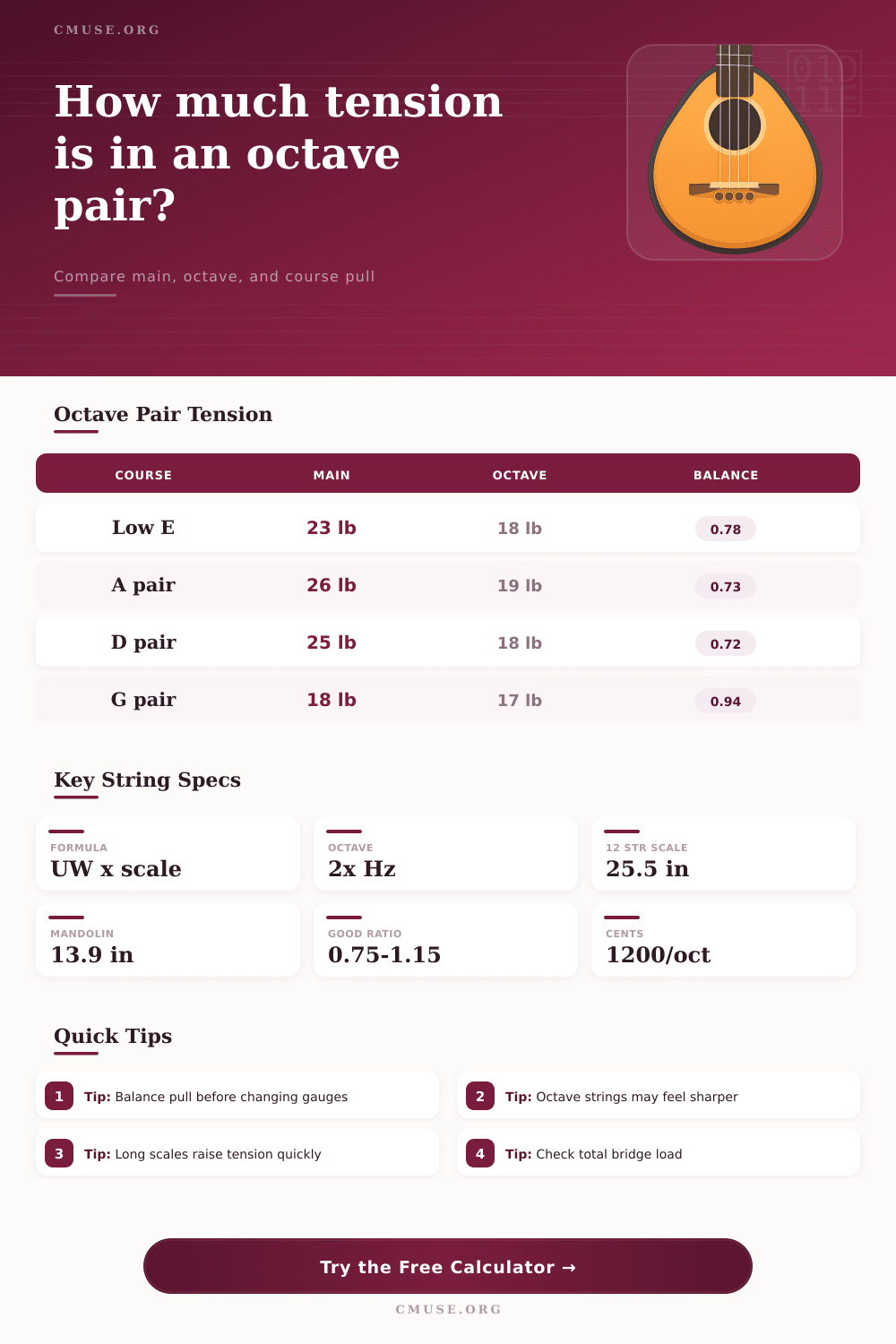
Octave String Pair Tension Calculator
Estimate the main string, octave string, combined course pull, balance ratio, and total instrument load for 12-string guitars, octave courses, citterns, mandolins, and custom paired-string setups.
Load a named octave-course starting point, then adjust scale length, pitch, gauges, materials, and detuning. The calculator uses vibrating-string tension math and estimated unit weight from the selected string construction.
Calculation Breakdown
Hz = A4 x 2^((MIDI - 69) / 12)Hz adjusted = Hz x 2^(cents / 1200)T = UW x (2 x L x F)^2 / 386.4ratio = octave tension / main tension| Preset | Scale | Main Pitch And Gauge | Partner Pitch And Gauge | Typical Use |
|---|---|---|---|---|
| 12-String Low E Pair | 25.5 in / 647.7 mm | E2, 0.046 wound bronze | E3, 0.026 wound bronze | Acoustic 12 |
| 12-String A Pair | 25.5 in / 647.7 mm | A2, 0.036 wound bronze | A3, 0.018 plain steel | Acoustic 12 |
| 12-String D Pair | 25.5 in / 647.7 mm | D3, 0.026 wound bronze | D4, 0.012 plain steel | Acoustic 12 |
| 12-String G Pair | 25.5 in / 647.7 mm | G3, 0.017 plain steel | G4, 0.008 plain steel | Bright octave |
| Baritone A Octave | 27.5 in / 698.5 mm | A1, 0.064 wound nickel | A2, 0.034 wound nickel | Long scale |
| Bouzouki D Octave | 25.0 in / 635.0 mm | D3, 0.030 wound bronze | D4, 0.014 plain steel | Celtic course |
| Construction | Density Used | Area Factor | Typical Gauge Range | Tension Behavior |
|---|---|---|---|---|
| Plain steel | 7850 kg/m3 | 1.00 | 0.007-0.024 in | Predictable high-frequency octave strings with clear attack. |
| Nickel-plated wound steel | 8050 kg/m3 | 0.72 | 0.018-0.080 in | Common electric and baritone octave-course choice. |
| Phosphor bronze wound | 8800 kg/m3 | 0.74 | 0.020-0.080 in | Common acoustic 12-string main courses and some octave strings. |
| Stainless wound | 7900 kg/m3 | 0.76 | 0.020-0.080 in | Slightly firmer response for the same diameter estimate. |
| Flatwound nickel | 8200 kg/m3 | 0.82 | 0.020-0.095 in | Higher effective mass and a smoother course response. |
| Nylon or nylon-core | 1150-1800 kg/m3 | 0.85-1.00 | 0.024-0.090 in | Lower tension estimate and softer paired-course feel. |
| Octave / Main Ratio | Feel In The Course | Likely Sound | Adjustment Direction | Good For |
|---|---|---|---|---|
| Under 0.60 | Octave feels loose | Main string dominates | Raise partner gauge or tuning | Soft shimmer behind a strong fundamental |
| 0.60-0.75 | Light octave | Bright but relaxed | Fine for gentle pick attack | Vintage 12-string response |
| 0.75-1.15 | Balanced pair | Even attack and sustain | Keep gauges close to current | General octave courses |
| 1.15-1.35 | Firm octave | Octave pops forward | Lower partner gauge slightly | Lead-forward shimmer and recording clarity |
| Over 1.35 | Very stiff octave | Possible sharp attack | Reduce partner gauge or scale load | Only when a bright octave is intentional |
| Instrument Family | Common Scale | Relative Tension | Octave Pair Note | Check First |
|---|---|---|---|---|
| Mandolin and tiple | 13-17 in / 330-432 mm | Low to medium | Small gauge changes are noticeable | Breakage on very thin octave strings |
| Octave mandolin | 19-23 in / 483-584 mm | Medium | Wound partners can balance lower courses | Bridge load across paired courses |
| Acoustic 12-string | 24.75-25.5 in / 629-648 mm | High | Lower four courses often use octave strings | Total neck and top pull |
| Irish bouzouki | 24-26 in / 610-660 mm | High | Octave or unison choices change feel strongly | Course-to-course tension jumps |
| Baritone 12-string | 27-30 in / 686-762 mm | Very high | Long scale raises pair load quickly | Use lighter gauges before tuning up |
| Preset | Interval | Materials | Balance Goal | Use The Result To |
|---|---|---|---|---|
| 12-String Low E Pair | Octave above | Bronze wound / bronze wound | Even course response | Check low-course bridge load before increasing gauge. |
| Nashville Low E Pair | Octave above | Bronze wound / plain steel | Light octave emphasis | Estimate high-strung rhythm shimmer without a full 12-string. |
| Baritone A Octave | Octave above | Nickel wound / nickel wound | Firm octave response | Keep the long-scale pair from exceeding comfortable pull. |
| Bouzouki D Octave | Octave above | Bronze wound / plain steel | Even course response | Compare octave brightness against course stiffness. |
| Mandocello C Pair | Octave above | Flatwound / wound nickel | Short-scale paired courses | Estimate low-course load without over-tight octave partners. |
When you first play a twelve-string guitar, what you experience is resistance. But that’s more a matter of tension than skill. On a twelve-string, a mandolin, or even a Nashville-tuned six-string, you invite physics into your playing because you are pairing strings together. The instrument doesn’t care whether that feels comfortable; it only cares about frequency, length and mass.
Because most players buy a set of strings in hopes of the best, they see string pairing as a guessing game. However, an octave string isn’t simply a thinner version of its partner string (the main). It is double the frequency which means it pulls with different intensity unless you adjust the gauge precisely. If the octave partner is too tight relative to the main string, then the course will feel stiff and unresponsive. It will fight your pick. If the string is too loose it won’t be defined and will also wobble on the note.
How to Choose Strings for Your Guitar
Once you plug in your gauges and scale length the calculator does all the maths for you; there’s no need to guess as to whether more tension is going to ruin your intonation or bend your neck. The chart shows gauges based off scale length: it’s not something to be memorized, but understanding how inputs work is important.
If we have the same pitch and diameter strings then the tension is largely determined by scale length. For example, a thirteen inch mandolin scale will pull less than a twenty five and a half inch electric guitar scale. The reason is that the tension increases exponentially, as the SQUARE of the scale length. That means doubling your scale length doubles your tension issue… unless you adjust the gauge.
Switching between imperial and metric measurements makes it easier to switch between regional or brand names. You can toggle back and forth between systems. It also factors in the relative density of the materials. Bronze is denser than nickel, steel is denser than nylon. Even at the same diameter, this changes the unit weight, which changes the tension.
Did you see the cents detuning field? It doesn’t seem like much until you understand that some pros will sweeten their octaves up a cent or two. This might be done to give them more of a chorus sound or to take away from any kind of beat. Even a ten-cent shift alters the tension slightly. And that can make the difference between a broken wire on a thin high-E octave string and a clean tone.
If your pair is at a ratio near one, they pull equally. If the ratio is lower than one, the main string dominates. If it is higher, the octave takes over. Nothing is perfect. Sometimes vintage players like a loose octave with a softer attack. Recording artist may like a firmer octave so that it cuts through a dense mix.
It’s all in the reference table on the page. It includes everything from bouzoukis to acoustic twelve-strings. They’re just places to start, not rules. Each instrument is its own beast with structural boundaries. Some necks take high-tension before they warp; others come off the body if you give them enough slack.
If you modify a custom setup, remember: total bridge load is king. One pair is one thing; it’s very easy to forget that six or twelve of ’em adds up fast. The math is honest, but the wood has limits.
So how they feel matter as much as, if not more then, how they sound. Do the strings make your instrument respond naturaly to your playing? Does the course move together? Does it ring clean and sustain but not fight you?
Begin with suggested gauges for your pitch and scale. From there tweak according to feeling of the neck and how the tone fits into your mix. It is not necessarily the brightest or loudest. But a harmony between instrument and string. The sound works when the foundation holds steady beneath the pressure.