Drop Tuning String Tension Calculator
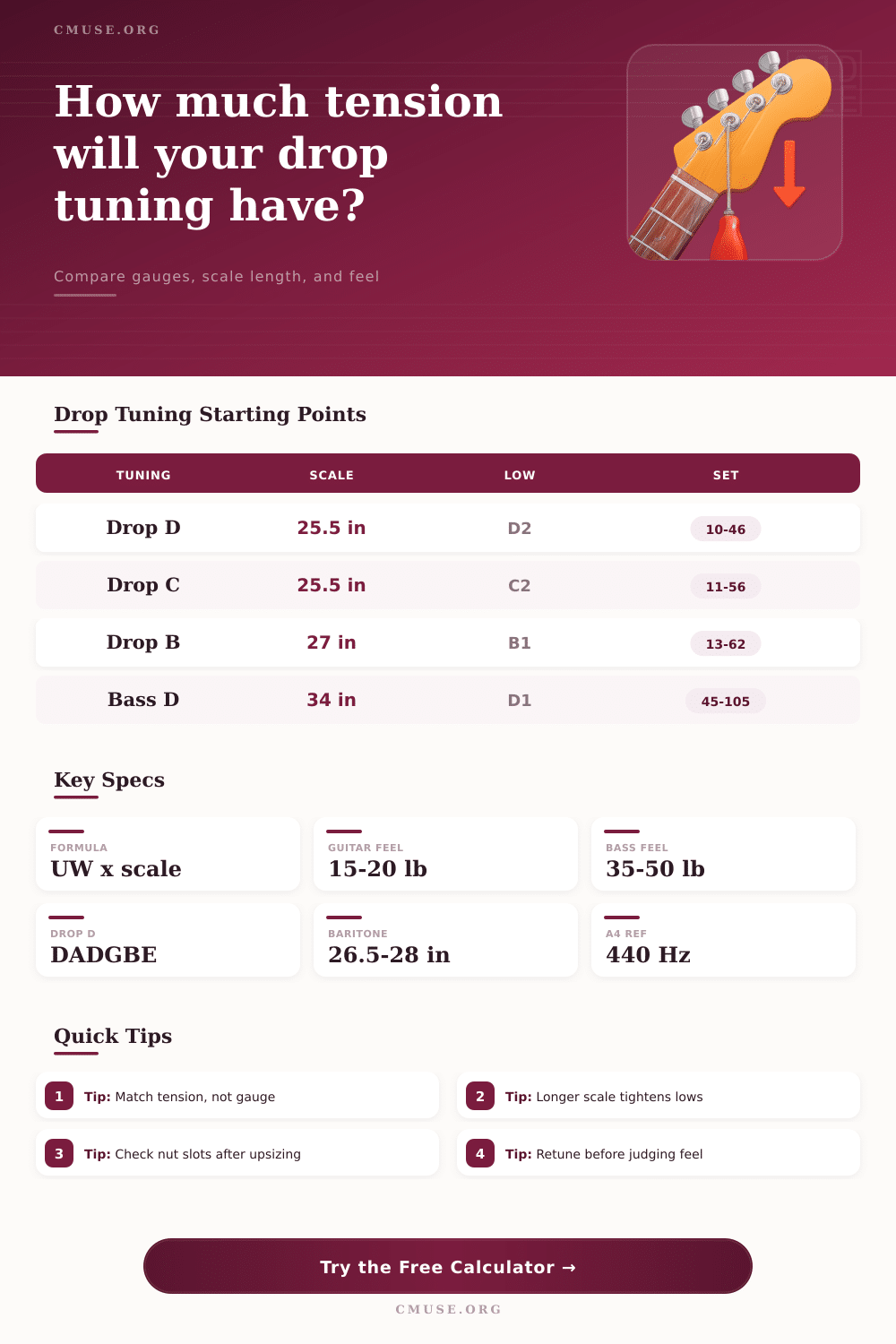
Estimate guitar or bass string tension for drop tunings from scale length, gauge, note choice, winding material, and pitch standard before changing sets.
Choose a starting point, then adjust individual gauges or notes. String numbers run from the lowest-pitched string to the highest-pitched string.
String 1 - lowest
String 2
String 3
String 4
String 5
String 6 - highest on 6-string
String-by-string breakdown
T = UW
Uses unit weight, scale, and frequency
25.5 in
Common electric guitar scale
34 in
Common long-scale bass length
440 Hz
Default A4 pitch reference
| Tuning | 6-string notes low to high | Typical scale | Common set |
|---|---|---|---|
| Drop D | D2 A2 D3 G3 B3 E4 | 24.75 to 25.5 in | 10-46 or 10-52 |
| Drop C# | C#2 G#2 C#3 F#3 A#3 D#4 | 25.5 in | 10-52 or 11-52 |
| Drop C | C2 G2 C3 F3 A3 D4 | 25.5 to 26.5 in | 11-56 or 12-56 |
| Drop B | B1 F#2 B2 E3 G#3 C#4 | 26.5 to 28 in | 12-60 or 13-62 |
| DADGAD | D2 A2 D3 G3 A3 D4 | 24.75 to 25.5 in | 12-53 acoustic |
| Use case | Low string range | Treble range | Feel note |
|---|---|---|---|
| Light electric drop D | 42 to 46 | 9 to 10 | Fast, flexible bends |
| Balanced drop C | 54 to 60 | 11 to 12 | Stable rhythm feel |
| Baritone drop B/A | 60 to 74 | 12 to 14 | Clear low note attack |
| 8-string drop E | 74 to 90 | 8 to 10 | Scale length matters most |
| Bass drop C/D | 105 to 120 | 40 to 55 | Nut slot width often changes |
| Scale length | Relative tension | Best fit | Practical result |
|---|---|---|---|
| 24.75 in | 94% of 25.5 in | Standard and mild drops | Softer at same gauge |
| 25.5 in | 100% reference | Most 6-string drop setups | Balanced baseline |
| 26.5 in | 108% of 25.5 in | Drop B and 7-string | Tighter low strings |
| 27 in | 112% of 25.5 in | Baritone and extended range | Cleaner low attack |
| 34 in bass | 178% of 25.5 in | Bass drop tunings | Large gauges stay controlled |
| Construction | Wound mass factor | Plain strings | Use in calculator |
|---|---|---|---|
| Nickel wound | 0.86 | Plain steel | Default electric estimate |
| Stainless wound | 0.88 | Plain steel | Slightly heavier feel |
| Coated nickel | 0.84 | Plain steel | Slightly lighter estimate |
| Phosphor bronze | 0.92 | Plain steel | Acoustic wound strings |
| Flatwound | 0.94 | Plain steel | Dense wrap estimate |
Most of us don’t realize when we begin to feel our strings going slack until it’s too late, and first sign isn’t typically a snapped string. Instead, you drop that low E down to D, or perhaps even all the way down to C. Suddenly, what was once your rhythm feels awkward, and your lead playing have become brittle.
In most cases, it doesn’t have anything to do with the guitar itself. Almost always it has to do with the tension balance along length of the neck. Many players intuitively understand that if they change their pitch, they should also increases the weight of every string. Makes sense from a logical standpoint, but that just isn’t how string physics operates on a fretboard.
How to Find the Right String Feel
The calculator above handle the complex math. It uses the weight of each string, the scale length, and the frequency of each note to estimate total tension. What most players pay attention to is how much tension there is pulling across neck as a whole, and how stable it make the structure. They don’t think about the feel of strings. Even though a set might be perfectly tensioned as a whole, you may find they feels inconsistent from string to string. One flies out from under your finger, while another feel like it’s dragging.
This tool takes it apart and shows you where every single note fall in relation to an ideal range of feel. Consistency is what you’re after. When the first string feels over-tight, and the sixth doesn’t feel quite tight enough, no amount of pick adjustment are going to even the playing field.
What’s different? Everything. That change in scale length, shifting from a 24.75-inch scale to a 25.5-inch scale, makes all those strings tighter for the same pitch and gauge. And that makes a big difference in terms of dropping tunings, since longer scales tend to automatically make up for slack induced by lower pitches. So maybe you’ll discover a lighter set sounds lovely on your baritone guitar but flops around on your regular Stratocaster.
With this direct connection taken into account, the calculator allows you to visualize the tension shift without having purchased any new strings. You will no longer have to use trial and error by opening packages only to find they is not tight enough or are way too stiff.
The other factors that matter a bit less but not insignificantly is the makeup of materials. Phosphor bronze, stainless steel, and nickel wound string vary in density. For example, a.046 nickel wound string tuned to the same note will feel lighter than a.046 stainless steel string because stainless is more dense. The calculator accounts for this difference in mass and allows you to compare like items rather then unlike items. If you’re replacing your nickel flats with bright rounds for instance, tension difference may catch you off-guard if you don’t account for the change in material. It is a little thing, but it is important if you want a particular touch.
The other limiting factor, not really calculable by any machine, is the nut. If you jump up several sizes in the same gauge to get enough tension for low strings like drop C and below, you will often find that the string are wider than the slot in your nut. Putting a fat string into a skinny slot binds the string, which cause it to tune slowly and cause intonation problems. What is the solution? Widen the slots slowly or set up a compensated saddle so that this instrument remain playable. The calculator indicates which size works best for feel, but won’t indicate if your nut can accommodates them without being modified.
Secondly, don’t rush through the break in. New strings are stiff and hold their tune poorly. They’re also not very tuneful at all. It takes time (sometimes days), for them to loosen up and stretch into place. You should of waited a bit longer. The moment you buy them and install a new set, you can’t really judge how they will feel. Play, stretch, and tune them again. Repeat this until they stop stretching and settling into place.
Then, the real story emerges. The first snap and squeal is just part of it; it’s no verdict on anything.
The secret of getting proper string tension lies not as much in the chart as it does in matching physics to the feel of your playing. If you’re a delicate fingerpicker or a heavy chugger, the desired result are still the same; equal clarity and effort from all strings. Your fingers and ears will determine finishing touches. After all, if you like how it feels, the tension is good and you don’t even think about the strings anymore. You just play.