Capo Fret Pitch Calculator
Transpose capoed chord shapes into sounding keys, reverse a concert key into playable shapes, and estimate pitch shift, frequency ratio, capo position, and open-string notes.
Choose a familiar capo scenario, then adjust the key, chord quality, tuning, notation, and reference pitch. Each preset loads a real fretted-instrument transposition case and recalculates immediately.
Capo Calculation Breakdown
Forward Transposition
When you play a chord shape with a capo, the sounding root rises by the capo fret count.
sounding root = shape root + capo frets
Reverse Transposition
To find a playable shape for a concert key, subtract the capo fret count from the desired sounding root.
shape root = concert root - capo frets
Pitch Ratio
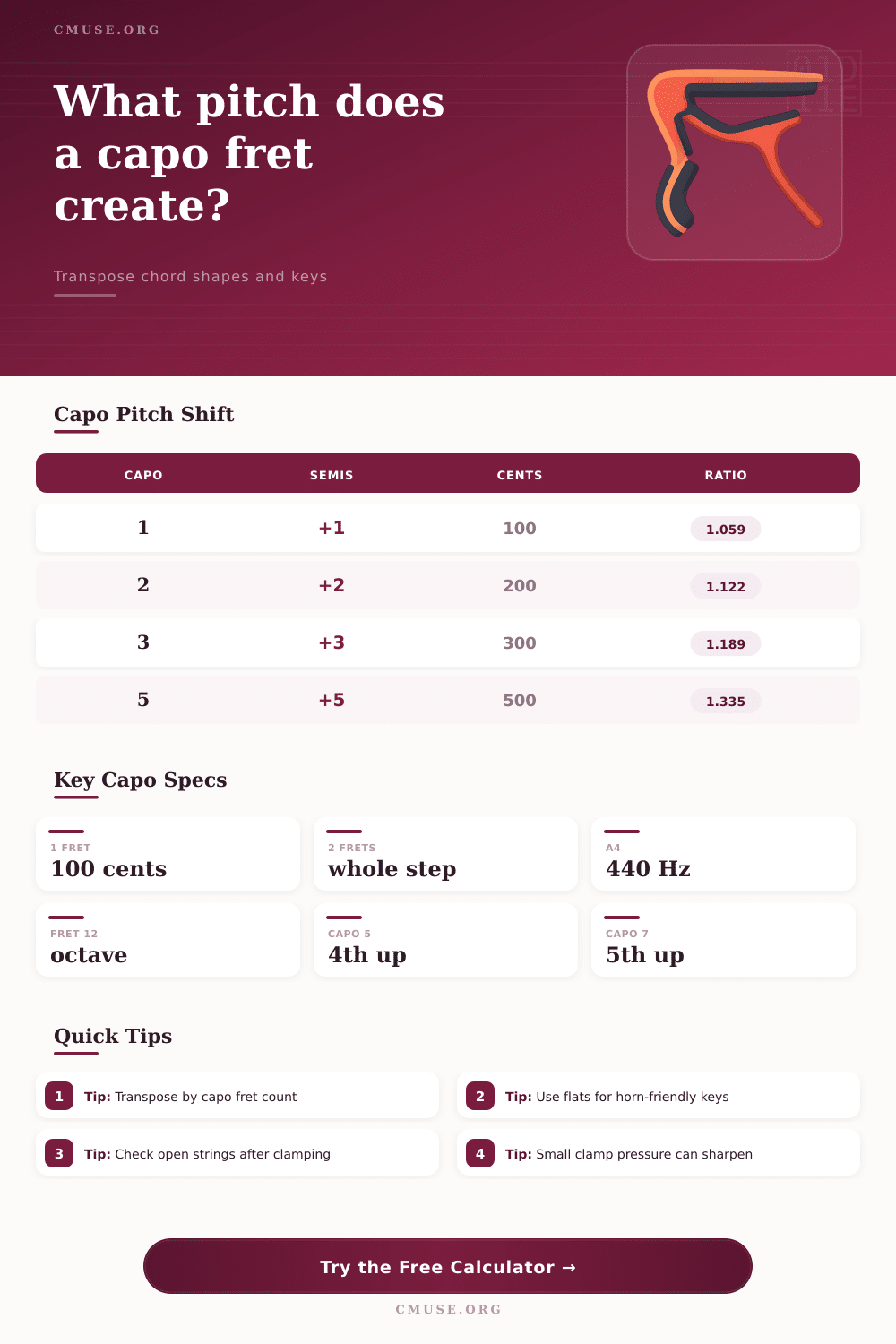
Equal temperament raises frequency by the twelfth root of two for every fret, with optional cents compensation.
ratio = 2 ^ ((frets + cents / 100) / 12)
Capo Position
The capo fret is located by the same twelfth-root-of-two geometry used to place frets on a scale length.
distance = scale * (1 - 2 ^ (-fret / 12))
| Capo Fret | Interval Up | Cents Shift | Frequency Ratio | Example From G Shape |
|---|---|---|---|---|
| 0 | Unison | 0 cents | 1.000000 | G sounds G |
| 1 | Minor 2nd | 100 cents | 1.059463 | G sounds Ab / G# |
| 2 | Major 2nd | 200 cents | 1.122462 | G sounds A |
| 3 | Minor 3rd | 300 cents | 1.189207 | G sounds Bb / A# |
| 4 | Major 3rd | 400 cents | 1.259921 | G sounds B |
| 5 | Perfect 4th | 500 cents | 1.334840 | G sounds C |
| 7 | Perfect 5th | 700 cents | 1.498307 | G sounds D |
| 12 | Octave | 1200 cents | 2.000000 | G sounds G octave |
| Goal | Capo Fret | Shape Played | Sounding Key | Useful Context |
|---|---|---|---|---|
| Bright A major | 2 | G major shape | A major | Country strum |
| Open E sound | 4 | C major shape | E major | High voicing |
| Acoustic F | 3 | D major shape | F major | Folk guitar |
| Concert Bb | 3 | G major shape | Bb major | Flat key |
| Ukulele D | 2 | C major shape | D major | Uke capo |
| Banjo C | 5 | G major shape | C major | Bluegrass |
| Instrument Tuning | Open Notes | Capo 1 | Capo 2 | Capo 5 |
|---|---|---|---|---|
| Guitar standard | E A D G B E | F Bb Eb Ab C F | F# B E A C# F# | A D G C E A |
| Guitar half-step down | Eb Ab Db Gb Bb Eb | E A D G B E | F Bb Eb Ab C F | G# C# F# B D# G# |
| Drop D guitar | D A D G B E | Eb Bb Eb Ab C F | E B E A C# F# | G D G C E A |
| DADGAD guitar | D A D G A D | Eb Bb Eb Ab Bb Eb | E B E A B E | G D G C D G |
| Ukulele reentrant | G C E A | Ab Db F Bb | A D F# B | C F A D |
| Mandolin | G D A E | Ab Eb Bb F | A E B F# | C G D A |
| Scale Length | Capo 1 Distance | Capo 2 Distance | Capo 5 Distance | Remaining At Capo 5 |
|---|---|---|---|---|
| 24.75 in / 628.7 mm | 1.39 in / 35.3 mm | 2.70 in / 68.6 mm | 6.21 in / 157.7 mm | 18.54 in / 471.1 mm |
| 25.5 in / 647.7 mm | 1.43 in / 36.4 mm | 2.78 in / 70.6 mm | 6.39 in / 162.4 mm | 19.11 in / 485.3 mm |
| 26.5 in / 673.1 mm | 1.49 in / 37.8 mm | 2.89 in / 73.4 mm | 6.65 in / 168.8 mm | 19.85 in / 504.3 mm |
| 27.5 in / 698.5 mm | 1.54 in / 39.2 mm | 3.00 in / 76.2 mm | 6.90 in / 175.3 mm | 20.60 in / 523.2 mm |
| 13.875 in / 352.4 mm | 0.78 in / 19.8 mm | 1.51 in / 38.5 mm | 3.48 in / 88.4 mm | 10.40 in / 264.0 mm |
| Preset | Instrument | Capo | Input | Result |
|---|---|---|---|---|
| G Shape To A | Standard guitar | 2 | G major shape | A major sounding |
| C Shape To E | Standard guitar | 4 | C major shape | E major sounding |
| DADGAD Folk F | DADGAD guitar | 3 | D major shape | F major sounding |
| Ukulele C To D | Reentrant ukulele | 2 | C major shape | D major sounding |
| Banjo G To C | 5-string banjo | 5 | G major shape | C major sounding |
| Find Shapes For Bb | Standard guitar | 3 | Bb concert key | G major shape |
After entering the key you want to play in and tuning, it works out what capo placement is right for you, no maths needed. As long as you know how this will physically affect instrument, you can rely on the output.
Each fret move up a semi-tone (around 100 cents higher). So when you use a capo on the second fret the length of string from there to the end shortens and that open G becomes an A major chord. You can hear it immediately with new note and see what finger positions you are creating.
How to Use a Capo Calculator
With a capo as new reference point, most people’s thoughts is relative to chord shapes and not absolute frequencies. For example, I might play a C shape, but with the capo on the fifth fret, what sounds like a C chord is actualy a G major sound. When arranging for an instrument or writing music this can be significant. It’s one thing that you fingered something on your guitar, it’s another the concert pitch for the clarinettist to perform. It shows the transposed root clearly so everyone understand the actual pitch.
The further up the neck that you go, the more critical precision is. Because strings are under more tension when they sits on the capo, pressing down too hard may pull them sharp. Experienced players will frequently double-check their intonation with the capo in place. By softening the pressure or making a tiny adjustment, notes stays pure. No piece of hardware are perfect, and there is a small amount of compensation in cents built into the calculator for this variation.
Pitch is not the only consideration, but also the place you play it from, as this will affect the tonal qualities too. The longer the string length that vibrates, the more natural sound are kept lower down on guitar. Once away from the fifth fret the strings starts to feel tighter and thinner under fingers making higher positions less comfortabley. For folk ballads perhaps you like the bright quality of higher positions despite your hand feeling more cramped.
The position of those frets depend on the scale length of the instrument. If the scale length of a standard guitar is 25.5-inches then second fret sits approximately two and three quarter inches away from nut. For shorter scale instruments like a baritone or even a ukulele, this distance will be in different physical location. With accurate information about specifications of your instrument, the tool can calculates specific measurements for you so that you know exactly where to position the capo for clear sounding notes without any buzzing.
For example, if you’re collaborating with someone who likes singing in Eb major, there’s no need to work it all out from first principles: Simply type in that as the desired key and get told what to play with a capo on good position. You should of used this earlier. It streamlines song-writing sessions.
It extends your musical reach without leaving home ground. Fluency with both sounds and shapes is mastering the capo. It’s not about changing the music but about how you look at it. The calculator takes the friction out of that change making it easier to concentrate on the feel instead of the arithmetic. This allows you to make smart creative choices knowing precisely what notes your strings will sound like.
Remember: The clamp give you access to all major and minor scales on the fretboard when you go to reach for it.