Double Stop Interval Calculator
Identify a two-note double stop, compare it with equal-tempered and pure tuning targets, estimate cents drift, check inversion, and judge the physical reach.
Load a named two-note example, then change the pitches, tuning target, offsets, and reach values. The calculator treats the lower note as the reference voice and analyzes the upper note against it.
Double-Stop Breakdown
Hz = A4 x 2^((MIDI - 69) / 12) x 2^(offset / 1200)cents = 1200 x log2(upper Hz / lower Hz)drift = actual cents - target tuning centsmargin = comfort limit - measured reach - tempo factorOne equal-tempered semitone
Pure major third cents
Pure minor third cents
Pure perfect fifth cents
Pure perfect fourth cents
Pure major sixth cents
Octave or compound wrap
Default A4 reference
| Simple Interval | Semitones | Equal Cents | Common Double-Stop Sound | Inversion |
|---|---|---|---|---|
| Unison or octave | 0 or 12 | 0 / 1200 | Blend and reinforcement | Unison or octave |
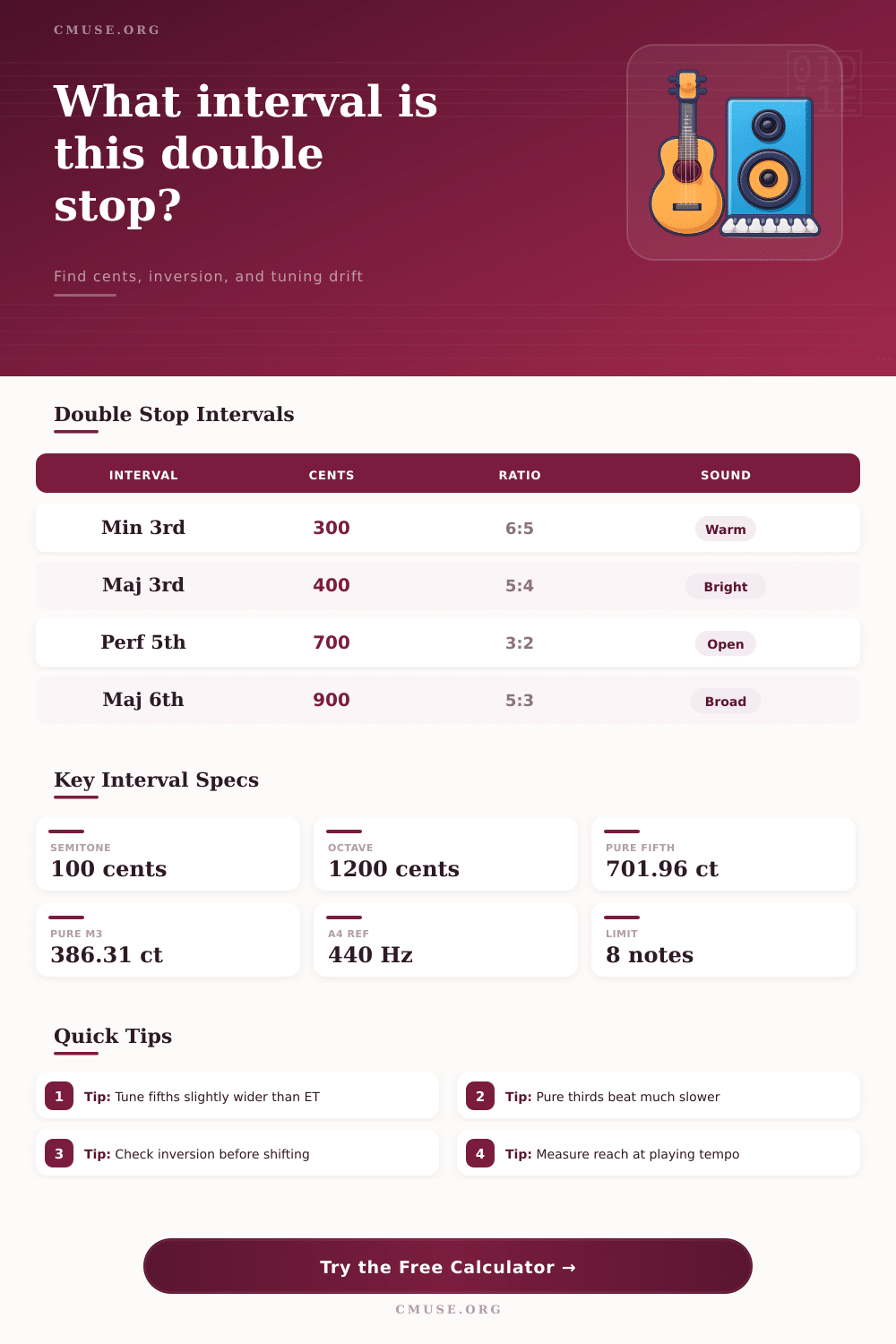
| Minor third | 3 | 300 | Warm, shaded harmony | Major sixth |
| Major third | 4 | 400 | Bright chord color | Minor sixth |
| Perfect fourth | 5 | 500 | Open, suspended | Perfect fifth |
| Tritone | 6 | 600 | Tense, directional | Tritone |
| Perfect fifth | 7 | 700 | Stable and open | Perfect fourth |
| Major sixth | 9 | 900 | Broad melodic harmony | Minor third |
| Interval | Equal Temperament | Just Target | Difference From Equal | Practical Tuning Cue |
|---|---|---|---|---|
| Minor third | 300.00 cents | 315.64 cents | +15.64 cents | Pure minor thirds sit wider than piano tuning. |
| Major third | 400.00 cents | 386.31 cents | -13.69 cents | Pure major thirds are noticeably lower. |
| Perfect fourth | 500.00 cents | 498.04 cents | -1.96 cents | Very close, but slightly narrow when pure. |
| Perfect fifth | 700.00 cents | 701.96 cents | +1.96 cents | Pure fifths are slightly wide and beat slowly. |
| Minor sixth | 800.00 cents | 813.69 cents | +13.69 cents | Inversion of a pure major third. |
| Major sixth | 900.00 cents | 884.36 cents | -15.64 cents | Inversion of a pure minor third. |
| Instrument Context | Typical Easy Reach | Careful Reach | Risk Zone | Double-Stop Note |
|---|---|---|---|---|
| Violin or fiddle | 0-35 mm | 36-48 mm | 49 mm and up | Shifts and string crossings change the feel quickly. |
| Viola | 0-42 mm | 43-58 mm | 59 mm and up | Same interval shapes can feel wider than violin. |
| Cello | 0-70 mm | 71-95 mm | 96 mm and up | Thumb position can reduce wide interval strain. |
| Double bass | 0-85 mm | 86-115 mm | 116 mm and up | Stopped fifths and octaves often require shifts. |
| Guitar or mandolin | 0-45 mm | 46-65 mm | 66 mm and up | Fret spacing depends strongly on neck position. |
| Piano or keyboard | 0-165 mm | 166-205 mm | 206 mm and up | Large tenths may require rolling or redistribution. |
| Preset | Notes | Main Interval | Tuning Target | Reach Assumption |
|---|---|---|---|---|
| Violin Open Fifth | G3 to D4 | Perfect fifth | Pythagorean or just fifth | Open strings, no left-hand reach. |
| Fiddle Major Sixth | D4 to B4 | Major sixth | Just major color | Moderate stopped reach. |
| Viola Minor Third | A3 to C4 | Minor third | Just minor color | Compact two-finger shape. |
| Cello Octave Stop | C2 to C3 | Octave | Equal or pure octave | Wide but idiomatic in position. |
| Guitar Major Third | G3 to B3 | Major third | Equal or slightly pure | Small adjacent-string shape. |
| Piano Compound Tenth | C3 to E4 | Major tenth | Equal temperament | Large keyboard span. |
Most digital devices and pianos is now routinely tuned to an equal tempered system which sacrifices all other intervals to allow for modulation into different keys. For example, the octave is not compromised but all other interval are. This means that while the instrument itself may be perfectly in tune (from a harmonic perspective), your instrument is tuned according to needs of chords rather than pure harmony (simple ratios of frequencies).
Playing in double stops is a clear example of this, because what you see on stave and how your fingers feel do not always match how it sounds. There can be a beating metallic sound that makes the listener wince. Here you are playing a perfect fifth and everything about your intonation feels fine. However, because you are playing two notes together, the compromise of equal temperament becomes very obvious.
The Problem with Equal Temperament Tuning
Once you have identified your pitch offset and desired temperament then the calculator will do the maths for you. This spares you having to guess if the dissonance you hear is due to poor tuning or inherent sound physics.
So what is the main problem? The issue is equal temperament versus just intonation. A major third in equal temperament measures out as precisely four hundred cents. In pure just intonation, it aligns roughly at three hundred eighty-six cents. On paper that sounds like no difference whatsoever, but in perception, it’s huge. It is enough to transform a clear sounding chord into one that seems harsh and not quite right.
For string players, this means they may choose to tune the top note down ever so slightly towards that purity and adjust their finger positions as they go if necessary. Keyboard players has no such choice. They must either correct it using software or work around the problem by using equal temperament, which is the compromise all keyboards must make.
Knowing which tuning system you’re intending to work towards alters your approach to the passage completely. Instead of thinking about hitting a certain place, it becomes more about bringing the beat frequencies into balance to produce something resonant and stable.
The second part of the equation is physical reach. If we had unlimited hand span then we could play any interval we wanted to in theory, but unfortunately, musicians don’t. The table below shows the comfortable reach range for different instruments. What it illustrates is the speed at which an otherwise easy interval becomes physically uncomfortable at higher speeds. At a slow adagio pace, perhaps you could manage a major sixth comfortably, but as soon as the tempo picks up, the margin for error is gone. Because you’re overcompensating for the reach, your hands tense up and your intonation suffers as it drifts from the note. This leads to a break in the musical line.
Knowing what is comfortaly within reach for you versus the limit means you can make a decision regarding staying in a wide shape or changing position completely. It’s a practical constraint that requires style choices.
The other thing to think about is that the target for tuning changes according to the harmonic context. A minor third played within a minor key doesn’t sound the same as one in a major key. It beats at a different rate, not just in theory but in sound. In fact, untempered minor thirds are around fifteen cents larger then their equally-tempered equivalents. For example, if you tune your thirds narrowly to a piano while playing in a minor harmony, they will be sharp and feel unstable against the bass. You need to hear the slow gentle pulse of a pure interval not the rapid rattling of an out-of-tune interval. It’s largely a question of knowing exactly what it is you are measuring. Are you tuning to the note or to the relationship between notes? In the world of ensemble playing it’s the relationship that counts.
Intonation and comfort also hinge on inversion in an odd way. An inverted major sixth transforms into a minor third, while the actual physical shape entirely alters. One voicing may seem to be closed in and another open. Unless you’re comfortable playing a certain interval there is no point forcing your hand into an uncomfortable position that will affect the quality of your sound. Often revoicing is simpler than torturing your hand to get into an unwilling position.
Keyboard players in particular face this when confronted with compound intervals such as tenths. Rolling the notes may be the only solution while maintaining accuracy. It is not so much mathematically perfect as it is musically coherent.
For instance, pure fifths are a little wider apart than their equal tempered counterparts, giving them that ring and open sound that is prized by early music fans and fiddlers alike. But if you simply tune each interval purely in isolation, you’ll have a scale that doesn’t work harmonically at all. It’s about the interplay between the melody (the ‘horizontal’ flow) and the sound of the double stop (the ‘vertical’). The tool can get you there, and then you use your ears for the fine tuning.
It is small perhaps, but significant. If you hear the beats slow down and dissipate, you’ve reached the point when the science and the study of music concur. And this clarity makes the difference between a right double stop and a compelling one.