Slide Pitch Interval Calculator
Convert slide or bar movement on a string into semitones, cents, note names, fret-equivalent positions, and target travel from the same scale-length geometry used for fretted instruments.
Choose a familiar slide move, then adjust the scale length, start point, travel direction, tuning, and intonation offset. Distances are measured from the nut to the center of the slide or bar.
Formula basis: pitch is inversely proportional to the active string length from slide to bridge. The equal-tempered interval is 12 x log2(starting active length / ending active length).
Calculation Breakdown
Scale length
Starting active length
One semitone travel
Estimated new note
| Equal-tempered interval | Semitones | Travel as active length | Example from 12 in active length |
|---|---|---|---|
| Quarter tone | 0.5 | 2.85% | 0.34 in / 0.86 cm |
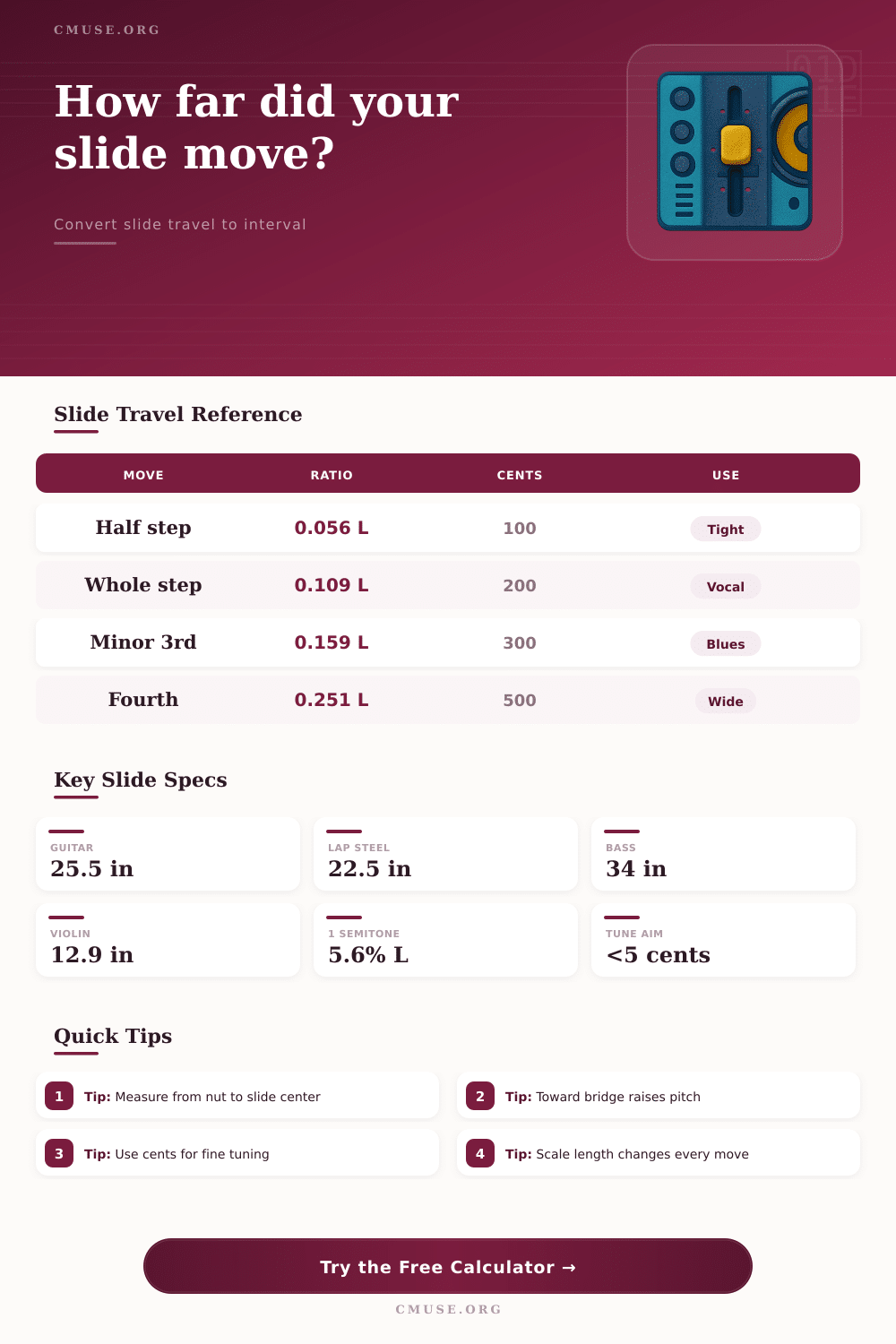
| Minor second | 1 | 5.61% | 0.67 in / 1.71 cm |
| Major second | 2 | 10.91% | 1.31 in / 3.33 cm |
| Minor third | 3 | 15.91% | 1.91 in / 4.85 cm |
| Major third | 4 | 20.63% | 2.48 in / 6.29 cm |
| Perfect fourth | 5 | 25.08% | 3.01 in / 7.64 cm |
| Tritone | 6 | 29.29% | 3.51 in / 8.93 cm |
| Perfect fifth | 7 | 33.26% | 3.99 in / 10.14 cm |
| Instrument | Typical scale | 12th-position active length | Half-step travel at 12th |
|---|---|---|---|
| Electric guitar slide | 25.5 in / 64.8 cm | 12.75 in / 32.4 cm | 0.716 in / 1.82 cm |
| Lap steel guitar | 22.5 in / 57.2 cm | 11.25 in / 28.6 cm | 0.631 in / 1.60 cm |
| Resonator guitar | 25.0 in / 63.5 cm | 12.50 in / 31.8 cm | 0.702 in / 1.78 cm |
| Fretless bass | 34.0 in / 86.4 cm | 17.00 in / 43.2 cm | 0.954 in / 2.42 cm |
| Violin | 12.9 in / 32.8 cm | 6.45 in / 16.4 cm | 0.362 in / 0.92 cm |
| Cello | 27.4 in / 69.6 cm | 13.70 in / 34.8 cm | 0.769 in / 1.95 cm |
| Interval name | Semitones | Cents | Slide use case |
|---|---|---|---|
| Micro slide / blues curl | 0.25 to 0.75 | 25 to 75 | Expressive approach into a target pitch |
| Minor second | 1 | 100 | Chromatic slide or fretless position correction |
| Major second | 2 | 200 | Common vocal-style guitar and lap-steel movement |
| Minor third | 3 | 300 | Blues-box and country-steel approach interval |
| Perfect fourth | 5 | 500 | Wide dobro, bass, and bowed-string position shift |
| Octave | 12 | 1200 | Travel to the midpoint of the active string length |
| Preset | Start point | Move | Expected musical result |
|---|---|---|---|
| Guitar Whole-Step Slide | 12th position on 25.5 in scale | 1.432 in toward bridge | About 200 cents, a clean major second |
| Lap Steel Minor Third | 5th position on 22.5 in scale | 2.200 in toward bridge | About 300 cents from a compact bar move |
| Fretless Bass Half Step | 3rd position on 34 in scale | 1.604 in toward bridge | About 100 cents with wide physical spacing |
| Violin Position Shift | First-position string stop | 1.083 in toward bridge | About 200 cents on a short scale |
| Quarter-Tone Blues Curl | 7th position on guitar | 0.448 in toward bridge | About 50 cents before resolving upward |
It is something about hearing someone bend a string just right to hit the pitch on no frets at all. They are bending not just metal but bending time. But that’s just poet talk. There’s also straight physics behind it.
As you move from the nut toward the bridge, the notes gets closer together. Suddenly, a millimeter matters much more at the end of neck than it did up by the nut. Which is why knowing what an interval is will help you with math of figuring out how close to the note you need to be. This converts the airy-fairy feeler into cold hard geometry. Believe your ears but know the math.
How the Slide Calculator Works
All this moving around comes down to a basic concept: leverage on a vibrating string. The shorter length of string being played from the bridge to where you place the slide, the higher the pitch. Run some math and it turns out that pitch are inversely proportional to the active length. Shorter = higher. Set your instrument’s scale length and starting point in calculator above and let it do the work for you.
What most people concentrate on when moving their hands is actual amount of distance moved in inches. However, what affects the pitch change are the percent of the string that remains vibrating. Moving your hand an inch up the neck at the 12th fret doesn’t create same interval as an inch near the 5th fret. Think about it like stretching a spring or slinky, the more stretched out the end, the lower note produced (for springs). And that’s what the reference table on the page illustrates… Travel in relation to the active length of string instead of absolute distance.
The true labor involves getting your inputs correct. First up, you have to know how long your instrument is (scale length), ranging from a thirty-four inch bass guitar to a twenty-two inch lap steel. Next, you need to specify precisely where your starting point lie. It’s better to measure it to the mid-point of the bar or slide than to the leading edge. The string actualy speaks there, in the middle of the contact patch. A slight mismeasurement here can explain why even though your technique might feel solid, the notes still don’t quite sound right. The beauty of the tool is that it ask you for an accurate start position and then calculates all subsequent intervals accordingly.
As important as distance is direction. When you move towards the nut, the pitch will go down; when you move towards the bridge, it goes up. I know this sounds simple, yet in the moment of performance, we lose sight of what is happening and mistake distance for interval. We believe that if we slide upwards, the pitch must have gone up, which is correct. However, we also need to remember that the rate of change accelerate. This is where seeing the results in cents helps you most. Semitones inform us which note we are on musically, while the cents indicate if we are sharp/flat by reference to the equally tempered scale. On a lap steel, or any fretless instrument, ability to fine tune becomes vital and you can hear a five-cent discrepancy. That lets you work with the instrument instead of fighting it, adjusting millimeters rather than centimeters.
But also think of the material; how does the feel change? Is it a solid steel bar which remains fixed and offers a constant point of contact? Or is it something more flexable such as a bottle-neck style made of glass that will want to roll around depending on your force of contact. The calculator allows you to choose nature of your contact so you can adjust the practical tolerance value displayed with the result.
It’s not simply a question of physics. It’s also ergonomics. Your hand naturaly moves in an arc, and maintaining that arc while moving in a straight line toward the bridge requires more effort then you would think. The preset values within the tool let you visualize common movements, such as a whole step on a guitar or a minor third on a lap steel. From there, you can get an idea of what these intervals feel like in practice.
The gentle warmth can have an effect too. Heat makes strings stretch and this change not only the tension on the string but also its pitch by very slight amounts. These are normally insignificant when casually playing around, but for recording purposes we need accuracy. The surrounding temperature will give you another little piece to add into the mix if there has been any ongoing change in intonation that isn’t accounted for by the geometry of the instrument. It is a tiny variable, but it completes the picture of why your slide might sound fine at home but flat in the warm recording studio.
To conclude. This is a bridging point between what you can hear and what you have remembered by muscle memory. Your ear isn’t replaced, only given a map. A semitone is a specific ratio of string lengths. Because of this, you stop feeling like you are randomly exploring with the slide and realize you are navigating precisely. The subtle tones that give slide and blues guitars soul now fall under your command. Knowing exactly how far to bend a note allows you to repeat that magic, making it predictable and highly expressiv.