Bend Pitch Interval Calculator
Estimate how a guitar string bend changes pitch from bend travel, fret position, scale length, string gauge, material stiffness, tuning reference, and bridge compliance.
Load a named guitar-bend starting point, then adjust the travel, target interval, string gauge, fret, and setup compliance. The model estimates pitch rise from added string stretch and compares it with the selected musical target.
Bend Calculation Breakdown
target Hz = start Hz x 2^(semitones / 12)speaking length = scale / 2^(fret / 12)pitch ratio = sqrt(new tension / old tension)cents = 1200 x log2(bent Hz / start Hz)One equal-tempered semitone
Standard whole-step guitar bend
Common long electric scale
Common short electric scale
Light high-E string gauge
Heavier lead string gauge
Scale midpoint bend reference
Default A4 tuning reference
| Bend Name | Semitones | Cents | Frequency Ratio | Typical Guitar Use |
|---|---|---|---|---|
| Micro inflection | 0.25 semitone | 25 cents | 1.0145 | Expressive color |
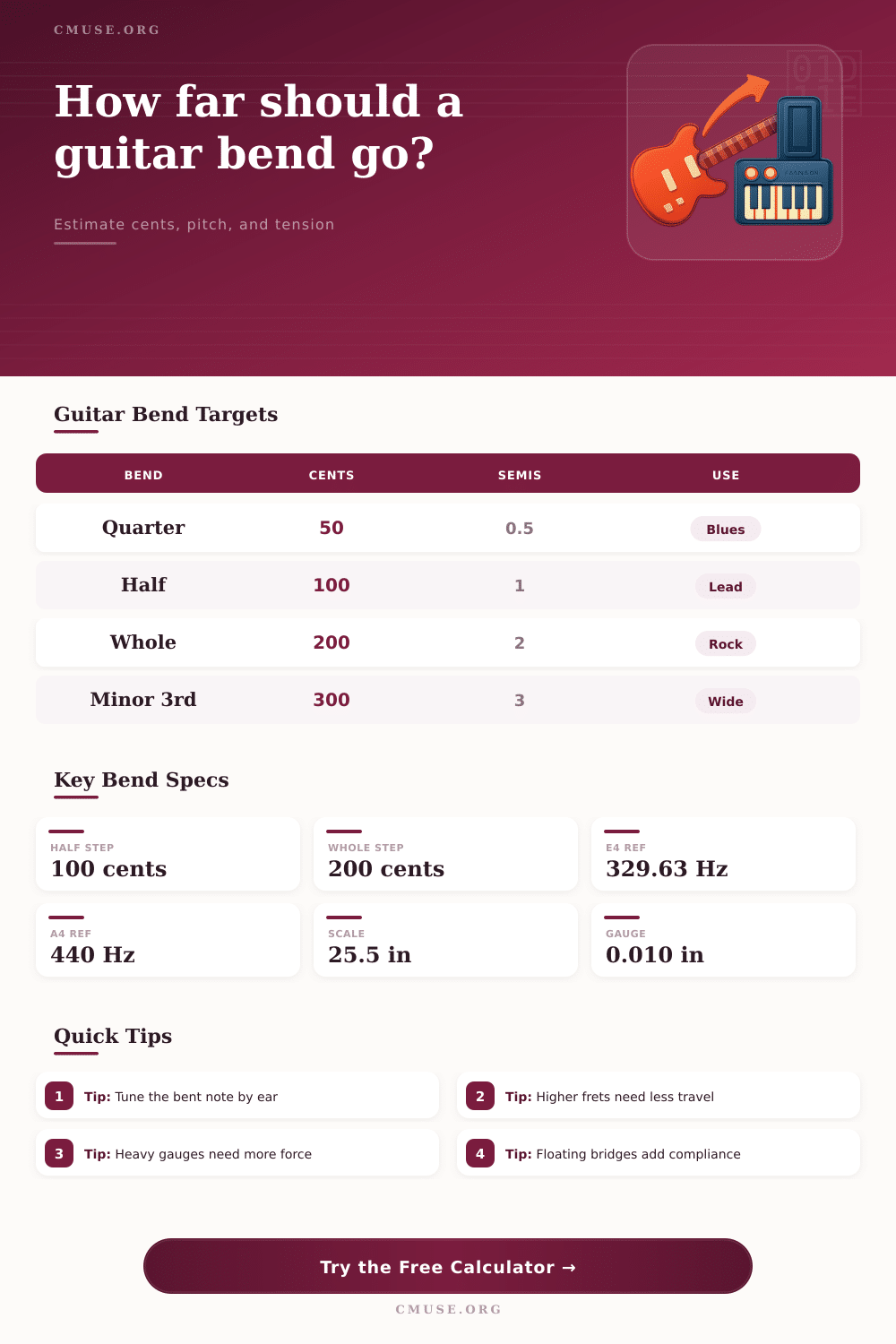
| Quarter-step blues curl | 0.5 semitone | 50 cents | 1.0293 | Blues phrasing |
| Half-step bend | 1 semitone | 100 cents | 1.0595 | Leading tone |
| Whole-step bend | 2 semitones | 200 cents | 1.1225 | Rock lead |
| Minor-third bend | 3 semitones | 300 cents | 1.1892 | Wide vocal bend |
| Perfect-fourth bend | 5 semitones | 500 cents | 1.3348 | Special effect |
| Gauge | Common String | Typical Feel | Bend Travel Trend | Useful Target |
|---|---|---|---|---|
| 0.008-0.009 in | Extra-light high strings | Very flexible | Less finger force, easier overshoot | Wide whole-step and minor-third bends |
| 0.010 in | Standard electric high E | Balanced | Predictable full-step response | Lead work around frets 10-17 |
| 0.011-0.012 in | Heavy electric plain strings | Firm | More effort for the same cents | Half-step and controlled whole-step bends |
| 0.017-0.026 in | Plain or wound G range | Setup dependent | Wound strings feel stiffer under bends | Unison bends and country bends |
| 0.032 in and up | Lower wound strings | Heavy | Small pitch bends need noticeable force | Quarter-step color and vibrato |
| Fret | Speaking Length On 25.5 In Scale | Playing Zone | Bend Feel | Common Use |
|---|---|---|---|---|
| 5 | 19.11 in / 485.4 mm | Lower neck | Longer string section, wider travel | Slow blues bends and vibrato |
| 7 | 17.03 in / 432.5 mm | Middle-low neck | Still broad but controllable | Country and pentatonic bends |
| 10 | 14.31 in / 363.5 mm | Lead center | Comfortable whole-step zone | Classic rock phrasing |
| 12 | 12.75 in / 323.9 mm | Octave position | Clear reference for targets | Practice and calibration bends |
| 15 | 10.72 in / 272.2 mm | Upper lead zone | Shorter travel, faster pitch rise | Unison and high-register bends |
| 17 | 9.55 in / 242.6 mm | High register | Sensitive to small movement | Vocal whole-step bends |
| Preset | Scale And Fret | Gauge | Target Interval | Setup Note |
|---|---|---|---|---|
| Blues Quarter-Step | 25.5 in, fret 7 | 0.010 plain steel | 50 cents | Fixed bridge with small expressive travel. |
| Classic Half-Step | 24.75 in, fret 10 | 0.010 plain steel | 100 cents | Short-scale electric lead feel. |
| Country Whole-Step | 25.5 in, fret 12 | 0.009 plain steel | 200 cents | Supported bend with light strings. |
| Minor Third Rock Bend | 25.5 in, fret 15 | 0.009 plain steel | 300 cents | Upper-register wide lead bend. |
| Unison G-String Bend | 25.5 in, fret 14 | 0.017 plain steel | 200 cents | Firm unison bend on the third string. |
| Baritone Wide Bend | 27.5 in, fret 12 | 0.013 plain steel | 100 cents | Long-scale setup with higher effort. |
Pulling hard will make a guitar string bend, but there’s more to bending a string than just tugging at it. There are tension forces, material science, and a certain amount of geometry that comes into play based off the position of your hand on the neck.
For most players, it’s a matter of treating all bends equally and requiring equal amounts of effort no matter what’s happening around them. Bending a whole step up from fifth fret requires far more tension then doing so from fifteenth fret. Once you enter the fret position and string gauge for your string set, this calculator do the math for you. So you don’t have to guess just how much tension is realy being exerted.
How to Bend Guitar Strings Correctly
What they always overlook is relationship between hand size and scale length. If you’re reaching up into the high registers then the difference between say a 24.75- and 25.5-inch scale are noticeable. Think of it in terms of speaking length of the string. How far do you have to move laterally to produce a given change in pitch? That decreases drasticly as you climb up the fretboard. To produce a whole semitone require less finger movement on the twelfth fret compared to the third fret.
When you swap between guitars with different specs, lead guitarists regularly complain of hand fatigue. This is due to the change in leverage whilst physics stay the same. Knowing this allows you to tweak your playing before your fingers fails you during an extended solo.
The other key variable in that equation is string gauge. Lighter nine gauges bends freely with broad, voice-like increases in volume while heavy eleven and even twelve gauges offers a solid anchor point without folding over. The tool takes all of this into account when calculating how much tension rises as you choose different materials. With a fixed bridge compliance (i.e. A “standard” electric set-up) these values is going to represent a stiff anchor point. Change to a floating tremolo system, however, and everything change. The bridge can absorbs a bit of the energy, which means it require more distance from your finger to hit desired cent. This subtle variation in setup options make huge variations in playability.
These mechanical factors must be aligned with what you hear for a pitch to ring true. On this page, there’s a handy table of reference showing the number of cents per musical interval. Bending half a step (a quarter step) are only fifty cents. That doesn’t seem like much, but consider just how small a difference our ears can hear alone, down to five cents. And when you’re performing rapidly, even two-tenths of a semi-tone will become perceptible.
Because a string doesn’t always instantly spring back to its initial position following an exaggerated bend, we have introduced into the model the idea of return loss. Often the note remain slightly sharp due to friction where it pass over the nut or binds against something further up the fingerboard. This residual pull makes the note sound unclear rather than clean.
Humidity and temperature also play into it. Strings played cold are stiffer and less easy to bend. Strings played warm is more elastic. Maybe you get a great sound in your well-heated studio. But you might feel like your string is acting sluggish on an outdoor stage on a chilly early fall day. The calculator can take into account the room temperature so you know what stiffness correction should of been applied. While not a huge factor, it goes some distance in explaining why your technique doesn’t always seem consistent one day to the next.
Getting the hang of the bend takes getting the hang of both the fretboard and the environment. Bending accurately becomes a loop of sound and feel. How much do you think it will move? It’s based on that prediction. And then what does it sound like? Is the pitch right with the open string or note you’re using as a reference? The process become second nature.
Once you’re sure that pulling this far on the G-string at fret fourteen result in a minor third, you don’t think in terms of millimeters anymore. It’s not so much that you see the instrument; you hear the phrase now. So, the instrument fades away, leaving only the phrase.