Neck Width Taper Calculator
Estimate neck width at any fret from nut width, reference width, scale length, fret position, bridge spacing, string count, and edge-clearance targets.
Load a common guitar, bass, mandolin, or ukulele neck layout, then adjust the measured numbers from your drawing, calipers, or full-size template. Presets are starting points, not manufacturer claims.
Calculation Breakdown
Equal-Tempered Fret Position
Fret location is measured from the nut using the standard twelfth-root-of-two spacing used on modern fretted instruments.
distance = scale x (1 - 2^(-fret / 12))
Linear Neck Width
The calculator treats the fingerboard edge as a straight taper from nut width to the measured reference width.
width = nut + (ref - nut) x targetDistance / refDistance
Taper Rate And Angle
Rate shows width change per length. Half-angle estimates the side-wall angle from the centerline.
halfAngle = atan((widthChange / 2) / refDistance)
Bridge Edge Margin
The bridge check projects the neck width to the scale line, then subtracts the outside string spread.
margin = (projectedScaleWidth - bridgeSpread) / 2
Nut width
Reference width
Scale length
String count
| Instrument | Typical nut width | Common 12th fret width | Playing feel |
|---|---|---|---|
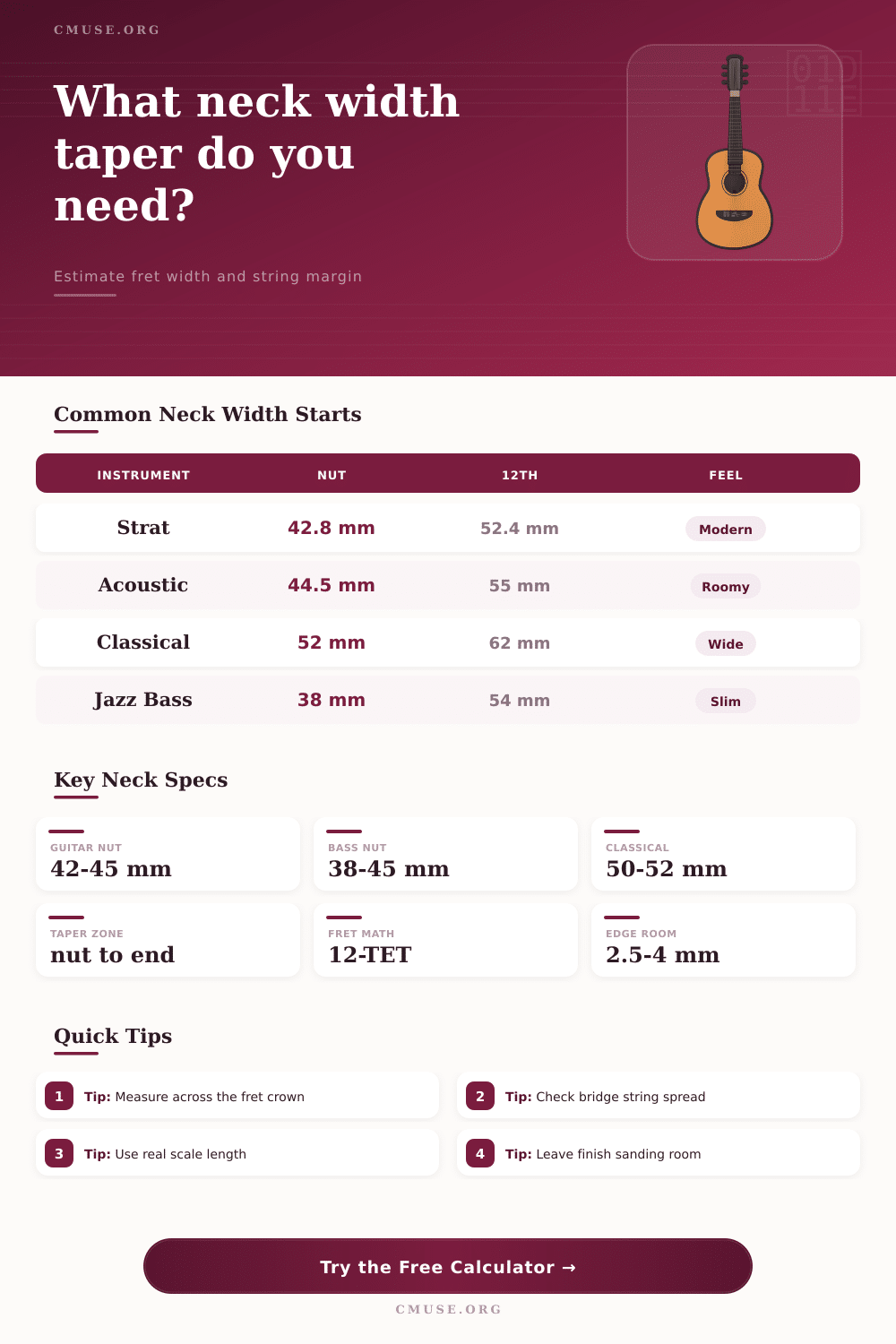
| Modern electric guitar | 42 to 43 mm (1.65 to 1.69 in) | 51.5 to 53 mm | balanced Fast enough for lead work with normal string spacing. |
| Vintage or narrow electric | 40.5 to 42 mm (1.59 to 1.65 in) | 50 to 52 mm | slim Comfortable for smaller hands, tighter for fingerstyle. |
| Steel-string acoustic | 43 to 45 mm (1.69 to 1.77 in) | 53.5 to 56 mm | roomy Supports open chords, flatpicking, and light fingerstyle. |
| Classical guitar | 50 to 52 mm (1.97 to 2.05 in) | 60 to 63 mm | wide Designed for nylon strings and right-hand separation. |
| Jazz-style bass | 38 to 39 mm (1.50 to 1.54 in) | 53 to 55 mm | slim nut Narrow first position with wider upper register. |
| Precision-style bass | 41 to 44.5 mm (1.62 to 1.75 in) | 55 to 58 mm | full More left-hand support for stronger attack. |
| Margin per side | Metric | Imperial | Use case |
|---|---|---|---|
| Very tight | 2.0 to 2.4 mm | 0.079 to 0.094 in | Only for precise fretwork and controlled vibrato. |
| Modern electric | 2.5 to 3.2 mm | 0.098 to 0.126 in | Common balance between speed and string security. |
| Acoustic comfort | 3.0 to 3.8 mm | 0.118 to 0.150 in | Useful for stronger fretting and wider string motion. |
| Bass or slide margin | 3.5 to 4.8 mm | 0.138 to 0.189 in | Helps with heavier strings and bigger lateral movement. |
| Classical spacing | 4.0 to 5.5 mm | 0.157 to 0.217 in | Gives nylon strings room for vibrato and rest-stroke playing. |
| Taper description | Width gain to 12th | Rate per 100 mm | Practical result |
|---|---|---|---|
| Very mild taper | 7 to 8.5 mm | 2.2 to 2.7 mm | Consistent neck feel, but check bridge string spread carefully. |
| Moderate electric taper | 8.5 to 10.5 mm | 2.7 to 3.3 mm | Common for 6-string electrics with 52 to 56 mm bridge spacing. |
| Roomy acoustic taper | 10 to 12 mm | 3.1 to 3.8 mm | Good for wider picking-hand spacing and open-position comfort. |
| Bass upper-register taper | 13 to 18 mm | 3.5 to 4.8 mm | Supports larger string excursion without a very wide nut. |
| Wide classical taper | 9 to 12 mm | 2.8 to 3.7 mm | Feels broad because the nut starts wide, not because taper is extreme. |
| Preset | Scale | Nut width | Reference width |
|---|---|---|---|
| Modern Strat Style | 647.7 mm / 25.5 in | 42.8 mm | 56.0 mm at 22nd fret |
| Single-Cut Electric | 628.7 mm / 24.75 in | 43.0 mm | 55.0 mm at 22nd fret |
| Steel-String Acoustic | 645.2 mm / 25.4 in | 44.5 mm | 55.5 mm at 14th fret |
| Classical Nylon | 650.0 mm / 25.59 in | 52.0 mm | 62.0 mm at 12th fret |
| Jazz Bass Slim Nut | 864.0 mm / 34.0 in | 38.1 mm | 63.5 mm at 20th fret |
| Mandolin Neck | 352.4 mm / 13.875 in | 28.5 mm | 42.0 mm at 12th fret |
A guitar is drawn on paper and then one day it become a thing in your hands. That day typically involve calipers. What wood? Maybe what pickups? But it’s still just a concept in your head until you decide how much the neck should taper in width. How many millimeters of geometry will make this a comfortly play instead of having your hand cramping up?
Most luthiers begin their design with a stock nut width like moddern electrics, which would be 42.8 millimeters. And there they stop. They take that starting point of a straight line parallel to the centerline of the guitar, but the line actualy isn’t straight. Or maybe it is. But by the time you get into the high frets your fingers is splayed out on some complex run or wider chord shape and you feel cramped.
How to Choose the Right Guitar Neck Size
First, measure your scale lengths, your nut width, and a point lower on the neck using a reference for your calculations. Once you have those numbers, just plug them into calculator above and let it do the work for you. This saves you from having to guess how much to convert or what coefficients to multiply by as you builds. You just tell the thing where your nut width is, where a point later in the neck is that you want to be a certain width, and the length of the scale. Then it will calculate the linear taper from point A to B, and spit out an exact number telling you exactly how wide your board would be at whatever point you chooses along its length.
This is crucial if you’re cutting a fingerboard yourself from rough lumber, or even if you’re having one cut for you from a blank. Under-estimating the taper means you could end up with a board that’s too narrow as it join the body, and therefore unbalanced in your hands. Over-estimating it means wasting precious wood and making high-fret access feel odd and wide.
It’s all about understanding the inputs. It starts with the nut width, which establishes your initial impression of the instrument and the reference width for how things feels as you move further up the neck. A lot of vintage-type instruments feature fairly narrow nuts but then open up considerably as you near the body end to allow for the natural physical spread of strings on the bridge. This naturaly provides a funneling effect for the hand.
Take a jazz bass for example: You may notice that its thirty-eight millimeter slim nut makes playing in the first position feel like lightning speed. However, as you approach the twentieth fret, you realize that same neck has opened up enough to provide plenty of room for complex chord voicings. This is no accident… It’s planned design intended to keep the instrument playable throughout the full range of its capability.
The size of the margin at the edge often receives less discussion then it should of be. In other words, the distance from the outside of the neck (at the point where the fingerboard ends) to the nearest outer string. A small margin can result in some issues with vibrato or aggressive playing as a string might pop off, but too large a margin results in an unwieldy feeling board. The page includes reference tables showing common margins for these areas.
These tables shows that electric guitars generally use tighter string margins because factors like picking angle and string tension need more side-to-side space. In contrast, acoustics typically has more room here. This parameter can be changed in the tool so you can see what impact it have on your overall board width prior to any irreversible cuts.
Simple linear calculators will be able to give you a decent idea about main taper rate but don’t account for the added complexity of compound curves. For this reason, the primary taper rate is a good starting point. To copy the natural shape our hands take on when we bend over strings, compound radius changes the effective width at each point along the neck. The tool assumes edges are straight between measurement points. However, the results provides a basic outline of the geometry. This lets you draw your own templates while confidently marking the body joint, nut, and twelfth fret.
It’s all about math, sure, but it’s just as much about feeling while building an instrument. The math keeps things in place and makes them fit together properly, but do they play? Your hands knows that better than the numbers ever could. Take away the guess work with the tool when selecting blanks and go with your ear and touch at the end of the shaping.
If the neck tapers well, it vanishes into your hands and the music becomes the focus instead of how you’re holding it. That seamless connection is what separates a finished project from a professional-grade instrument.