String Spread at Bridge Calculator
Calculate bridge string spread, saddle center spacing, fingerboard edge margin, string taper from nut to bridge, and pickup pole alignment for fretted instruments.
Load a real-world bridge layout, then adjust the spread, nut width, fingerboard width, and pickup spacing to check whether the strings sit where the player and hardware expect them.
Calculation Breakdown
Center Spacing
Equal saddle spacing divides the bridge spread by the number of gaps between outer strings.
spacing = bridge spread / (strings - 1)
Edge Margin
True clearance subtracts half of the outside string diameter from the available fingerboard overhang.
margin = (board - spread) / 2 - string radius
Pickup Spread
String spread narrows as the pickup moves away from the bridge and toward the nut.
pickup spread = bridge - taper x distance
Taper Angle
The half-spread change over scale length gives the left and right string fan angle.
angle = atan(((bridge - nut) / 2) / scale)
| Instrument or bridge | Strings | Outer spread | Center spacing | Typical use |
|---|---|---|---|---|
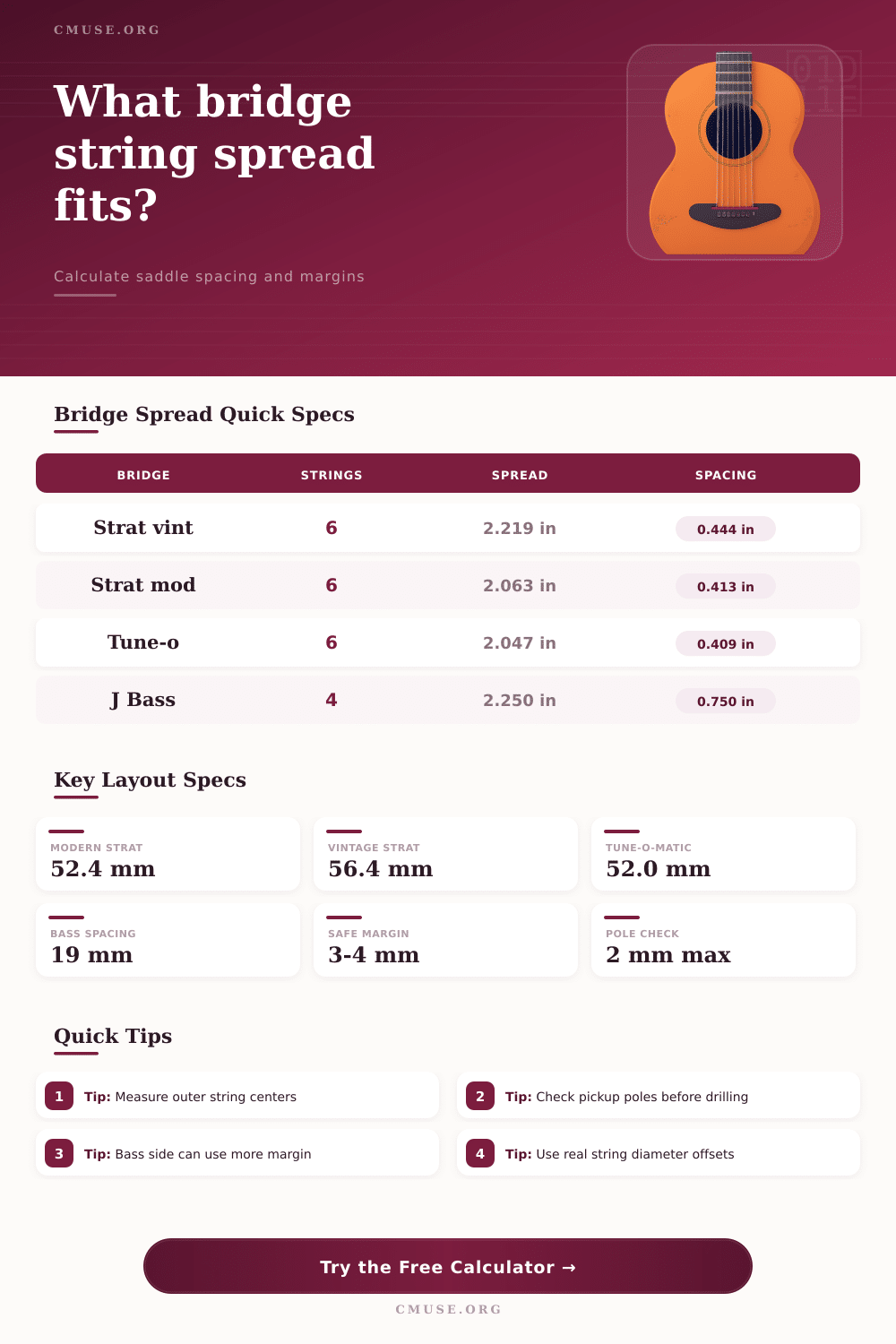
| Vintage Strat | 6 | 2.219 in / 56.36 mm | 0.444 in / 11.27 mm | Traditional synchronized tremolo, wider E-to-E feel. |
| Modern Strat | 6 | 2.063 in / 52.39 mm | 0.413 in / 10.48 mm | Narrower tremolo or hardtail layouts with safer edge margin. |
| Tune-o-matic | 6 | 2.047 in / 52.00 mm | 0.409 in / 10.40 mm | Common Gibson-style bridge and stop-tail geometry. |
| Vintage Tele | 6 | 2.125 in / 53.98 mm | 0.425 in / 10.80 mm | Three-saddle and vintage-style Tele bridge plates. |
| Jazz Bass | 4 | 2.244 in / 57.00 mm | 0.748 in / 19.00 mm | Standard 4-string bass bridge spacing. |
| 5-String Bass | 5 | 2.835 in / 72.00 mm | 0.709 in / 18.00 mm | Moderately tight 5-string spacing for broad bass necks. |
| Clearance per side | Metric | Status | Feel at edge | Setup note |
|---|---|---|---|---|
| Under 0.080 in | Under 2.0 mm | Tight | Outer strings may leave the fret ends under bends. | Use a narrower bridge spread or wider board projection. |
| 0.080 to 0.120 in | 2.0 to 3.0 mm | Close | Usable for precise players and narrow vintage necks. | Check fret bevel and real string diameter carefully. |
| 0.120 to 0.170 in | 3.0 to 4.3 mm | Balanced | Comfortable for most guitar and bass layouts. | Good target range for new bridge placement. |
| Over 0.170 in | Over 4.3 mm | Wide margin | Strings feel tucked inward from the board edge. | Can be useful for heavy bending or rounded fret ends. |
| Outer-string offset | Metric offset | Alignment | Common cause | Practical result |
|---|---|---|---|---|
| 0 to 0.040 in | 0 to 1.0 mm | Excellent | Bridge and pickup spreads closely match. | Strings sit visually centered over the outer poles. |
| 0.040 to 0.080 in | 1.0 to 2.0 mm | Normal | Vintage bridge with modern or humbucker spacing. | Usually acceptable, especially with blade magnets. |
| 0.080 to 0.120 in | 2.0 to 3.0 mm | Check | Wide bridge paired with narrow pickup poles. | Visual mismatch and possible outer-string imbalance. |
| Over 0.120 in | Over 3.0 mm | Mismatch | Wrong pickup spacing or bridge family. | Consider F-spaced, wider poles, or a different bridge. |
| Preset | Bridge spread | Nut spread | Board width at bridge | Best fit check |
|---|---|---|---|---|
| Vintage Strat tremolo | 2.219 in / 56.36 mm | 1.375 in / 34.93 mm | 2.520 in / 64.01 mm | Needs enough fret-end margin on narrow necks. |
| Modern Strat bridge | 2.063 in / 52.39 mm | 1.375 in / 34.93 mm | 2.500 in / 63.50 mm | Safer on replacement necks and rolled edges. |
| Tune-o-matic guitar | 2.047 in / 52.00 mm | 1.365 in / 34.67 mm | 2.375 in / 60.33 mm | Good with humbucker pole spreads near 50 to 52 mm. |
| 4-string bass bridge | 2.244 in / 57.00 mm | 1.500 in / 38.10 mm | 2.875 in / 73.03 mm | Large low-string diameter reduces true edge clearance. |
| Classical guitar tie block | 2.283 in / 58.00 mm | 1.693 in / 43.00 mm | 2.875 in / 73.03 mm | Wide nut spread keeps taper angle moderate. |
When you place your finger on a fret and you bend the note, you notice that high E string goes dead as it touches edge of the fretboard. No worries, this isn’t a case of bad technique or bad luck. Rather it’s geometry gone wrong. Simply put, the bridge spread have been pushed to the outside edges of the neck. There is no safe zone for your fingers to operate with anymore.
This occurs frequently because players change out parts but never measure to see if those parts will fit width of their particular fingerboard. Once you input string diameters and bridge type into the calculator on this page, it’ll do the rest of the work for you. You won’t have to guess anymore when purchasing a new tremolo system to see if it fits your vintage neck.
Why Your Guitar Strings Feel Wrong
Most setups look fine at first glance until you actualy play them. In most cases, it’s not the overall width of the instrument that’s causing problems. It’s the specific distance between outer strings and where the actual piece of wood ends. Too little space and you sacrifice tone as well as comfort. Too much and the bass strings becomes isolated and difficult to reach. That sweet spot comes down to checking out the numbers in context instead of isolation.
We’ll begin our calculation at the bridge and look at E-to-E spread there. How wide is your playing field? It is the outside perimeter of the playing area. If you have a vintage Stratocaster with its bridge spacing near 56 millimeters, that’s wide enough to really allow you some breathing space on the treble side. But if you’ve got a narrow neck it can be pushing those low strings dangerously out over the edge.
These days, moddern bridges tend to reduce this E-to-E spread to perhaps 52 or so millimeters. That is only about four millimeters in total, but it makes a world of difference when you’re reaching from string one to six. Which side of the compromise do you need more of for how you play?
Another wrinkle is the taper angle. From bridge to nut, strings don’t travel perfectly parallel with each other. To eliminate string angle problems at the nut and improve intonation, they fan out over time toward the saddle. So the spread between them at the bridge will always be greater than at the nut. That difference is what tool measures, allowing you to visualize just where you’ve gained and/or lost margin in terms of room between the frets all along length of the instrument.
The fanning out, if the neck is very narrow for example, can gobble up more of your edge margin more quickly than you might think. It is a little detail but it matters when precision counts.
Many builders cuts corners with pickup alignment. This means that if the string spread isn’t matched to the pickup poles at their given point along the body, the outer strings won’t be centrally positioned over the pole. This results in less even output and also a visual misalignment which can look sloppier. Depending off how far the pickup sits from the bridge, the calculator figures out what that offset would be.
Why? Because the closer you get to the nut, the closer together the strings is. Two millimeters can be the difference between having a good sounding guitar and one that has a slightly thinned-out sound on high E string. For consistent response, you want the magnetic field right underneath the string.
These calculations are surprisingly dependent on string diameter. While most folks remember to measure from center to center, they tend to overlook that thicker strings occupies more physical space near their edges. For example, a low E string with a.046 diameter needs considerably more room away from the fretboard’s edge than a high E string with a.010 diameter. Take this bulk into consideration when you’re calculating your margins if you play heavy gauge strings. Otherwise, you’ll be taking a ‘shoes-on-paper-only’ approach. They might fit okay on paper but on your feet, they’ll feel all wrong.
Before gluing down that bridge or even drilling your holes, take the time to double-check your measurements. Measure your fingerboard projection with a ruler as well as your actual nut width. Enter those actual numbers into tool and let the math tell you if it agrees with what you think looks good.
The geometry supporting your hands should of been comfortable not fighting against them. When pickup alignment, spread, and taper all match, the instrument becomes invisible and you’re simply playing. That blend of playability and precision makes for a great setup different than something merely functional.