Scale Length to Fret Spacing Calculator
Lay out fretted instrument slots from any scale length using equal temperament, nut-to-fret distances, fret-to-fret spacing, octave checks, and bridge compensation allowance.
Load a common lutherie scale, then adjust the fret count, start and end frets, compensation allowance, and rounding. All positions are calculated from the nut as the fixed datum.
Calculation Breakdown
Nut-To-Fret Position
Each fret shortens the remaining speaking length by the same equal-tempered ratio.
position = L - L / 2^(n / 12)
Fret-To-Fret Spacing
Spacing is the difference between adjacent nut-to-fret positions.
spacing = pos(n) - pos(n - 1)
Rule Of 17.817
The first fret is often approximated by dividing scale length by this constant.
divisor = 1 / (1 - 2^(-1 / 12))
Remaining Length
The bridge-side speaking length after a fret equals the original scale divided by the fret ratio.
remaining = L / 2^(n / 12)
25.500
Scale length in inches
22
Calculated fret slots
1.431
First fret from nut
12.750
12th fret octave point
| Fret | Nut To Fret | Previous Spacing | Remaining Length | Ratio From Open |
|---|---|---|---|---|
| Calculate to generate the fret spacing table. | ||||
| Instrument Or Style | Scale Length | Typical Frets | 12th Fret Position | Layout Note |
|---|---|---|---|---|
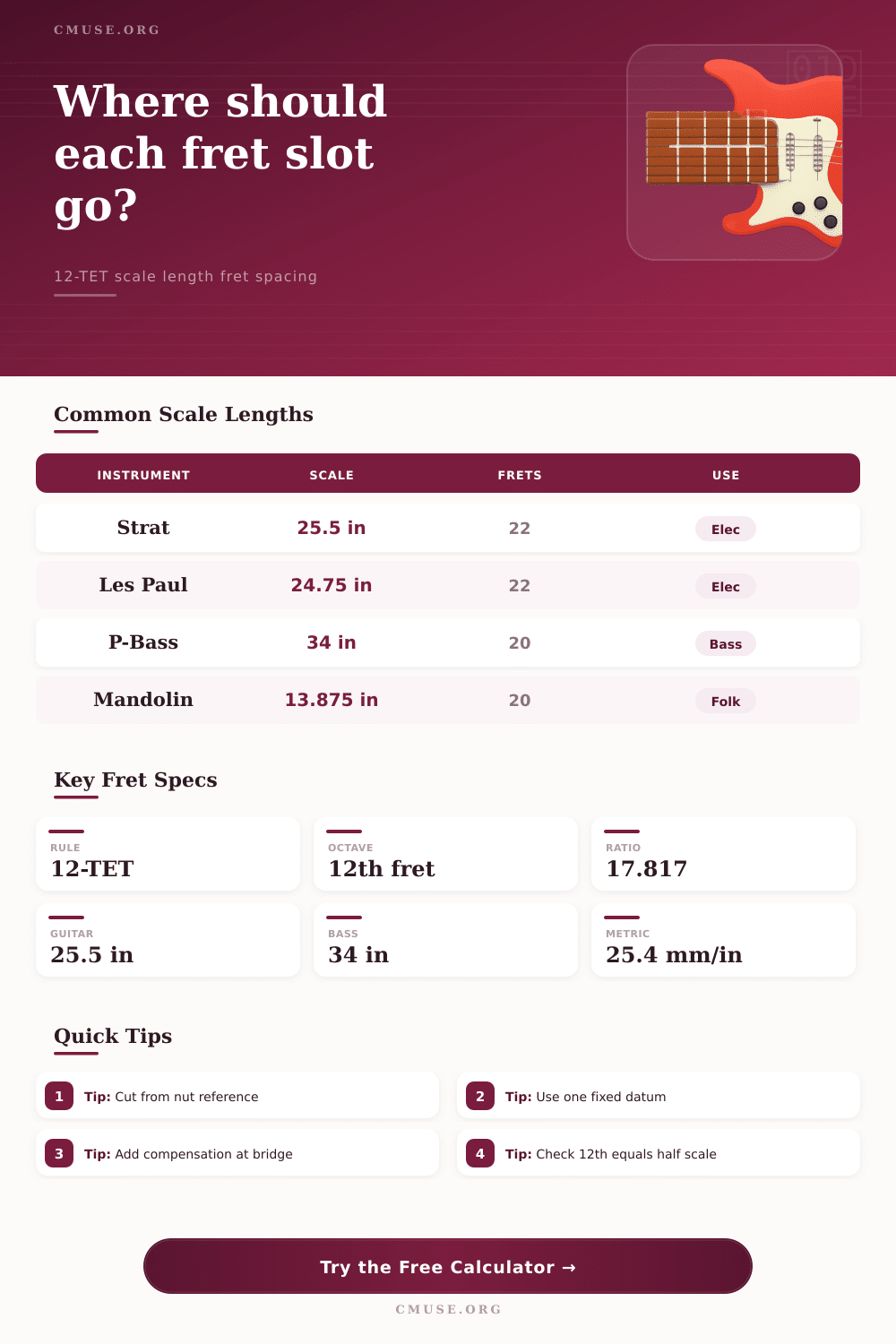
| Fender electric | 25.500 in / 647.70 mm | 21 to 22 | 12.750 in / 323.85 mm | Longer string feel, bright attack. |
| Gibson electric | 24.750 in / 628.65 mm | 22 | 12.375 in / 314.33 mm | Shorter reach and softer tension feel. |
| Classical guitar | 650 mm / 25.591 in | 19 | 325 mm / 12.795 in | Metric layouts are common for nylon builds. |
| Precision bass | 34.000 in / 863.60 mm | 20 | 17.000 in / 431.80 mm | Large early fret spacing requires accurate templates. |
| Mandolin | 13.875 in / 352.43 mm | 20 to 22 | 6.938 in / 176.21 mm | Small errors become visible on short scales. |
| Tenor ukulele | 17.000 in / 431.80 mm | 17 to 19 | 8.500 in / 215.90 mm | Short layout benefits from metric precision. |
| Fret | Pitch Ratio | Remaining Scale | Nut Position | Why It Matters |
|---|---|---|---|---|
| 1 | 1.059463 | 94.387% | 5.613% | First slot is the largest individual cut distance. |
| 5 | 1.334840 | 74.916% | 25.084% | Useful check near the fourth interval position. |
| 7 | 1.498307 | 66.742% | 33.258% | Perfect-fifth check for rough layout inspection. |
| 12 | 2.000000 | 50.000% | 50.000% | The octave fret must land exactly halfway. |
| 19 | 2.996614 | 33.371% | 66.629% | Second-octave fifth region on extended boards. |
| 24 | 4.000000 | 25.000% | 75.000% | Two octaves place the fret at three-quarters scale. |
| Layout Task | Recommended Precision | Common Tool | Check Point | Practical Note |
|---|---|---|---|---|
| Hand-marked fretboard | 0.001 in / 0.02 mm | Steel rule plus knife | 12th fret half scale | Mark every slot from the nut, not from the prior mark. |
| Printed paper template | 0.1 mm or finer | Scaled print check | Nut-to-bridge length | Verify printer scaling before trusting the sheet. |
| CNC or laser file | 0.001 mm export | CAM coordinate list | Coordinate origin | Use absolute coordinates from the nut-side zero line. |
| Repair partial board | Match original datum | Calipers and gauge | Known existing frets | Measure the existing scale before replacing slots. |
Before you even put your hands on it, you know the scale length. The scale length affect more than just how far your fingers must stretch to play chord shapes. It determines how much effort is needed to accurately fret notes, how tight or slack the string tension will be, and ultimatly how bright or dark the tone is going to sound.
At the same pitch, the longer scale length of a Fender Stratocaster holds strings tighter then they’d be if strung on a shorter neck. That’s why the Strat has that snappy high end. Because the Gibson Les Paul has a scale length closer to twenty-four inches, guitar feels softer in the hands. These aren’t subtle distinctions. They’re what make an instrument sound like itself.
How to Measure a Guitar Fretboard
Typically, builders select their length intuitively (or according to tradition) and then do math on the fretboard. They want to know where each position is located and they want to be sure it’s right. The math get gnarly. The fretboard calculator (above) will run those numbers for you after you input your scale.
This means there is no error on your part, and you will know how much space shift from one end of the neck to the other. Yes: Frets are not equally spaced and yes, a linear progression is not what happens here, either. Equal temperament frets use logarithms. As you approach the body, the frets grows closer together. Just a few inches past the nut, they are squeezed into small slots that leave almost no room for error.
In other words, being precise at the nut is important, but being sloppy near bridge results in a major mistake. It’s all about dividing up the remaining length of string with a certain constant to determine where next place will be. While many luthiers use seventeen point eight one seven as a shortcut for finding first fret, relying on that single number for every slot accumulates error over time.
The best solution is to work out each fret from the nut instead of building measurement forward. If you measure from the previous fret to the next, you’ll notice these slight errors in marking accumulate. After the twentieth fret, those little blips becomes significant errors in tuning. Make each cut from the nut as your unchanging starting point for every single cut.
Note too that the calculator take into account the need for saddle compensation. Beginners sometimes assume that the scale length simply runs right through the centre point of the twelfth fret. However, it doesn’t. This is because strings stretch as you apply more pressure to them when fretting a note. This cause the pitch to become slightly sharper. What’s needed then is for bridge saddle to be located further back along string than would of been suggested by the pure maths. This calculator automatically includes this compensation so you can expect a realistic estimate of where the string will actualy end. Failing to do this will give you an instrument that sounds sharp up the neck regardless of how well you’ve cut your fret slots.
How do you mark on the board? This decision makes a difference. Hand marked boards with steel rules with fine graduations will be fine. If you use a printed paper template, make sure it was scaled correctly in printer settings. When working with CNC machines, simply export the table generated and then don’t transcribe any coordinates. Consistency here is key and that means using either imperial inches or metric millimeters. Don’t mix them, as this will cause confusion and result in misplaced slots.
Smaller scales such as those found on ukuleles and mandolins requires an even tighter tolerance since there’s simply less margin for error. What would be a half-millimeter difference on a bass guitar, you may never notice, but on a mandolin with a scale just shy of a foot, it create a big issue with intonation. So make sure to check your work at the octave point. When you’re looking at the 12th fret, it should be right in the middle (halfway) on the speaking length of the string. Anything else means you messed up somewhere in either your measuring or initial set-up process.
In conclusion, making a fretboard takes precise measurement and patience. There’s no wiggle room in the math, yet there’s nothing more apparent than the pathway when armed with good tools. Once you understand why the spacing is compressed toward the bridge and how compensation affects the final tuning, you’re holding the reins of its voice. What you’re doing isn’t simply making cuts into a piece of wood; you’re crafting a stringed instrument whose touch respond accurately and clearly with each played note. Your hand follows the numbers and resulting neck will sing true from the moment it’s used to strum the first chord.