Perpendicular Fret Position Calculator
Lay out a multiscale fretboard by locating the neutral fret, bass-side nut setback, bridge stagger, and the fan angle of any target fret line.
Choose a realistic fanned-fret layout, then adjust scale lengths, string spread, and neutral fret. The calculator uses the outer treble and bass strings as the two layout rails.
Layout Breakdown
Equal-Tempered Fret Distance
Each string rail uses its own scale length, so the bass and treble fret distances are calculated independently.
D = scale x (1 - 2^(-fret / 12))
Neutral Fret Alignment
The bass nut is shifted until the bass and treble coordinates match at the chosen perpendicular fret.
nut setback = Db(neutral) - Dt(neutral)
Bridge Stagger
The remaining scale difference appears at the bridge, plus any separate bass saddle travel allowance.
bridge stagger = scale fan - nut setback
Target Fret Slant
Any fret angle comes from the bass-side offset divided by the string spread at that fret position.
angle = atan(offset / spread)
Total scale fan
Neutral fret
Nut slant angle
Bridge line angle
Bridge-end blank width
Compensation allowance
Last fret checked
Practical check zone
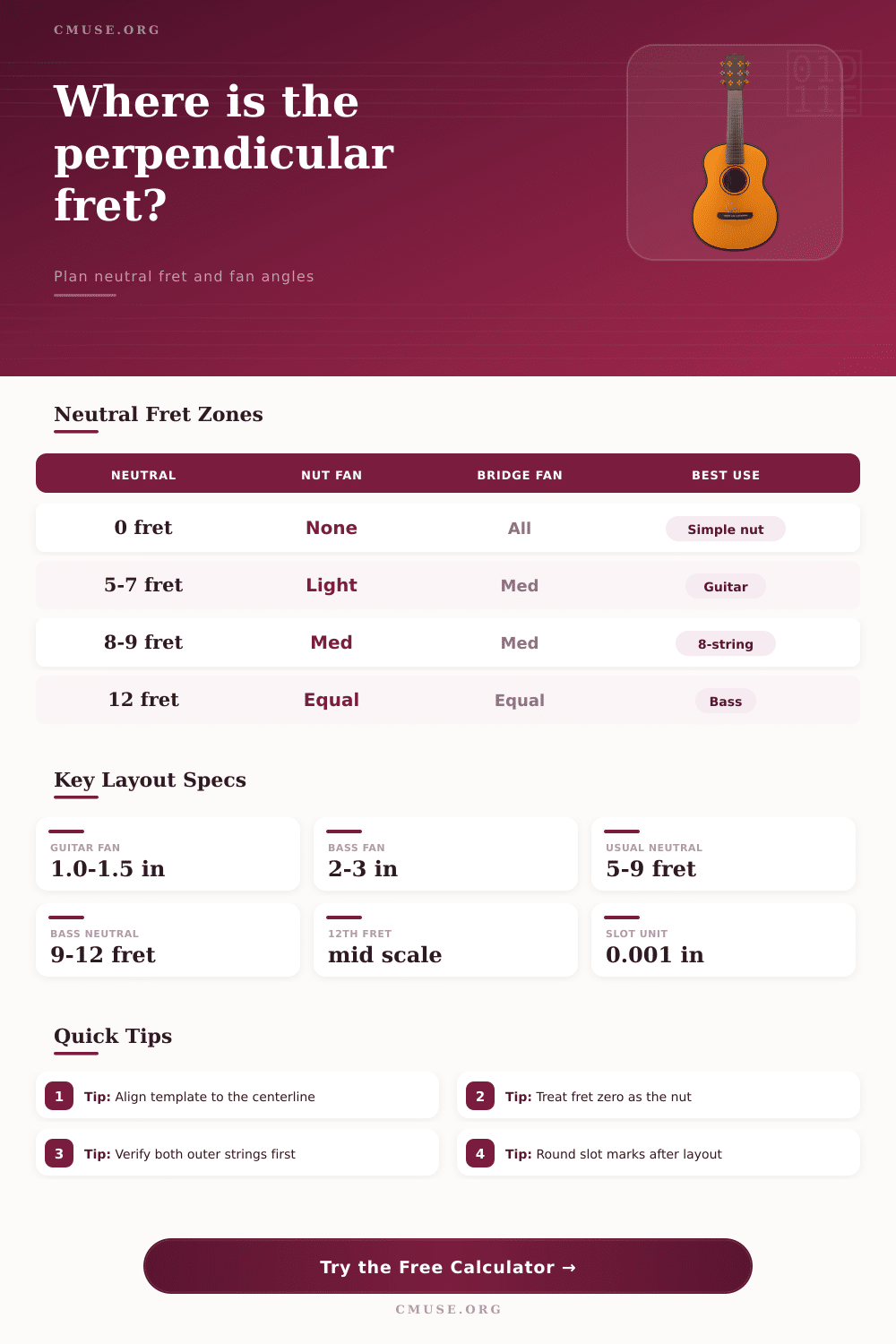
| Neutral choice | How the fan splits | Typical instrument | Layout effect |
|---|---|---|---|
| 0 fret / nut | No nut setback; all extra length appears at the bridge | Simple conversions, fixed straight nut designs | Easy nut work, stronger bridge angle |
| 5th to 7th | Less fan at the nut, more fan at the bridge | Six-string and seven-string guitars | Comfortable first position with visible bridge stagger |
| 8th to 9th | Balanced split for wider guitar scale spreads | Eight-string, baritone, and compact headless layouts | Reduces extreme bridge angle while keeping low frets playable |
| 12th fret | Approximately half of the fan at nut and bridge | Long-scale bass and symmetrical concept layouts | Even visual fan, but stronger nut slant than guitar norms |
| Instrument | Treble scale | Bass scale | Common neutral |
|---|---|---|---|
| Modern 6-string guitar | 25.5 in / 648 mm | 26.5 in / 673 mm | 6th to 7th fret |
| Extended 7-string guitar | 25.5 in / 648 mm | 27.0 in / 686 mm | 7th fret |
| Progressive 8-string guitar | 25.5 in / 648 mm | 28.0 in / 711 mm | 8th to 9th fret |
| Five-string bass | 34.0 in / 864 mm | 37.0 in / 940 mm | 9th to 12th fret |
| Mandolin fan layout | 13.875 in / 352 mm | 14.5 in / 368 mm | 6th to 7th fret |
| Fret | 25.5 in treble | 27.0 in bass | Rail difference |
|---|---|---|---|
| 1 | 1.431 in / 36.35 mm | 1.516 in / 38.49 mm | 0.084 in / 2.14 mm |
| 5 | 6.380 in / 162.05 mm | 6.755 in / 171.58 mm | 0.375 in / 9.53 mm |
| 7 | 8.499 in / 215.87 mm | 8.999 in / 228.57 mm | 0.500 in / 12.70 mm |
| 12 | 12.750 in / 323.85 mm | 13.500 in / 342.90 mm | 0.750 in / 19.05 mm |
| 24 | 19.125 in / 485.78 mm | 20.250 in / 514.35 mm | 1.125 in / 28.58 mm |
| Check point | Suggested tolerance | What to compare | Why it matters |
|---|---|---|---|
| Neutral fret line | 0.005 to 0.010 in | Both outer-string coordinates on the same square line | This confirms the selected fret is truly perpendicular |
| Nut setback | 0.010 in / 0.25 mm | Bass-side nut shift against the treble nut reference | A small nut error shifts every low-position fret angle |
| Bridge stagger | 0.020 in / 0.50 mm | Bass scale endpoint before individual saddle compensation | Bridge placement must leave intonation travel available |
| Outer fret marks | 0.005 in / 0.13 mm | Treble and bass rail marks before drawing each slot | Slot lines should be drawn from accurate rail coordinates |
Multiscale fretboards are typicaly thought of as simply two parallel necks merged into one. This miss the math entirely. You are dealing with a series of individual strings, each a different length from its neighbor. The arrangement involve finding where the bass and treble scales cross at a right angle. The calculator above will do the work for you if you input your chosen scale spread and neutral fret position; here’s what to know about the impact that has on playing feel.
Your design center around the neutral fret. Putting the neutral at the 12th fret will give you most symmetrical looking fan, but it will produce a pronounced slant at the nut/headstock area. However, it will also give you a steep bridge angle that will make it difficult to position the saddle accurately. Placing the neutral closer to the nut will yield a straighter headstock angle with a steeper bridge angle. A slanted nut may cause some awkwardness when playing open chord. The common mistake builders make is wanting their guitar to look symmetrical instead of considering how it fits there hands. Look at the bass side compensation allowance when you enter your values into the calculator. It may sound like no big deal, but trying to force wide saddles into a narrow bridge rail should of helped you understand this point.
Choosing the Right Neutral Fret Position
There is some math that gets us to an end point… But there’s real world stuff we need to factor in. How thick are those saddle? And how much room do they require to get your low strings tuned correctly? Failure to allow for this space will result in tuning issue after assembly.
Steepness of fan, The aggressiveness of your fan angles is dictated by the string spread at both ends. For example, wider bridge spread and narrower nut width result in a gentler fan, something you might find more comfortabley if you are accustomed to straight necked instruments. On an extended range guitar, you will want a wider spread between strings so they don’t get muffled or confused. This require a steeper fan, which results in different hand placement on higher frets as you play up the neck. You’ll be able to see the effect in the calculator and make a decision about whether the altered feel is worth the extra length on the bass side.
When you look at the reference data provided, notice how different instruments settles into specific neutral zones. Because it balances comfortable playing and easy bridge angle, the guitar typically has its neutral point around the 5th or 7th fret these days. For basses, the neutral point is often closer to the 9th or even 12th fret. This avoid problems with neck relief on the treble side while maintaining proper tension for bass strings. Nothing is arbitrary here, all these decisions have come after decades of experiments by luthiers.
Checking your outside rails is key for a practical layout. If you draw the slot lines without doing this, small mistakes at the nut will grow quickly as you move up the board. What might be a slight slant at the nut can become major misalignment by the 20th fret. First of all, check the two outside strings are meeting cleanly where you want them to, then make sure the neutral point match that position. If you find the angle of the target fret appears over-ambitious on screen, try shortening the overall difference between scales a little bit or move the neutral fret nearer to that region.
You must not only be mathematically accurate but also intuitively understand the physics of how the human body, strings, and wood interact. While the calculator gives us the coordinates it’s up to us to visualise where we hold the neck. If in doubt pick a preset then move the scale lengths around till the angles seem right in your head. This combination of instinct and numbers makes for a great instrument rather than just a good design.
Creating a multiscale guitar is an exercise of controlled asymmetry. You are breaking the conventional fretboard geometry rules to enhance playability and tone for certain ranges of your instrument. With the neutral fret position calculator, the trigonometry is simplified so that you can concentrate on artistic decisions without having to consider complicated offsets. Use the math to get things placed and then use your ears and hands to make the final judgment. The numbers will tell you where to put a fret, but only by playing it will you know if it feels right.