Multiscale Fret Angle Calculator
Estimate fanned-fret slant from treble scale, bass scale, string spread, neutral fret, fret count, handedness, and target fret geometry.
Load a realistic fanned-fret layout, then adjust the scale spread, string spacing, and neutral fret. Angles are shown as slant from a square fret line, where 0° is perpendicular to the strings.
Geometry Breakdown
1.50 in
Scale spread
0.60 in
Neutral offset
1.96 in
Target board width
Modern
Angle reading
Equal-Temperament Fret Position
Each string's fret distance is calculated from its own scale length, so bass and treble edges land at different longitudinal positions.
x = scale × (1 - 2^(-fret / 12))
Neutral-Fret Offset
The bass edge is shifted until the chosen neutral fret has the same longitudinal position as the treble edge.
shift = xBass(neutral) - xTreble(neutral)
Fret Slant Angle
The calculator compares bass-side lead against the fretboard width at that station, then converts the tangent into degrees.
angle = atan((xBass - shift - xTreble) / width)
Interpolated Board Width
String spread widens from nut to bridge, with edge overhang added to estimate the actual fret line length.
width = stringSpreadAtFret + 2 × overhang
| Layout | Treble Scale | Bass Scale | Typical Neutral | Use Case |
|---|---|---|---|---|
| 6-string mild fan | 25.0 to 25.5 in | 25.75 to 26.5 in | 7th to 9th fret | Traditional feel with clearer low strings |
| 7-string extended | 25.5 in | 26.5 to 27.5 in | 7th to 9th fret | Low B tuning without a very stiff treble side |
| 8-string modern | 26.0 to 26.5 in | 27.5 to 28.5 in | 8th to 10th fret | Extended range with manageable upper positions |
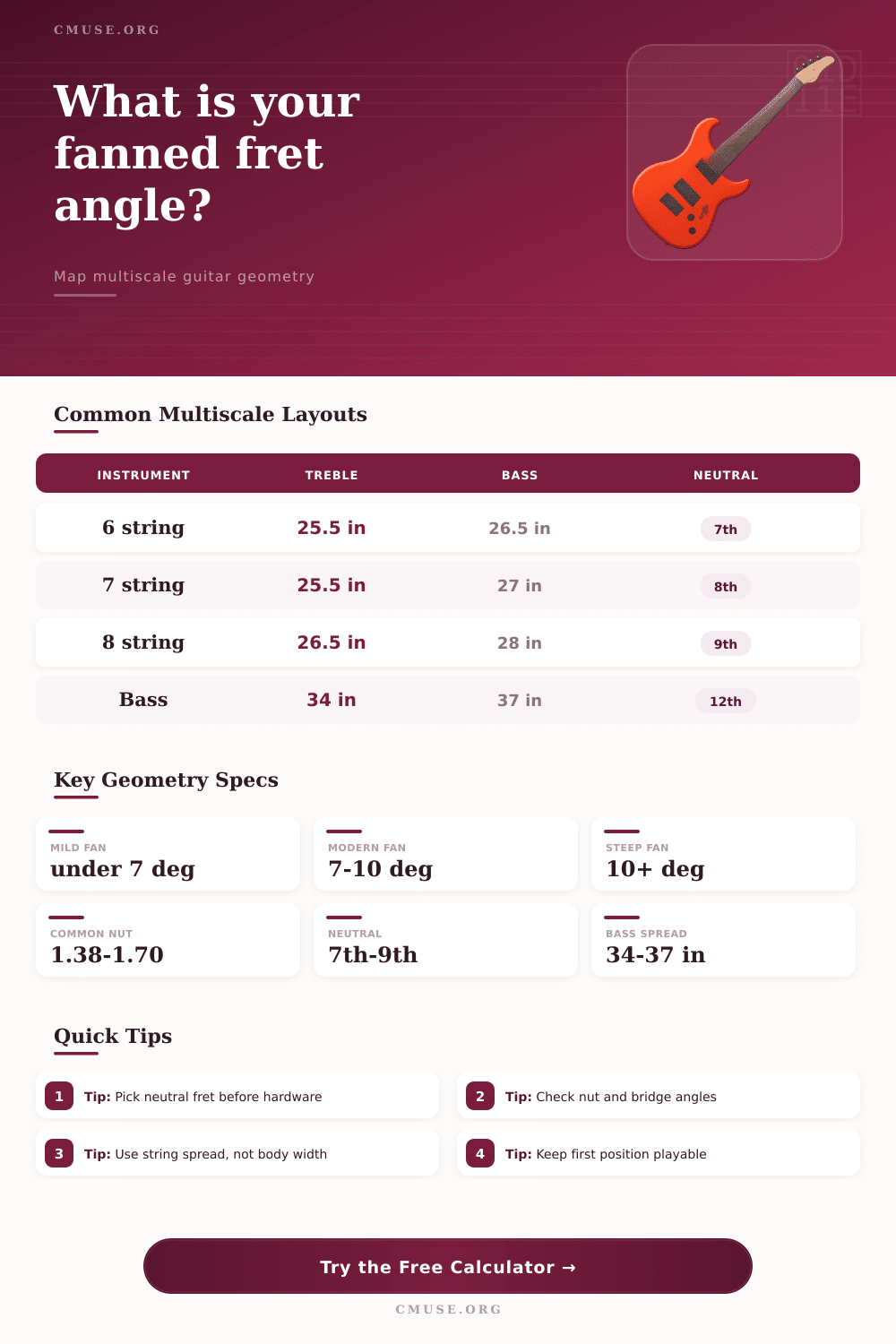
| Multiscale bass | 33 to 34 in | 35 to 37 in | 10th to 12th fret | Even tension across low B and high strings |
| Neutral Choice | Nut Feel | Bridge Feel | Best Fit | Tradeoff |
|---|---|---|---|---|
| Nut or 1st fret | Very square | Steeper saddle line | Chord-heavy first-position playing | Bridge hardware angle increases quickly |
| 5th to 7th fret | Mild to moderate slant | Moderate slant | 6-string and 7-string guitars | Often balances open chords and upper runs |
| 8th to 10th fret | More visible first-position fan | Less severe bridge angle | Modern 7-string and 8-string designs | Needs careful nut slot layout |
| 12th fret or higher | Strong nut angle | Gentler bridge fan | Bass and long-scale extended range | First-position hand angle becomes the main check |
| Instrument | Nut String Spread | Bridge String Spread | Edge Overhang | Angle Effect |
|---|---|---|---|---|
| 6-string electric | 1.35 to 1.45 in | 2.00 to 2.10 in | 0.075 to 0.100 in | Narrower boards show steeper angles |
| 7-string electric | 1.55 to 1.70 in | 2.35 to 2.55 in | 0.080 to 0.110 in | Extra width softens the same scale spread |
| 8 or 9 strings | 1.85 to 2.25 in | 2.75 to 3.30 in | 0.085 to 0.120 in | Wide boards can handle larger fans |
| Electric bass | 1.50 to 2.25 in | 2.25 to 3.60 in | 0.100 to 0.150 in | Long scale spreads need wide bridge spacing |
| Max Absolute Angle | Reading | First Position | Hardware Notes | Builder Check |
|---|---|---|---|---|
| 0 to 5° | Subtle | Feels close to straight frets | Most bridges can be arranged cleanly | Verify intonation room on each saddle |
| 5 to 8° | Comfort fan | Noticeable but familiar | Individual saddles or angled bridge preferred | Print a full-size fret template |
| 8 to 12° | Modern fan | Requires a deliberate neutral fret choice | Pickup and bridge angles need planning | Mock up nut, bridge, and pickup routes |
| 12° and up | Steep | Can feel specialized in low positions | Custom hardware placement is likely | Check player reach before cutting slots |
Probably by now you’ve heard about the tension problems solved with multiscale fret boards, but what you might not know is that when you fix tension you create a geometry problem. Your strings is no longer parallel. Instead they fan out from the nut to the bridge. Each individual fret line are at a slight angle compared to how your hand would naturaly be positioned. That’s where it gets tricky.
You need to pay attention to the neutral point. If you don’t, you can easily find yourself with an instrument that’s awkward to play in open positions. Or your wrist will be forced into a uncomfortably twist further up the neck.
How to Fix String Problems
The calculator above take care of the math for you as soon as you define your own specific setup. It saves you from costly trial and error in workshop.
So what is at the heart of all this? It’s your bass scale and your treble scale; that distance between them. For some mild fan, maybe one inch on that low E string length. On a more moddern extended range guitar, it can be up to three inches. Sounds minor on paper but goes directly to the slant angle of those frets.
How far apart do you want to be? The page has a little chart that lays it out in terms of common configurations. Five degrees or less is most common for a six-string guitar making it feel almost straight. Ten degrees plus is not uncommon with eight-strings. Big change, both visually and tactiley
So what about the choice of your neutral fret? That’s the key fret that you are going to choose. At this particular fret the fan effect negates itself. You’ll see that the line on the fret stays flat against the string all the way down the fingerboard. This will typically be anchored either at the 7th or 8th fret since it provides the best balance between open chord comfort and higher neck playability.
Go up too far in your neutral point and you end up distorting shape of your first position chords and making them difficult to shape. Go below and you have a severe angle at the bridge. This means you need custom hardware placement and a tricky intonation setup. It’s a compromise based off where your hands will tend to lie.
There is an additional wrinkle to these angles called string spread. With a narrow nut width, a single degree of scale alteration appear more extreme because it compresses the lateral distance. Conversely, with a wide board, the strings are farther away from one another which softens the visual slant. When you do your measuring, measure the actual outside center of each string, not merely the outline of the body. Often, the fretboard extends outward beyond the strings. If you include that overhang in your measurement, your templates will match reality.
Many musicians commonly misunderstand that a multiscale instrument has merely longer bass strings. But in fact, it’s more about tension equality. Longer strings is required on the lower B or C-strings to achieve a similar pitch without them feeling like slack cables. On the other hand, shorter string length are beneficial for the higher E-strings as they don’t require equal draw weight to vibrate cleanly. The result is greater tuning stability in all registers while reducing finger fatigue when playing. You can also down-tune without losing the snap in your high strings.
The calculator gives you angle breakdowns for everything from the bridge and nut to whatever fret you select as a reference point. Because so much of our lead work and solos occur in the middle part of the neck it’s smart to have that checked out. You can end up with an unexpected hand position change if the angle at a mid-neck fret are excessive. Having the option to print it out and place the full size template next to your hand allows you to feel it first prior to sawing lumber. That’s something the numbers wouldn’t of tell you.
Creating a multiscale guitar is not for the impatient. Careful measurements and careful planning is necessary. Inaccuracies in measuring angles and fret placement accumulates rapidly. This results in difficult-to-correct intonation issues. If you understand which variables affect what other variables and you have clear parameters from the beginning, you will be able to create an instrument that conforms to your hand’s comfort zone.
The goal is total transparency, where you feel no wood just the music. Find your starting point of neutrality and work forward. Respect the distance between the strings. Allow the geometry to enhance how you play instead of struggling against it.