Tone Capacitor Cutoff Calculator
Estimate how a guitar tone capacitor, pot value, pickup inductance, cable capacitance, and amp load shape cutoff frequency, pickup resonance, Q, and treble roll-off.
Choose a named wiring scenario, then adjust the component values to match your guitar. The model uses a passive pickup approximation: pickup inductance and capacitance set resonance, while pots, cable, amp input, and tone-cap engagement damp and shift the peak.
Calculation Breakdown
Tone Branch Cutoff
Fc = 159154.94 / (Rtone kΩ x C nF)
Estimates the frequency where the tone cap branch starts shunting highs strongly.
Pickup Resonance
Fres = 1 / (2 x pi x sqrt(L x Ctotal))
Combines pickup inductance with cable, coil, and engaged tone capacitance.
Parallel Load
Rload = 1 / (1/Rvol + 1/Ramp + 1/Rtone)
Lower load resistance damps the resonance and rounds off the top end.
Loaded Q Estimate
Q = Rload / (2 x pi x Fres x L)
Adjusted by pickup DC resistance so overwound coils look less peaky.
| Cap Value | Common Use | With 250 k Tone Pot | With 500 k Tone Pot | Typical Character |
|---|---|---|---|---|
| 10 nF | Bright guitar, subtle roll-off | 63.7 Hz at full resistance | 31.8 Hz at full resistance | Leaves upper mids clearer when rolled down |
| 15 nF | Tele, Filtertron, bright humbucker | 42.4 Hz at full resistance | 21.2 Hz at full resistance | Moderate top cut without a heavy blanket |
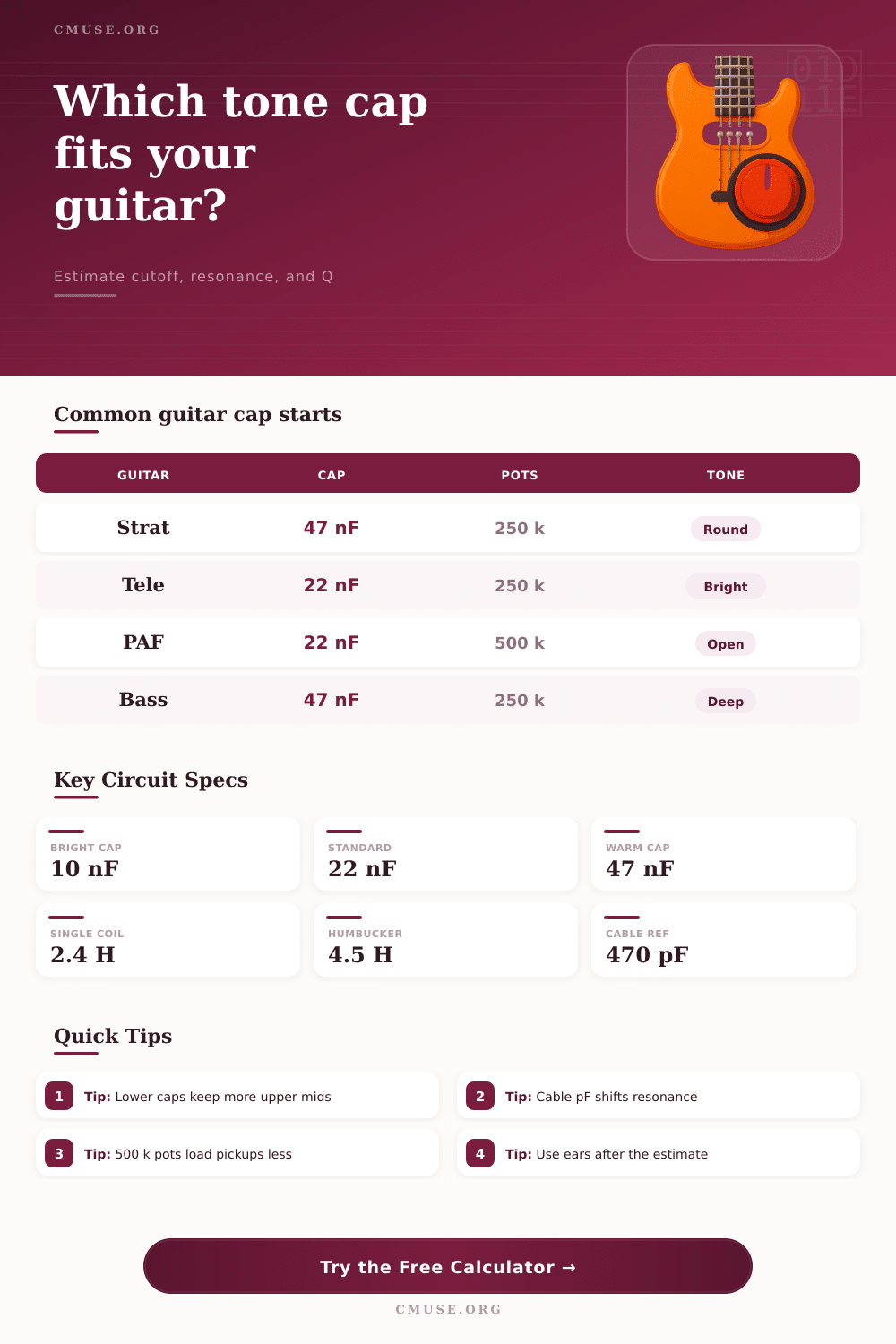
| 22 nF | Humbucker and many modern guitars | 28.9 Hz at full resistance | 14.5 Hz at full resistance | Balanced sweep with familiar rock voicing |
| 33 nF | Offsets bright single coils or offsets | 19.3 Hz at full resistance | 9.6 Hz at full resistance | Warmer roll-off and stronger mid focus |
| 47 nF | Strat, bass, darker vintage wiring | 13.5 Hz at full resistance | 6.8 Hz at full resistance | Deep treble cut when the knob is low |
| 100 nF | Very dark special wiring | 6.4 Hz at full resistance | 3.2 Hz at full resistance | Strong low-mid emphasis at low tone settings |
| Pickup Family | Typical Inductance | Typical DCR | Common Pots | Resonance Tendency |
|---|---|---|---|---|
| Vintage single coil | 2.0 to 3.0 H | 5.5 to 6.5 kΩ | 250 k volume and tone | Higher, clearer resonant peak |
| Tele bridge single coil | 3.0 to 4.2 H | 6.5 to 8.5 kΩ | 250 k volume and tone | Firm upper-mid bite, cable sensitive |
| P90 style | 4.0 to 6.0 H | 7.5 to 10 kΩ | 500 k or 300 k pots | Lower peak with thick midrange |
| PAF humbucker | 4.0 to 5.5 H | 7.0 to 9.0 kΩ | 500 k volume and tone | Open top if cable capacitance is moderate |
| Hot humbucker | 6.0 to 9.0 H | 12 to 18 kΩ | 500 k or 1 M pots | Lower, more damped peak |
| Passive bass pickup | 4.5 to 8.0 H | 8 to 14 kΩ | 250 k or 500 k pots | Low resonance; large caps get very dark |
| Preset | Pickup Model | Cap And Pots | Cable | Why It Is Useful |
|---|---|---|---|---|
| Strat Neck 47 nF | 2.4 H single coil | 47 nF, 250 k pots | 470 pF | Classic rounded tone control with familiar single-coil loading |
| Tele Bridge 22 nF | 3.6 H bridge coil | 22 nF, 250 k pots | 330 pF | Keeps more bite while still taming the sharpest top end |
| PAF Neck Woman Tone | 4.8 H humbucker | 22 nF, 500 k pots | 560 pF | Shows how a low knob setting pulls resonance downward |
| P90 Blues Roll-Off | 5.2 H P90 | 33 nF, 500 k pots | 430 pF | Good middle ground for thick but still articulate blues tones |
| Passive Bass 47 nF | 6.5 H bass pickup | 47 nF, 250 k pots | 650 pF | Demonstrates the low resonance and strong damping of bass wiring |
| Result Range | What It Suggests | Likely Sound | Adjustment To Try |
|---|---|---|---|
| Resonance above 4.5 kHz | Low capacitance or low inductance | Glassy, bright, very cable-sensitive | Increase cable pF slightly or use 250 k loading |
| Resonance 2.5 to 4.5 kHz | Common guitar range | Clear top with identifiable pickup character | Choose cap by sweep feel rather than raw cutoff |
| Resonance below 2.5 kHz | High inductance, high capacitance, or tone rolled down | Warm, vocal, or dark depending on Q | Try a smaller cap or lower cable capacitance |
| Q below 0.7 | Heavy loading or high coil loss | Smooth with little resonant bite | Use 500 k pots or a buffer if more snap is needed |
| Q above 1.8 | Light load and strong resonance | Peaky, lively, sometimes sharp | Lower pot value or add capacitance if too piercing |
In guitar circles there still exists the myth that changing out a tone capacitor is easy. On the forums, you’ll find people debating which value to change. Some say twenty-two nanofarads sounds moddern, while others say forty-seven nanofarads sound vintage. In truth, there’s much more going on than what you’re hearing through your ears. You aren’t just hearing the capacitor but also its interaction with potentiometer resistance, pickup inductance, cable capacitance and amplifier input impedance. Those are the passive interactions modeled by this calculator. Using this calculator, you can predict what changing out the cap will sound like before breaking out a soldering iron.
To explain, you need to consider physicality of what’s happening inside a tone circuit. A tone pot and capacitor creates a low-pass filter. Any capacitance added to the pickup, which is an inductor, will produce a resonant peak. Turning down the tone knob add capacitance to the circuit. That moves the resonant peak lower in frequency, decreasing its strength. That isn’t just lowering high frequencies. It’s moving the character of sound you’re getting from instrument.
How Tone Calculators Help You Choose the Right Capacitor
The calculation of that change considers total capacitance, which includes the cable. Players often neglect that. A long guitar cable will add several hundred picofarads into equation. Before signal even reaches the amp it will be pulled down, so a tone that sounds bright at home with a short patch cable can sound dark on stage.
At least initially, information requested on the input fields is tedious: DC resistance, pickup inductance. This data captures electrical personality of your coil and magnets. Higher DC resistance and inductance characterize a high-output humbucker compared to vintage single-coil. That means it is less capacitive. It will have a lower resonance frequency. It will also respond different than capacitive loading. Enter accurate numbers into the calculator for your pickups and it will show you where treble roll-off will occur. In other words, it calculates estimated cutoff frequency where the tone branch begins diverting the signal.
It also reveals how this impact the overall resonance Q factor. The lower the Q, the smoother the sound; the higher the Q, the more articulate and peaky it remains. Few players realize that they’re hunting for a certain tone as a result of trying to achieve a particular Q value. If you don’t own a multimeter, there are some handy reference tables on page. If you’re working with common pickups such as PAF humbuckers or Strats, their electrical profile has been documented and serves as good place to start. These form the presets in calculator, which automatically fill it with typical values.
Now you can observe how a standard forty-seven nanofarad cap sound on a bridge pickup vs. A neck single-coil. Most people will find that changing cable length and even value of the pots alters the result from a given capacitor. When tone recipes are copied, this is where folks get off track. A twenty-two nanofarad cap on a Telecaster with two hundred fifty kilohm pots isn’t going to be the same thing electricaly as that same cap on a Jazzmaster with one megohm controls. Everything works differently.
However, don’t think of the cut off frequency as hard and fast. This is typically the frequency at which output is reduced by 3db compared to the open circuit, but we hear these changes over quite a range. The benefit here with the model is to see what happens to resonance peak as you change the knob setting. You can then try varying this on other scenarios and it will give you insight into why sometimes rolling back a tone can make your guitar clear up. This quite often expose some of its midrange fundamentals that are being hidden by a bright resonant peak.
Once you get a Q or frequency from the calculator, check that against what you actualy own. Even though the math is pretty solid, there’s always slight variation in reality due to components, pot taper linearity, and other factors like wiring. Run through some possibilities using the calculator to whittle them down. Maybe it will be between 22 nanofarads and 33. Then use your ears to make the decision. Your ears won’t tell you which sounds best for your type of playing; nobody can program that into a spreadsheet. But they’ll help you eliminate the combos you know aren’t right and direct you toward ones you should of try. Begin with the math, allow it to direct you as you swap parts initially, and listen to where it leads.